Best Tools for SEO for SaaS in 2026: 7 Compared
The best tools for SEO for SaaS compared on nine criteria: Search Console, Ahrefs, Semrush, SE Ranking, Screaming Frog, Surfer and Prime, with pricing. Vendor pages reviewed Nov 14, 2026.
Short answer: the best tools for SEO for SaaS depend on the job you need done. Of seven reviewed on November 14, 2026, Google Search Console shows how Google sees your site, Ahrefs, Semrush and SE Ranking cover research and tracking, Screaming Frog crawls, Surfer edits content, and Prime checks AI answers. Start with Search Console plus one suite, and add the rest as a gap appears.
SaaS SEO should lead to pipeline, not just sessions. This guide is for SaaS marketing and growth leads choosing tools for search, content and AI answers, and for the SEO who has to justify each one. Pyra makes Prime AI Visibility and Lead Seeker, and the author, Bob Generale, is Pyra's COO and co-founder and President of Percepture; Prime is held to the same nine criteria and listed last. Prices and features are what each vendor displayed on November 14, 2026, and "not described" means those pages did not say.
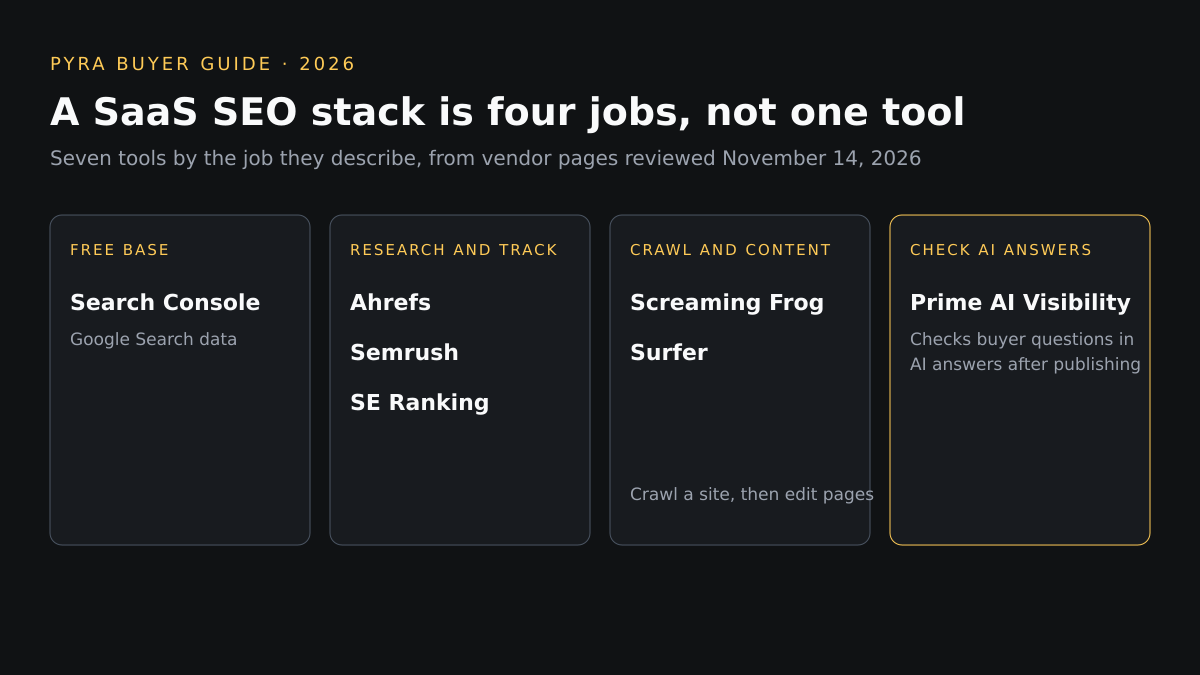
The jobs a SaaS SEO stack has to cover
No single product does everything below, and the tools in this guide are grouped by the job they describe on their own pages.
- See what Google does: impressions, clicks, index status and crawl problems for your own site.
- Research and track: keywords, competitors, backlinks and rankings, including the product-category and comparison searches SaaS buyers use.
- Crawl: find broken links, duplicates and structure problems across marketing pages, docs and template-built page sets.
- Write and update: turn a gap into a page with a clear job.
- Check AI answers: see whether ChatGPT, Perplexity and other engines name or cite you for buyer questions.
- Tie it to revenue: match landing pages to signups and opportunities in your own analytics and CRM; none of the seven tools here is described as doing that.
For a deeper look at the crawl job, see our technical SEO audit tools guide. For AI-agent tooling and the evidence standard behind AI answers, see the ChatGPT SEO analysis tools guide.
How we compared these SaaS SEO tools
The same nine criteria were applied to every tool using only its public pricing, product and documentation pages. No hands-on scores were produced, and no tool was run for this guide. The order is editorial: the free base first, then research suites, a crawler and a content tool, then the evidence-and-content layer. The set is not exhaustive; it covers tools that recur in published SaaS SEO lists and whose own pages describe what they do. Several criteria are about AI answers, so Search Console and Screaming Frog read "not described" or "not applicable" on them by design; they are here for the Google-side and technical jobs, not because they should track AI engines.
| Criterion | The question it answers |
|---|---|
| Engine coverage | Which AI answer engines, if any, does the tool check besides Google? |
| Mention vs citation | Does it separate being named from being cited? |
| Exact cited source | Does it show which URL an engine cited? |
| History and trend depth | Can you compare results over time? |
| Competitor comparison | Can you see how a rival does on the same data? |
| Question and prompt tracking | Can you track the keywords or questions your buyers use? |
| Reporting, export, API | Can the data leave the tool as a file, report or integration? |
| Pricing transparency | Is the price published, and what does it meter? |
| Diagnosis to action | What happens after a problem or gap is found? |
Best tools for SEO for SaaS compared
Two tables, the same seven tools in profile order. The first covers type, what each does, AI engines, evidence and price; the second covers history, competitors, questions, reporting and what happens after a problem is found. Scroll sideways on small screens.
| # | Tool | Type | What it does | AI engines | Mention vs citation | Exact cited source | Pricing shown |
|---|---|---|---|---|---|---|---|
| 1 | Google Search Console | Free search data source | Search Analytics for queries, impressions, clicks and average position; sitemap and URL submission; index coverage; URL Inspection of how Google sees a page; Core Web Vitals and rich result reports | Google Search only; no AI answer engines are named on its about page | Not described | Not described | No price is shown on the about page |
| 2 | Ahrefs | SEO research suite | Site Explorer, Keywords Explorer, Competitive Analysis, Rank Tracker and Site Audit are listed under what plans include; Brand Radar for AI search as an add-on | Brand Radar add-on lists Google, ChatGPT, Gemini, Perplexity, Copilot and Claude; the base plans list checks on AI prompts | Not described on the pricing page | Not described on the pricing page | Lite $129, Standard $249 and Advanced $449 a month (annual billing saves up to 17%); Brand Radar from $199 a month; prompt packages $50, $100 and $250 a month; extra users $40 to $80 a month |
| 3 | Semrush | All-in-one SEO platform | Keyword research, competitor insights, Position Tracking, Site Audit, content optimization and keyword cannibalization analysis, plus AI visibility reports; the site also has a SaaS and B2B tech solutions page | Starter, Pro+ and Advanced show Google Search, ChatGPT, Perplexity and Gemini 'and more'; the SEO plan lists tracking performance in AI search without naming engines | Not described; the pricing page lists AI sentiment and brand performance | Not described on the pricing page | SEO $117.33, Starter $165.17 and Pro+ $248.17 a month billed annually ($139, $199 and $299 billed monthly); Advanced is custom |
| 4 | SE Ranking | SEO suite with AI visibility | Rank tracking, keyword, competitor and backlink research, website and on-page audit, local and content marketing tools; separate AI visibility product | AI visibility product lists AI Overviews, AI Mode, Gemini, ChatGPT, Copilot and more; Core and Growth show five AI engines | Described as tracking brand mentions, citations and competitors; whether they are separate fields is not described | Not described on the pricing page | Core $103.20 and Growth $223.20 a month billed annually ($129 and $279 monthly); AI visibility from $71 a month; Enterprise custom |
| 5 | Screaming Frog SEO Spider | Desktop crawler | Crawls a site to find technical issues; crawl comparison, scheduling, near-duplicate and semantic similarity checks, structured data validation, custom extraction and Search Console, Analytics and PageSpeed Insights integrations | None tracked; an AI integration with OpenAI, Gemini, Anthropic and Ollama is listed for use inside crawls, not for checking answer engines | Not applicable | Not applicable | Free for up to 500 URLs; the paid licence is shown as 245 euros per year per user |
| 6 | Surfer | Content optimization and AI tracking | Creates and optimizes documents with an editor; Content Audit, Keyword Research and Topical Map features are listed; AI visibility tracking is sold on its own and with content plans | AI visibility plans list ChatGPT, Perplexity, Google AI Overviews and Gemini; the Standard plan shows ChatGPT only | Mention Gap and Brand Sentiments are listed; a separate named-versus-cited field is not described | Not described on the pricing page | AI Search Analytics $82, Standard $99 and Pro $182 a month billed yearly; a Peace of Mind plan at $299 is also listed |
| 7 | Prime AI Visibility | Evidence and fix layer for AI answers | Saves the answers AI engines give to your buyer questions, with the named-or-cited result and cited websites; it does not research Google keywords, crawl a site or monitor Google organic rankings | ChatGPT, Claude and Perplexity on the free Flash plan; Gemini and an AI Overview-style preview on paid plans. No Grok, DeepSeek or Copilot | Yes: brand mention and owned citation are tracked separately | Yes: exact answers and cited websites are saved per question | Flash free (30 credits, one check a month); Starter $69, Growth $179, Agency $369, Enterprise $1,499 a month |
| Tool | History | Competitors | Question tracking | Reporting, export, API | Diagnosis to action |
|---|---|---|---|---|---|
| Google Search Console | Not described on the about page | Not described; the reports cover your own site | Shows the queries that already brought users to your site, not a list you enter | Email alerts on issues; export options are not described on the about page | Shows which URLs an issue affects and lets you tell Google when a fix is done |
| Ahrefs | Lite 6 months, Standard 2 years and Advanced 5 years of historical data | Competitive Analysis and Site Explorer are listed; Brand Radar researches any brand across 565 million+ organic prompts from Ahrefs' database | Tracked keywords of 750 on Lite, 2,000 on Standard and 5,000 on Advanced; AI prompt checks of 150, 300 and 600; custom prompt packages from $50 a month | API and MCP access are listed on all three plans; personalized data exports are listed for Enterprise | Site Audit and Rank Tracker are listed; briefs or drafts are not described |
| Semrush | Historical SEO data is listed from Pro+ | Competitor insights tools from Starter; SEO share of voice on Advanced | 50 prompts a day on Starter, 100 on Pro+ and unlimited on Advanced; the SEO plan monitors custom prompts; 500, 1,500 and 5,000+ keywords tracked daily | Reporting and advanced API data integration on Advanced; MCP access on Starter | Site Audit, an AI-ready Site Audit and content optimization are listed; the pricing page does not describe briefs or drafts |
| SE Ranking | Growth lists historical data across the project lifetime; Core does not | Unlimited competitor research is listed, and AI visibility tracks competitors | 2k tracked keywords a day on Core and 5k on Growth; 25 AI prompts a day on each; the standalone AI plans run 75, 200 and 1,000 prompts | Report Builder, data exports of 50k rows on Core and 100k on Growth, Data Studio, Matomo and GA and GSC integrations, API credits and MCP access; white-label reporting listed for agencies | Website and on-page audit and content marketing tools are listed; a diagnosis-to-draft workflow for AI answers is not described |
| Screaming Frog SEO Spider | Save and open crawls and crawl comparison let you compare crawls you saved | Not described | Not applicable; it crawls the URLs you give it | Data Studio crawl report, email notifications and exports, command line automation and an MCP server are listed | Finds and exports issues; fixing and rechecking happen outside the tool |
| Surfer | Not described | Mention gap reporting is listed; competitor data beyond that is not described | AI Search Analytics tracks 50 prompts refreshed daily; Standard tracks 25 prompts refreshed weekly; Pro tracks 50 prompts refreshed daily | WordPress and Google Docs integrations on content plans; API access is listed on a higher plan; MCP is listed | Create or optimize up to 360 documents on Standard; content audit and a content editor are listed |
| Prime AI Visibility | Exact answer history on Agency and above; each check keeps its saved answers | Cited website and competitor evidence per question on Agency and above | Your own buyer questions: 5 on Flash, up to 25 on Starter, 50 on Growth, 120 on Agency, 500 on Enterprise per check | PDF and CSV reports; reading and exporting saved data costs no credits | Content gap recommendations and source-enriched Word drafts from the saved answers |
Profiles
1. Free search data source
Google Search Console
Best fit: Every SaaS site, as the starting point for what Google shows and indexes.
Evidence: job: Search Analytics for queries, impressions, clicks and average position; sitemap and URL submission; index coverage; URL Inspection of how Google sees a page; Core Web Vitals and rich result reports. AI engines: Google Search only; no AI answer engines are named on its about page. Mention vs citation: Not described. Exact cited source: Not described. Competitors: Not described; the reports cover your own site. Questions: Shows the queries that already brought users to your site, not a list you enter.
Pricing: No price is shown on the about page.
Strength: The vendor's own data on how its search engine crawls, indexes and shows your pages.
Limitation: It does not research keywords you do not rank for, compare competitors or check AI answer engines.
What to verify: How far back the performance data goes for your property, and which export route your reporting needs.
Source: Search Console about page (reviewed November 14, 2026).
2. SEO research suite
Ahrefs
Best fit: SaaS teams that want backlink, keyword and competitor research with rank tracking and an AI prompt add-on.
Evidence: job: Site Explorer, Keywords Explorer, Competitive Analysis, Rank Tracker and Site Audit are listed under what plans include; Brand Radar for AI search as an add-on. AI engines: Brand Radar add-on lists Google, ChatGPT, Gemini, Perplexity, Copilot and Claude; the base plans list checks on AI prompts. Mention vs citation: Not described on the pricing page. Exact cited source: Not described on the pricing page. Competitors: Competitive Analysis and Site Explorer are listed; Brand Radar researches any brand across 565 million+ organic prompts from Ahrefs' database. Questions: Tracked keywords of 750 on Lite, 2,000 on Standard and 5,000 on Advanced; AI prompt checks of 150, 300 and 600; custom prompt packages from $50 a month.
Pricing: Lite $129, Standard $249 and Advanced $449 a month (annual billing saves up to 17%); Brand Radar from $199 a month; prompt packages $50, $100 and $250 a month; extra users $40 to $80 a month.
Strength: Combines a large keyword and backlink index with competitor research and tracking in one plan, with AI prompt checks counted in the plan.
Limitation: Named-versus-cited results and exact cited URLs are not described on the pricing page, and Brand Radar is priced separately.
What to verify: Which plan includes the AI prompt checks you need, and what an Ahrefs 'check' of one prompt on one platform in one location costs at your volume.
Source: Ahrefs plans and pricing (reviewed November 14, 2026).
3. All-in-one SEO platform
Semrush
Best fit: SaaS teams that want one account for keyword research, tracking, site audit, content and AI search.
Evidence: job: Keyword research, competitor insights, Position Tracking, Site Audit, content optimization and keyword cannibalization analysis, plus AI visibility reports; the site also has a SaaS and B2B tech solutions page. AI engines: Starter, Pro+ and Advanced show Google Search, ChatGPT, Perplexity and Gemini 'and more'; the SEO plan lists tracking performance in AI search without naming engines. Mention vs citation: Not described; the pricing page lists AI sentiment and brand performance. Exact cited source: Not described on the pricing page. Competitors: Competitor insights tools from Starter; SEO share of voice on Advanced. Questions: 50 prompts a day on Starter, 100 on Pro+ and unlimited on Advanced; the SEO plan monitors custom prompts; 500, 1,500 and 5,000+ keywords tracked daily.
Pricing: SEO $117.33, Starter $165.17 and Pro+ $248.17 a month billed annually ($139, $199 and $299 billed monthly); Advanced is custom.
Strength: One plan family covers classic SEO tracking and AI prompt tracking, with published prices for three tiers.
Limitation: Which engines each plan checks, and any separation of mention from citation, are not spelled out on the pricing page.
What to verify: Which engines the 'and more' covers on your tier, and whether prompts and keyword limits fit the number of products and markets you track.
Source: Semrush pricing (reviewed November 14, 2026).
4. SEO suite with AI visibility
SE Ranking
Best fit: Smaller SaaS teams that want rank tracking, audits and AI visibility tracking at published prices.
Evidence: job: Rank tracking, keyword, competitor and backlink research, website and on-page audit, local and content marketing tools; separate AI visibility product. AI engines: AI visibility product lists AI Overviews, AI Mode, Gemini, ChatGPT, Copilot and more; Core and Growth show five AI engines. Mention vs citation: Described as tracking brand mentions, citations and competitors; whether they are separate fields is not described. Exact cited source: Not described on the pricing page. Competitors: Unlimited competitor research is listed, and AI visibility tracks competitors. Questions: 2k tracked keywords a day on Core and 5k on Growth; 25 AI prompts a day on each; the standalone AI plans run 75, 200 and 1,000 prompts.
Pricing: Core $103.20 and Growth $223.20 a month billed annually ($129 and $279 monthly); AI visibility from $71 a month; Enterprise custom.
Strength: Lists keyword, audit and AI engine tracking together with the plan limits and prices on one page.
Limitation: Exact cited URLs are not described, and the plan pages put keyword and AI prompt limits in different places.
What to verify: Whether 25 AI prompts a day cover your buyer questions, and what the standalone AI visibility plan adds.
Source: SE Ranking pricing (reviewed November 14, 2026).
5. Desktop crawler
Screaming Frog SEO Spider
Best fit: SaaS marketing sites, docs and programmatic page sets that need a technical crawl before content work.
Evidence: job: Crawls a site to find technical issues; crawl comparison, scheduling, near-duplicate and semantic similarity checks, structured data validation, custom extraction and Search Console, Analytics and PageSpeed Insights integrations. AI engines: None tracked; an AI integration with OpenAI, Gemini, Anthropic and Ollama is listed for use inside crawls, not for checking answer engines. Mention vs citation: Not applicable. Exact cited source: Not applicable. Competitors: Not described. Questions: Not applicable; it crawls the URLs you give it.
Pricing: Free for up to 500 URLs; the paid licence is shown as 245 euros per year per user.
Strength: Crawls a site's real URLs and links so technical issues can be listed before pages are rewritten.
Limitation: It does not research keywords, track rankings or check AI answers, and it audits only what you crawl.
What to verify: Whether your crawl size and memory fit the desktop limits, and which integrations your reporting needs.
Source: Screaming Frog pricing page (reviewed November 14, 2026).
6. Content optimization and AI tracking
Surfer
Best fit: SaaS content teams that write and update pages in a content editor and want AI prompt tracking next to it.
Evidence: job: Creates and optimizes documents with an editor; Content Audit, Keyword Research and Topical Map features are listed; AI visibility tracking is sold on its own and with content plans. AI engines: AI visibility plans list ChatGPT, Perplexity, Google AI Overviews and Gemini; the Standard plan shows ChatGPT only. Mention vs citation: Mention Gap and Brand Sentiments are listed; a separate named-versus-cited field is not described. Exact cited source: Not described on the pricing page. Competitors: Mention gap reporting is listed; competitor data beyond that is not described. Questions: AI Search Analytics tracks 50 prompts refreshed daily; Standard tracks 25 prompts refreshed weekly; Pro tracks 50 prompts refreshed daily.
Pricing: AI Search Analytics $82, Standard $99 and Pro $182 a month billed yearly; a Peace of Mind plan at $299 is also listed.
Strength: Puts a writing editor and AI prompt tracking in the same plans, so a gap can lead straight to a page edit.
Limitation: The pricing page lists several plan families, and exact cited URLs are not described.
What to verify: Which plan family you need (content, AI tracking or both) and how many documents and prompts it meters.
Source: Surfer pricing (reviewed November 14, 2026).
7. Evidence and fix layer for AI answers
Prime AI Visibility
Best fit: SaaS teams that already have a Google-side stack and want to see whether AI answers name or cite them for buyer questions.
Evidence: job: Saves the answers AI engines give to your buyer questions, with the named-or-cited result and cited websites; it does not research Google keywords, crawl a site or monitor Google organic rankings. AI engines: ChatGPT, Claude and Perplexity on the free Flash plan; Gemini and an AI Overview-style preview on paid plans. No Grok, DeepSeek or Copilot. Mention vs citation: Yes: brand mention and owned citation are tracked separately. Exact cited source: Yes: exact answers and cited websites are saved per question. Competitors: Cited website and competitor evidence per question on Agency and above. Questions: Your own buyer questions: 5 on Flash, up to 25 on Starter, 50 on Growth, 120 on Agency, 500 on Enterprise per check.
Pricing: Flash free (30 credits, one check a month); Starter $69, Growth $179, Agency $369, Enterprise $1,499 a month.
Strength: Keeps the exact answer, the named-or-cited result and cited URLs for every buyer question, then drafts the page that closes the gap.
Limitation: Flash covers three engines (ChatGPT, Claude, Perplexity) and Starter and above cover all five supported tools; no Grok, DeepSeek or Copilot, no Google organic rankings and no traffic attribution or CRM integration described.
What to verify: Whether five engines cover where your buyers ask, and how credits map to your question count.
Source: primeaivisibility.com/pricing (reviewed November 14, 2026).
How to choose SEO tools for a SaaS company
Choose by the job you lack, not by the longest feature list. A SaaS site with no data yet needs Search Console and a crawl first, a team with a keyword list and no competitor view needs one research suite, and a team that publishes often needs an editor or a brief process. Test two suites on your own product categories and competitor set before paying, and compare plan limits (tracked keywords, prompts, users and history) rather than headline price.
Google-side tools say little about what AI answers tell buyers. Prime's guide to choosing an AI visibility tool scores six axes (engine coverage, query cadence, prompt-set ownership, metric definitions, data export and pricing) and suggests trialing with ten of your own buyer prompts. Prime AI Visibility, which Pyra makes, saves the answers AI engines give to those questions, along with the cited websites. It does not research Google keywords, crawl sites or monitor Google organic rankings.
From search visibility to the accounts worth contacting
A SaaS demand journey has three separate jobs: build visibility, identify buyer-fit accounts and turn signals into action. Prime covers the first for AI answers; the Google-side tools above cover it for search. Lead Seeker handles B2B prospecting, verified contacts and buyer dossiers, and does not track AI answers.
When intent signals must become qualified account selection, campaign execution or sales activation, Percepture's B2B intent data services connect signal interpretation, ICP targeting and campaign activation. These are separate products and services, not one tool, and none of them replaces the SEO tools above.
Best tools for SEO for SaaS: questions buyers ask
What are the best tools for SEO for SaaS?
Start with Google Search Console for what Google shows and indexes, add one research suite (Ahrefs, Semrush or SE Ranking) for keywords, competitors and tracking, and add a crawler such as Screaming Frog when a technical audit is needed. Surfer helps when the work is writing and updating pages, and Prime checks what AI answers say about your buyer questions. Each does a different job, so pick by the job you lack.
Is Ahrefs or Semrush better for a SaaS company?
This guide did not run either tool, so it does not rank them. On their pricing pages reviewed November 14, 2026, Ahrefs sells Brand Radar as a separate add-on from $199 a month while Semrush lists AI visibility inside its Starter and higher plans, and both list historical data, competitor research and API access on some plans. Compare the two on your own keyword list, the number of markets and competitors you track, and the plan that includes the prompts you need.
What should an early-stage SaaS company start with?
Search Console and Screaming Frog's free crawl of up to 500 URLs cost nothing to start, according to their pages. They show how Google crawls and shows your pages and what a crawl finds, but not keywords you do not rank for. Add a paid suite when you need keyword research, competitor data or tracking, and trial it on your own product categories first.
Do SEO tools show what ChatGPT and other AI engines say about my SaaS product?
Some do. Ahrefs, Semrush, SE Ranking and Surfer list AI prompt tracking on their pricing pages, and Prime AI Visibility is built for it, but they differ on engines, prompt limits and whether a mention is separated from a citation. Search Console and Screaming Frog do not check AI answers. Because an AI answer is generated each time it is asked, save the full answer and its date and track a fixed question list.
Does SaaS SEO tool traffic data prove pipeline?
No. Rankings, impressions and sessions are search measures; signups and revenue come from your analytics and CRM. Match each landing page to the signups and opportunities it produced before judging a tool's value, and treat tool-reported traffic as an estimate.
Sources
Vendor pricing and product pages are linked from each profile and were reviewed November 14, 2026. Vendor-stated features are attributed to the vendor, and prices change often. Written by Bob Generale; reviewed by Alex Mannine.
Match the stack to your SaaS buyers
Talk with Pyra about which of these jobs your SaaS site is missing, the buyer questions to check in AI answers and the content work that follows.