Best Programmatic SEO Tools in 2026: A 10-Tool Stack Compared on Evidence
The best programmatic SEO tools sorted by stage: Ahrefs, Whalesync, SEOmatic, Byword, AirOps, WP All Import, Typemat, Screaming Frog, Search Console and Prime, each on nine criteria from its own pages. Verified Oct 6, 2026.
Short answer: the best programmatic SEO tools are a stack, not one product. Of ten reviewed on October 6, 2026, Whalesync syncs a database to Webflow or WordPress from $32 a month; SEOmatic alone combines page templates, internal linking, an approval gate and an AI-visibility scan; WP All Import and Typemat are the cheapest WordPress routes; Screaming Frog and Search Console are the QA layer; Prime AI Visibility shows whether the pages get cited by AI.
This guide is for marketing and SEO leads at B2B companies planning a set of templated pages, such as "[service] in [city]", "[tool] alternatives" or "[integration] with [platform]", who need to pick tools before the data model is built. Prime AI Visibility is built by Pyra, the publisher of this page; it does not build pages, so it appears only in the measurement stage, held to the same nine criteria. Prices are the figures each vendor displayed on October 6, 2026; "not published" means the page did not say. We did not run paid trials for this comparison.
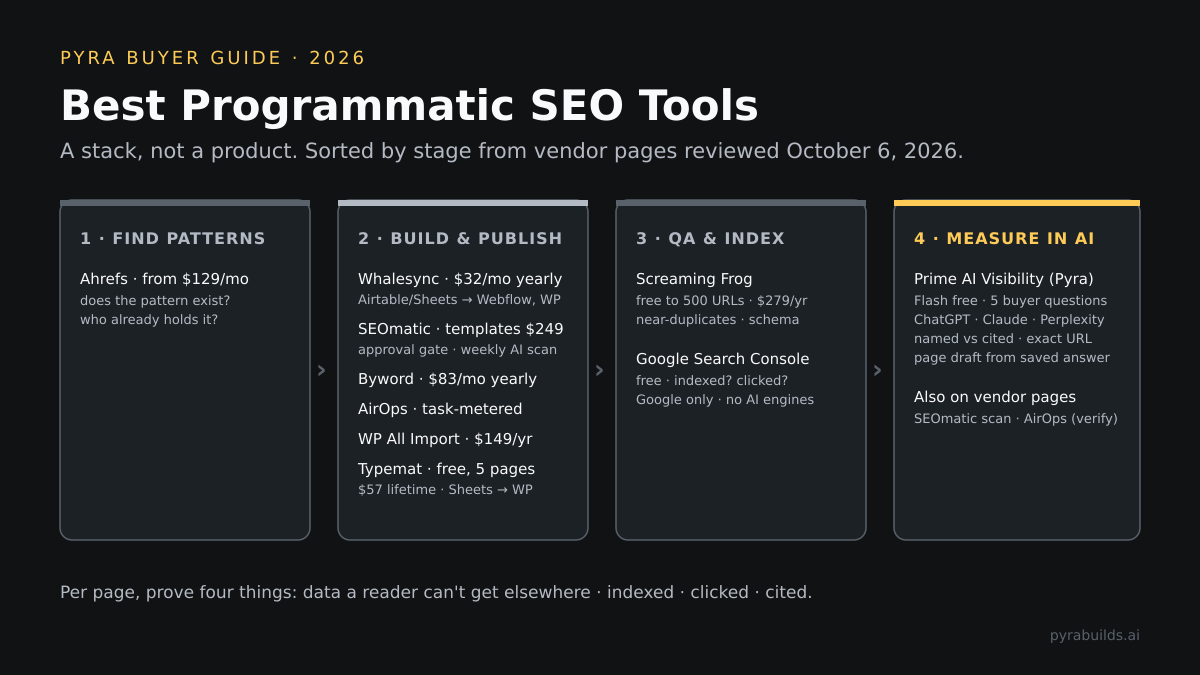
What a programmatic SEO tool has to do in 2026
Google's spam policies define scaled content abuse as generating many pages "for the primary purpose of manipulating search rankings and not helping users", and the first example given is "using generative AI tools or other similar tools to generate many pages without adding value for users" (Google Search Central, spam policies). The policy is about value per page, not the tool that made it. So the job of the best programmatic SEO tools is to make each page carry something a reader could not get elsewhere, get it indexed, and show you whether it worked.
That is four stages, and no vendor page we reviewed covers all of them. Find patterns: prove the keyword pattern exists and see who holds it. Build and publish: turn rows into pages in your CMS, with enough per-row data that two pages are not interchangeable. QA and index: catch near-duplicates and canonical mistakes before launch, then confirm Google indexed the set. Measure in AI answers: the stage most 2026 roundups still skip. Long-tail buyer questions are the queries programmatic pages exist for, and buyers increasingly ask them in ChatGPT, Claude and Perplexity, where a Google position tells you nothing about whether your page was cited. The table below sorts the ten tools by stage so you can see which gaps a given stack leaves open.
How we evaluated each tool
Nine criteria, applied to every option from its own public pages. Where a criterion does not apply to a stage, the row says so.
| Criterion | The question it answers |
|---|---|
| Engine coverage | For build tools: which data sources come in and which CMSs the pages go out to. For measurement tools: which search and AI engines are checked. |
| Mention vs citation | Does it separate 'the page exists or was indexed' from 'the page earned the click or the citation'? |
| Exact cited source | Can you see the exact URL that was indexed, ranked or cited, yours or a competitor's? |
| History and trend | Is per-page or per-question history kept so a change can be dated? |
| Competitor comparison | Does it show who already holds the pattern you are targeting? |
| Question tracking | Does it start from the keyword patterns or buyer questions you choose? |
| Reporting, export, API | Can the pages and the evidence leave the tool? |
| Pricing transparency | Is the price per record, article, task, credit or URL on the public page? |
| Diagnosis to action | Does it help fix thin, unindexed or uncited pages, or only build or report them? |
Best programmatic SEO tools compared
Sorted by stage. Scroll sideways on small screens.
| Tool | Stage | Sources in, pages out | Evidence after publish | Pricing shown |
|---|---|---|---|---|
| Ahrefs | Find patterns | Ahrefs index in; keyword lists and reports out | Rank Tracker and SERP history show positions; 'Tracked AI prompts' and Brand Radar are listed on the plan table | Lite $129 a month, Standard $249, Advanced $449, Enterprise $1,499; up to 17% off annually |
| Whalesync | Build and publish | Airtable, Notion, Google Sheets, Postgres, Supabase and others in; Webflow, WordPress, Framer, Wix CMS, Sanity and others out | Sync status and automated monitoring; no ranking or indexing evidence | Starter $32 a month on yearly billing ($384 a year) for 2,000 records in sync; Plus $64 for 5,000; Pro $160; 7-day free trial, no card |
| SEOmatic | Build and publish | Site data, Google Search Console and Analytics in; WordPress, Webflow, Shopify and ten more CMSs out | Proof Reports and an 'AI Search Visibility' line (weekly on Launch, daily on Scale) are listed as plan features | Free $0 (1 site, 1 AI-visibility scan); Launch $99 a month; Scale $249 (adds Page Templates, 5 sites); Infrastructure $699 (white label, 20 sites); 14-day trial for $1 |
| Byword | Build and publish | Keywords, Airtable, Notion, Google Docs and Sheets in; WordPress, Webflow, Ghost, HubSpot, Medium and webhooks out | 'Google indexing' and 'Content optimization' are listed features; no ranking or citation view is described | Starter $83 a month on annual billing (25 articles), Standard $249 (80 articles, API), Scale $833 (300 articles); 5 free articles, no card. Pages plan limits are shown inside the workspace, not on the public page |
| AirOps | Build and publish | Knowledge bases and brand kits in; CMS, SEO, AEO, social and project integrations out (WordPress, Contentful, Strapi and Sanity logos shown) | 'Insights across 7+ answer engines' is a Pro feature; 'ChatGPT Insights only' on Solo | Solo (35,000 tasks), Pro (100,000 tasks) and Enterprise; dollar prices were not in the page text we retrieved; extra Solo tasks $0.025 each; 14-day free trial |
| WP All Import | Build and publish | CSV, XLSX, XML, a Google Sheets URL or a file on a URL or FTP in; WordPress post types, taxonomies and custom fields out | None after publish; it is an importer | Import & Export Pro listed at $149 a year (page shows $299 struck through); Professional $299 a year ($599 struck through); 90-day money-back guarantee; the page says lifetime licences are ending |
| Typemat | Build and publish | A public Google Sheets URL in; a WordPress, Wix or Squarespace import file out, split into batches | None; it generates the import file | Free for 5 pages; lifetime access $57 for unlimited pages and saved builds |
| Screaming Frog SEO Spider | QA and index | Your site, a URL list or a sitemap in; crawl reports, Looker Studio reports and exports out | Near Duplicate Content, Structured Data & Validation and Crawl Comparison are listed features; Search Console integration adds index status | Free up to 500 URLs; licence $279 a year per user, with volume discounts |
| Google Search Console | QA and index | Your verified property in; Page indexing and Performance reports, URL Inspection and an API out | Impressions versus clicks per page; indexed versus 'Why pages aren't indexed' reasons such as 'Discovered - currently not indexed' | Free |
| Prime AI Visibility (Pyra) | Measure in AI answers | Your buyer questions in; saved answers, named-versus-cited results, cited URLs, content gap recommendations and Word drafts out | Yes: brand mention and owned-citation tracking are separate fields per question | Flash free (5 questions, ChatGPT, Claude and Perplexity, one check a month); Starter $69; Growth $179; Agency $369; metered by credits |
Profiles
Stage: Find patterns
Ahrefs
Role: Keyword and competitor research to choose the page pattern before anything is built.
Best for: Teams that need to prove a repeatable keyword pattern exists, and who already holds it, before committing to a page set.
In and out: Ahrefs index in; keyword lists and reports out.
Evidence: Rank Tracker and SERP history show positions; 'Tracked AI prompts' and Brand Radar are listed on the plan table. Exact source: Yes: ranking URLs per keyword, including competitors' pages. History: SERP history is a listed feature.
Competitors: Competitive Analysis and Site Explorer on all plans. Question tracking: Keywords Explorer for patterns; tracked AI prompts are a listed line item. Reporting: Report Builder, API access and an MCP server appear on the plan table.
Pricing: Lite $129 a month, Standard $249, Advanced $449, Enterprise $1,499; up to 17% off annually. Workflow: Research and audit; it does not build or publish pages.
Strength: The research step most roundups skip: it shows whether the '[service] in [city]' or '[tool] alternatives' pattern has real volume and who already ranks for it.
Limitation: Nothing here generates pages, and the $129 entry price buys a single user.
Verify before relying on it: Which plan unlocks tracked AI prompts and API access; the table lists them but the tier boundaries are not in the page text we retrieved.
Source: ahrefs.com/pricing (reviewed October 6, 2026).
Stage: Build and publish
Whalesync
Role: Two-way sync between a database and a CMS so page rows become CMS items.
Best for: No-code teams that keep the page data in Airtable or Sheets and publish to Webflow or WordPress.
In and out: Airtable, Notion, Google Sheets, Postgres, Supabase and others in; Webflow, WordPress, Framer, Wix CMS, Sanity and others out.
Evidence: Sync status and automated monitoring; no ranking or indexing evidence. Exact source: Not applicable: it moves records, it does not measure them. History: Real-time two-way updates; no page-performance history.
Competitors: Not applicable. Question tracking: Not applicable: the keyword pattern lives in your database. Reporting: Live Export is listed on every plan.
Pricing: Starter $32 a month on yearly billing ($384 a year) for 2,000 records in sync; Plus $64 for 5,000; Pro $160; 7-day free trial, no card. Workflow: Sync only; content, templates and QA happen in the database and the CMS.
Strength: The cleanest separation of data and presentation in this set: edit a row, the page updates, with record-based pricing you can forecast.
Limitation: No content generation, no uniqueness checks and no indexing view; pair it with a crawler and Search Console.
Verify before relying on it: Record counts per plan against your page set, and how many records a two-way mapping consumes.
Source: whalesync.com/pricing and the programmatic SEO use-case page (reviewed October 6, 2026).
Stage: Build and publish
SEOmatic
Role: Agent-driven SEO platform with page templates, CMS publishing and a weekly AI-visibility scan.
Best for: Founders and agencies that want templates, internal linking, approval and rollback in one tool.
In and out: Site data, Google Search Console and Analytics in; WordPress, Webflow, Shopify and ten more CMSs out.
Evidence: Proof Reports and an 'AI Search Visibility' line (weekly on Launch, daily on Scale) are listed as plan features. Exact source: Not published on the pricing page. History: Agents 'compare each changed page with the rest of your site' per the page's job table.
Competitors: Not published on the pricing page. Question tracking: SEO Copilot questions (5 a month on Free); keyword tooling via bring-your-own Ahrefs or Semrush keys on Scale. Reporting: Zapier, Make and n8n triggers on Launch; REST API and webhooks on Infrastructure.
Pricing: Free $0 (1 site, 1 AI-visibility scan); Launch $99 a month; Scale $249 (adds Page Templates, 5 sites); Infrastructure $699 (white label, 20 sites); 14-day trial for $1. Workflow: Approval workflow and one-click rollback on paid plans; nothing ships without your approval, per the page.
Strength: The only option in this set with a page-template feature, automated internal linking, an approval gate and an AI-visibility scan on the same plan table.
Limitation: Page Templates, the programmatic feature, sit on the $249 Scale tier, not the $99 Launch tier; AI credits are capped per month.
Verify before relying on it: What the weekly AI-visibility scan shows per page, and how many template pages the credit caps allow.
Source: seomatic.ai/pricing (reviewed October 6, 2026).
Stage: Build and publish
Byword
Role: AI article generation with a separate 'Pages' beta for template-driven page sets.
Best for: Teams whose programmatic set is long-form articles rather than data tables.
In and out: Keywords, Airtable, Notion, Google Docs and Sheets in; WordPress, Webflow, Ghost, HubSpot, Medium and webhooks out.
Evidence: 'Google indexing' and 'Content optimization' are listed features; no ranking or citation view is described. Exact source: Not published on the pricing page. History: Not published on the pricing page.
Competitors: Not published on the pricing page. Question tracking: Keyword explorer and research dashboard on all plans. Reporting: API access from Standard; webhooks listed under integrations.
Pricing: Starter $83 a month on annual billing (25 articles), Standard $249 (80 articles, API), Scale $833 (300 articles); 5 free articles, no card. Pages plan limits are shown inside the workspace, not on the public page. Workflow: Generates and publishes; the Pages beta 'deploys, hosts, and optimizes' pages on your domain, per its page.
Strength: Per-article pricing is explicit, and the integrations row names every publishing target.
Limitation: The programmatic product (Pages) is a beta whose price is not public; the roughly $0.10-a-page figure on its page is Byword's own estimate.
Verify before relying on it: Pages pricing and limits once inside the workspace, and whether generated pages pass your own uniqueness test.
Source: byword.ai/pricing and byword.ai/labs/pages (reviewed October 6, 2026).
Stage: Build and publish
AirOps
Role: Workflow builder that chains research, generation and CMS publishing as billable tasks.
Best for: Teams that want to design their own generation pipeline with human review steps.
In and out: Knowledge bases and brand kits in; CMS, SEO, AEO, social and project integrations out (WordPress, Contentful, Strapi and Sanity logos shown).
Evidence: 'Insights across 7+ answer engines' is a Pro feature; 'ChatGPT Insights only' on Solo. Exact source: Not published on the pricing page. History: Not published on the pricing page.
Competitors: Not published on the pricing page. Question tracking: Custom prompts; 'Custom Prompts & Pages Limits' on Enterprise. Reporting: Not published on the pricing page.
Pricing: Solo (35,000 tasks), Pro (100,000 tasks) and Enterprise; dollar prices were not in the page text we retrieved; extra Solo tasks $0.025 each; 14-day free trial. Workflow: Workflows run end to end; the page describes task-based billing per successful workflow run.
Strength: The most flexible pipeline in this set, with answer-engine insights built into the Pro tier.
Limitation: Pricing is task-metered and the plan prices are not in the page's text, so the cost per page is hard to forecast before a trial.
Verify before relying on it: Plan prices, how many tasks one page consumes, and what the answer-engine insights show per URL.
Source: airops.com/pricing (reviewed October 6, 2026).
Stage: Build and publish
WP All Import
Role: CSV, XML, Excel or Google Sheets import into WordPress posts, pages and custom fields.
Best for: WordPress sites that already have the page data in a spreadsheet.
In and out: CSV, XLSX, XML, a Google Sheets URL or a file on a URL or FTP in; WordPress post types, taxonomies and custom fields out.
Evidence: None after publish; it is an importer. Exact source: Not applicable. History: Scheduled re-imports can update or delete missing records.
Competitors: Not applicable. Question tracking: Not applicable. Reporting: Export to CSV, XLSX and XML; PHP functions can run on import.
Pricing: Import & Export Pro listed at $149 a year (page shows $299 struck through); Professional $299 a year ($599 struck through); 90-day money-back guarantee; the page says lifetime licences are ending. Workflow: Import, map fields, schedule; ACF, Meta Box and JetEngine add-ons for structured pages.
Strength: Mature, cheap and unopinionated: any spreadsheet becomes any WordPress post type with custom fields intact.
Limitation: No content generation, uniqueness checks or measurement; thin pages import as easily as good ones.
Verify before relying on it: Whether the struck-through prices are a promotion or the new list price, and which add-ons your templates need.
Source: wpallimport.com/pricing (reviewed October 6, 2026).
Stage: Build and publish
Typemat
Role: Free Google Sheets to XML generator for WordPress, Wix and Squarespace imports.
Best for: A first 50-page experiment on WordPress with no budget.
In and out: A public Google Sheets URL in; a WordPress, Wix or Squarespace import file out, split into batches.
Evidence: None; it generates the import file. Exact source: Not applicable. History: Not applicable: re-export and re-import.
Competitors: Not applicable. Question tracking: Not applicable. Reporting: XML export only.
Pricing: Free for 5 pages; lifetime access $57 for unlimited pages and saved builds. Workflow: Map columns to title, slug, categories and tags, write an HTML template with {{variables}}, download, import.
Strength: The lowest-cost way to see whether a page pattern indexes before buying a platform.
Limitation: Template-only output with no enrichment, no sync after import, and no Webflow or Framer target.
Verify before relying on it: That the export imports cleanly into your theme, and that each page passes your own uniqueness test before it goes live.
Source: typemat.com (reviewed October 6, 2026).
Stage: QA and index
Screaming Frog SEO Spider
Role: Desktop crawler for duplicate, thin, mis-canonicalised and broken pages before and after launch.
Best for: Anyone launching more than a handful of templated pages.
In and out: Your site, a URL list or a sitemap in; crawl reports, Looker Studio reports and exports out.
Evidence: Near Duplicate Content, Structured Data & Validation and Crawl Comparison are listed features; Search Console integration adds index status. Exact source: Yes: every URL crawled, with its canonical, directives and duplicates. History: Crawl Comparison and saved crawls; scheduling on the paid licence.
Competitors: Crawl a competitor's page set the same way. Question tracking: Not applicable. Reporting: Exports, Looker Studio crawl report, Google Analytics and Search Console integrations.
Pricing: Free up to 500 URLs; licence $279 a year per user, with volume discounts. Workflow: Diagnosis only; fixes happen in the CMS or templates.
Strength: Catches the near-duplicate pages that get a templated set demoted, before Google does.
Limitation: A desktop tool with a 500-URL free limit; it reports issues and leaves the fixing to you.
Verify before relying on it: Memory and storage headroom for your page count; the page says crawl size depends on allocated memory.
Source: screamingfrog.co.uk/seo-spider/pricing (reviewed October 6, 2026).
Stage: QA and index
Google Search Console
Role: Free index coverage and click data for every page Google knows about.
Best for: Every programmatic set, as the ground truth for whether pages were indexed and clicked.
In and out: Your verified property in; Page indexing and Performance reports, URL Inspection and an API out.
Evidence: Impressions versus clicks per page; indexed versus 'Why pages aren't indexed' reasons such as 'Discovered - currently not indexed'. Exact source: Yes: your own URLs with status and query data; nothing about competitors. History: Performance history per URL and query; issue history per indexing status.
Competitors: None. Question tracking: Queries are reported after the fact; you cannot pre-register a question set. Reporting: Exports and the Search Console API.
Pricing: Free. Workflow: Diagnosis; the report says the example-URL list is limited to 1,000 items per status, so large sets need the API or sampling.
Strength: The only source that says, per URL, whether Google indexed the page and whether anyone clicked it.
Limitation: Google only, example lists capped at 1,000 URLs per status, and no view of AI answer engines.
Verify before relying on it: That your property covers the subfolder where the pages live, and that sitemaps are submitted for the full set.
Source: Page indexing report, Search Console Help (reviewed October 6, 2026).
Stage: Measure in AI answers
Prime AI Visibility (Pyra)
Role: Checks whether the buyer questions your page set targets get your brand named or cited in AI answers, then drafts the fix.
Best for: Teams whose programmatic pages target questions buyers now ask ChatGPT, Claude or Perplexity instead of Google.
In and out: Your buyer questions in; saved answers, named-versus-cited results, cited URLs, content gap recommendations and Word drafts out.
Evidence: Yes: brand mention and owned-citation tracking are separate fields per question. Exact source: Yes: exact answers and cited websites saved per question, yours or a competitor's. History: Saved answers per check; exact answer history on the Agency plan.
Competitors: Cited website and competitor evidence per question. Question tracking: Your own buyer questions: 5 on Flash, 25 on Starter, 50 on Growth, 120 on Agency. Reporting: PDF and CSV reporting; exports from saved data do not use credits.
Pricing: Flash free (5 questions, ChatGPT, Claude and Perplexity, one check a month); Starter $69; Growth $179; Agency $369; metered by credits. Workflow: Content gap recommendations and source-enriched Word drafts from the saved answers.
Strength: Turns 'did the page set work in AI search' into per-question evidence: named or not, cited or not, and which URL won instead.
Limitation: Question-level, not URL-level: it samples the pattern through up to 120 questions per check rather than auditing thousands of pages, and it does not build or publish pages.
Verify before relying on it: That your highest-value page pattern can be expressed as buyer questions, and which engines matter for your buyers; Grok and Copilot are not covered.
Source: primeaivisibility.com/pricing (reviewed October 6, 2026).
A near-free starter stack for the first 50 pages
Before paying for a platform, prove the pattern with tools that cost almost nothing. Model the pages in Google Sheets with one row per page and at least three columns of data that differ meaningfully between rows; if you cannot fill those columns, the pattern is not ready. Generate the import file with Typemat (free for 5 pages, $57 lifetime) or WP All Import (from $149 a year) into WordPress, or push the sheet into Webflow with Whalesync's 7-day trial (Webflow's CMS needs the Premium site plan, $25 a month on yearly billing). Crawl the staging set with Screaming Frog's free 500-URL tier and fix anything flagged as near-duplicate before launch. Submit the sitemap, then read Search Console's Page indexing report weekly; "Discovered - currently not indexed" on most of the set is the signal to stop and add value, not to publish more. Finally, write the ten buyer questions the set is meant to answer and run them through Prime's free Flash check, which saves the answers and cited URLs for ChatGPT, Claude and Perplexity, so you know whether the pattern earns citations before you scale it. The GEO 2026 playbook covers what makes a page citable in the first place.
What was left out, and why
PageFactory still appears in 2026 roundups, including one updated in July 2026 that reports a 2026 index-rate test for it; pagefactory.app itself says the product has not been operational since August 2024, so it is not in this table. Webflow and Airtable are the base layer most of these tools plug into rather than programmatic tools themselves; their pricing appears where it affects a row. Letterdrop, Bardeen, Prismic and Slate appear in competing lists, but we did not verify their current plans and so they are not scored. Four of the five roundups ranking for this query are written by a vendor on their own list, and each ranks itself first; the facts above come from pricing and documentation pages instead, which is also why "not published" appears often in the table.
From a published set to a cited page
Search Console will tell you which pages were indexed and clicked. It will not tell you whether ChatGPT cites your "[service] in [city]" page or a competitor's when a buyer asks. The loop Pyra runs for clients, and that Percepture's generative engine optimization services describe, closes that gap: express the page pattern as buyer questions, record per question whether you were named and cited and which URL won, compare your page with the winning URL on directness and dated specifics, revise the template or the row data, and recheck on a schedule. Prime's Content Fix step drafts the revised page from the saved answer and flags any claim that needs proof before export. Pyra's digital infrastructure case study shows the measured result of running that loop on a question set, and the ChatGPT SEO analysis tools guide applies the same evidence standard to ChatGPT-specific tooling. For a wider market list, see Percepture's AI visibility tools comparison.
Best programmatic SEO tools: questions buyers ask
What is the best programmatic SEO tool?
No single tool covers the loop. Of the pages reviewed on October 6, 2026, Whalesync is the cleanest database-to-CMS sync (from $32 a month on yearly billing), SEOmatic is the only option with page templates, internal linking, an approval gate and an AI-visibility scan on one plan table (templates from $249), WP All Import and Typemat are the cheapest WordPress routes, and Screaming Frog plus Google Search Console are the QA layer. Prime AI Visibility checks whether the resulting pages get named or cited in AI answers.
Does Google penalise programmatic SEO?
Not as a technique. Google's spam policies define 'scaled content abuse' as generating many pages 'for the primary purpose of manipulating search rankings and not helping users', including using generative AI tools to generate many pages without adding value. A page set where each page carries information the user could not get elsewhere is outside that definition; a set of swapped-variable pages is inside it, whatever tool built it.
Can I do programmatic SEO for free?
For a small experiment, yes. Typemat generates a WordPress, Wix or Squarespace import file from a Google Sheet for free up to 5 pages ($57 lifetime for unlimited), WordPress's built-in importer is free, Screaming Frog crawls up to 500 URLs free, Google Search Console is free, and Prime's Flash plan checks five buyer questions across ChatGPT, Claude and Perplexity once a month without a card. Webflow's CMS needs the Premium site plan at $25 a month on yearly billing.
How do I know whether programmatic pages show up in AI answers?
Google Search Console cannot tell you. Write the buyer questions your page pattern targets, run them through the engines your buyers use, and record per question whether your brand was named, whether your page was cited, and which URL was cited instead. Prime AI Visibility stores those fields automatically for ChatGPT, Claude, Perplexity and Gemini; SEOmatic lists a weekly AI-visibility scan on its $99 plan and AirOps lists answer-engine insights on Pro. Verify what each shows per URL on a trial.
Sources
Google: Spam policies, scaled content abuse; Page indexing report. Vendor pricing and documentation pages are linked from each profile; webflow.com/pricing and pagefactory.app were checked for the context above. Competing roundups consulted: theStacc (updated July 10, 2026), Prismic, QuickSEO, Slate and Byword. Prime facts come from primeaivisibility.com and the Pyra Prime page. All pages reviewed October 6, 2026. Written by Bob Generale, COO and co-founder of Pyra; reviewed by Alex Mannine.
Get the page pattern, the data model and the measurement loop built for you
Book a Pyra strategy call and we will pick the page pattern worth building, define the data each page needs to carry, choose the stack above that fits your CMS and budget, and set up the question-level measurement so you know whether the set earns citations. If you want to see the evidence first, Prime's Flash check runs five buyer questions through ChatGPT, Claude and Perplexity for free, no card required.