Best Tools for SEO Topical Map in 2026: 7 Compared
The best tools for SEO topical map work compared on nine criteria: Floyi, Semrush, Surfer, MarketMuse, Keyword Insights, Agility Writer and Prime, with pricing. Reviewed Nov 6, 2026.
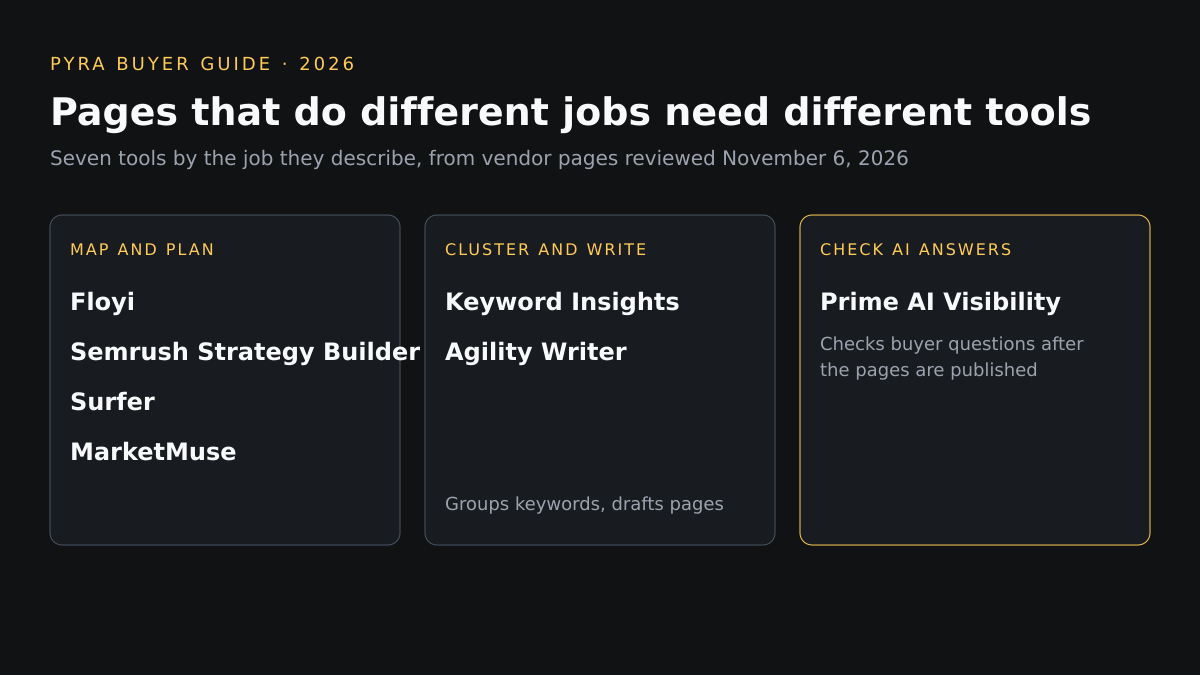
Short answer: the best tools for SEO topical map work build the map from search data, show competitor coverage and carry a gap through to a brief. Of seven reviewed on November 6, 2026, Floyi builds maps from search-result overlap, Surfer and Semrush add one to a larger account, MarketMuse plans by tracked topics, and Prime checks AI answers after publishing.
A topical map is useful only when pages do different jobs. This guide is for SEOs and content leads who need to plan pillar and supporting pages before writing them, and who want to know which tool does which part. Pyra makes Prime AI Visibility and Lead Seeker, and the author, Bob Generale, is Pyra's COO and co-founder and President of Percepture; Prime is held to the same nine criteria and listed last. Prices and features are what each vendor displayed on November 6, 2026, and "not described" means those pages did not say.
What an SEO topical map has to do
A map is a plan, not a keyword list. It names the pillar pages, the supporting pages under each, the links between them and the gaps still open, and the tools below cover different parts of that plan.
- Cluster: group keywords that one page can serve, so two pages do not compete for the same intent.
- Map: arrange clusters into pillars and supporting pages across the whole site, and mark what exists.
- Brief and write: turn each open gap into a page with a clear job.
- Check: see whether search and AI answers reward the pages after they are live.
None of these tools crawls your site on behalf of an AI engine, and a map does not guarantee a ranking. To audit the mapped pages for crawl and index problems, see our technical SEO audit tools guide. For the measurement side, our guide to ChatGPT SEO analysis tools covers the evidence standard.
How we compared these topical map tools
Nine criteria were applied to every tool using only its public pricing, product and documentation pages. No hands-on scores were produced. The order is editorial: SEO suite modules, then dedicated platforms, then the evidence-and-content layer. The set is not exhaustive; it covers tools that recur in published topical map lists and whose own pages describe mapping, clustering or measuring the result. Tools that only cluster or only measure are labeled so.
| Criterion | The question it answers |
|---|---|
| Engine coverage | Which AI answer engines, if any, does the tool check besides Google? |
| Mention vs citation | Does it separate being named from being cited? |
| Exact cited source | Does it show which URL an engine cited? |
| History and trend depth | Can you compare coverage or visibility over time? |
| Competitor comparison | Can you see a rival's topic coverage or visibility? |
| Question and prompt tracking | Can you track the questions your buyers ask? |
| Reporting, export, API | Can the plan leave the tool as a file, report or integration? |
| Pricing transparency | Is the price published, and what does it meter? |
| Diagnosis to action | What happens after a gap is found: brief, draft, publish or recheck? |
Best tools for SEO topical map compared
Two tables, the same seven tools in profile order. The first covers type, how the map is built, AI engines, evidence and price; the second covers history, competitors, questions, reporting and what happens after a gap is found. Scroll sideways on small screens.
| # | Tool | Type | How the map is built | AI engines | Mention vs citation | Exact cited source | Pricing shown |
|---|---|---|---|---|---|---|---|
| 1 | Floyi | Topical map platform | SERP-based topical maps and SERP-based keyword clustering that groups keywords by real search-result overlap, plus a Topical Audit that reverse-engineers any site's topics into a four-level hierarchy | AIRS Analyzer on Pro and Scale shows side-by-side answers and source citations from Google AI Mode, AI Overviews, Bing Copilot, Claude, Gemini, OpenAI and Perplexity | Topical Authority Scorecard tracks coverage, visibility, share of voice and AI Overview presence; a separate named-versus-cited metric is not described | AIRS reports list source citations for each engine's answer | Free/PAYG with 500 credits a month; Pro $99 a month ($82.50 billed yearly); Scale $299 ($249.17 billed yearly); $7 14-day Pro trial; extra credits from $10 per 1,000 |
| 2 | Semrush Keyword Strategy Builder | SEO suite module | Maps keywords to topic clusters and generates topics, pillar pages and subpage ideas from a starting keyword; Semrush's guide says generation can take up to 15 minutes | The separate AI Visibility Toolkit tracks ChatGPT, Google AI, Gemini and Perplexity | Mentions are listed; the pricing page does not describe a separate citation metric | Not described on the pricing page | A Keyword Strategy Builder price was not itemized on the pages reviewed; the AI Visibility Toolkit is Base $99 a month per domain billed annually |
| 3 | Surfer | Content optimization platform | Topical Map analyzes your current topical coverage and finds neighbor topic clusters by semantic similarity; All Topics and Map views, and a check that a cluster's main keyword matches search intent | AI Tracker covers ChatGPT, Gemini, AI Overviews and other models | Reports a Visibility Score, mention gaps and where models mention and cite you; a separate named-versus-cited metric is not itemized | Not itemized on the pricing page | Per month billed yearly: Discovery $49, Standard $99, Pro $182, Peace of Mind $299; AI Search Analytics $82 |
| 4 | MarketMuse | Content strategy platform | Topic Navigator and Content Strategy Documents; tracked topics from 100 on Optimize to 1,000 on Research and 10,000 on Strategy; the vendor describes its topic model as relating a topic to its neighbors | No AI answer engines described on the pricing page | Not described | Not described | Free (10 queries a month, 1 user); paid Optimize, Research and Strategy plans are sold through a demo with no price shown |
| 5 | Keyword Insights | Keyword clustering and briefs | Keyword discovery and keyword clustering (1 credit per keyword) with search-intent context; the pricing page does not describe a site-level map view | No AI answer engines described on the pricing page | Not described | Not described | Basic $58 a month (10,000 credits, 1 seat, 5 workspaces); Professional $99 (20,000 credits, 3 seats, 10 workspaces); Enterprise custom; $1 7-day trial with 5,000 credits |
| 6 | Agility Writer | AI writer with a map helper | Topical Map Helper builds semantic topic clusters, spots entity gaps and plans internal links, per its feature page updated June 12, 2026 | No AI answer engines described on the pricing page | Not described | Not described | $1 trial; Basic $28 a month (40 credits), Pro $98, Premium $228; yearly plans from $240 a year (300 credits) |
| 7 | Prime AI Visibility | Evidence and fix layer | It does not build a topical map or crawl or index pages; it discovers questions from citation research and your website and checks the ones you keep | ChatGPT, Claude and Perplexity on the free Flash plan; Gemini and an AI Overview-style preview on paid plans. No Grok, DeepSeek or Copilot | Yes: brand mention and owned citation are tracked separately | Yes: exact answers and cited websites are saved per question | Flash free (30 credits, one check a month); Starter $69, Growth $179, Agency $369, Enterprise $1,499 a month |
| Tool | History | Competitors | Question tracking | Reporting, export, API | Diagnosis to action |
|---|---|---|---|---|---|
| Floyi | Scorecard and Organic Audit (Google Search Console) on Pro and Scale; history depth is not described | Topical Audit works on competitor sites; SERP Insights analyzes every ranking competitor page | PAA Explorer question trees; how AIRS question sets are saved is not described | Scorecard action plan can be exported; one-click WordPress and GitHub publishing on Pro (3 sites) and Scale (10) | Map, then SERP clustering, briefs (150 credits each), drafts (150) and publishing; Scorecard filters gaps and generates briefs |
| Semrush Keyword Strategy Builder | Daily, weekly and monthly data updates in the AI Visibility Toolkit; map history is not described | Competitor Analysis and Keyword Gap reports sit in the same account; AI competitor analysis is in the AI toolkit | Prompt Research and 25 custom prompts on the AI toolkit's Base plan, for one domain | Report add-ons: Base at $10 and Pro at $20 a month (white-label, AI summaries); API and custom integrations are Enterprise | Clusters feed Semrush's content tools; the guide tells you to add internal links between the pillar page and its cluster pages |
| Surfer | Rank drop alerts and Google Search Console position monitoring; AI history depth is not described | Compare a competitor's topical coverage; AI Tracker shows competitor share of voice | AI Tracker follows the prompts your buyers ask in AI models; confirm the prompt allowance for your selected plan | Not itemized on the pricing page; API access is listed on the top plan | Topical Map, Content Editor and Content Audit are positioned as the plan, write and refresh steps |
| MarketMuse | Site inventory and tracked topics; trend history is not described | SERP X-ray, SERP Heatmap and Site Heatmap are listed; competitor topic coverage is not itemized | Queries and tracked topics, not AI prompts | Export for saved writing, applications and documents on paid plans; API is not described | Briefs per month (5, 10 and 20 on the three paid plans) and strategy documents (1, 3 and 5) |
| Keyword Insights | Not described | Not described on the pricing page | Keywords, not AI prompts | Google Search Console and WordPress integrations are listed; confirm the export format you need before choosing a plan | Clustering, content briefs (100 credits each), a Writing Assistant (200 credits an article) and an AI Writing Agent (1,200) |
| Agility Writer | Not described | Not described on the pricing page | Not described | WordPress and Zapier integrations are listed | Map, then article writing in the same credit-based tool; research with citations is on paid plans |
| Prime AI Visibility | Exact answer history on Agency and above; each check keeps its saved answers | Cited website and competitor evidence per question on Agency and above | Your own buyer questions: 5 on Flash, up to 25 on Starter, 50 on Growth, 120 on Agency, 500 on Enterprise per check | PDF and CSV reports; reading and exporting saved data costs no credits | Content gap recommendations and source-enriched Word drafts from the saved answers |
Profiles
1. Topical map platform
Floyi
Best fit: Teams that want the map, SERP analysis, briefs, drafts and publishing in one credit-based workspace.
Evidence: map: SERP-based topical maps and SERP-based keyword clustering that groups keywords by real search-result overlap, plus a Topical Audit that reverse-engineers any site's topics into a four-level hierarchy. AI engines: AIRS Analyzer on Pro and Scale shows side-by-side answers and source citations from Google AI Mode, AI Overviews, Bing Copilot, Claude, Gemini, OpenAI and Perplexity. Mention vs citation: Topical Authority Scorecard tracks coverage, visibility, share of voice and AI Overview presence; a separate named-versus-cited metric is not described. Exact cited source: AIRS reports list source citations for each engine's answer. Competitors: Topical Audit works on competitor sites; SERP Insights analyzes every ranking competitor page. Questions: PAA Explorer question trees; how AIRS question sets are saved is not described.
Pricing: Free/PAYG with 500 credits a month; Pro $99 a month ($82.50 billed yearly); Scale $299 ($249.17 billed yearly); $7 14-day Pro trial; extra credits from $10 per 1,000.
Strength: The map is built from search-result overlap rather than a keyword list alone, and the credit cost of each action is published.
Limitation: Credits are one shared pool, the free plan includes a single lifetime research run, and the AI-engine reports are not on the free plan.
What to verify: How many credits your site's keyword count and audit pages consume, and whether the AIRS engines match where your buyers ask.
Source: floyi.com/pricing (reviewed November 6, 2026).
2. SEO suite module
Semrush Keyword Strategy Builder
Best fit: Teams already working in Semrush who want clusters, pillar pages and subpage ideas from a keyword they have already researched.
Evidence: map: Maps keywords to topic clusters and generates topics, pillar pages and subpage ideas from a starting keyword; Semrush's guide says generation can take up to 15 minutes. AI engines: The separate AI Visibility Toolkit tracks ChatGPT, Google AI, Gemini and Perplexity. Mention vs citation: Mentions are listed; the pricing page does not describe a separate citation metric. Exact cited source: Not described on the pricing page. Competitors: Competitor Analysis and Keyword Gap reports sit in the same account; AI competitor analysis is in the AI toolkit. Questions: Prompt Research and 25 custom prompts on the AI toolkit's Base plan, for one domain.
Pricing: A Keyword Strategy Builder price was not itemized on the pages reviewed; the AI Visibility Toolkit is Base $99 a month per domain billed annually.
Strength: Clustering sits beside keyword gap, competitor and AI visibility data in a single account.
Limitation: Plan-by-plan availability and price of the Keyword Strategy Builder were not shown on the pages reviewed.
What to verify: Which Semrush plan includes the Keyword Strategy Builder and how many keywords or projects it allows.
Source: semrush.com topic clusters guide (reviewed November 6, 2026).
3. Content optimization platform
Surfer
Best fit: Content teams that want a map of coverage gaps next to a content editor, audit and AI visibility tracking.
Evidence: map: Topical Map analyzes your current topical coverage and finds neighbor topic clusters by semantic similarity; All Topics and Map views, and a check that a cluster's main keyword matches search intent. AI engines: AI Tracker covers ChatGPT, Gemini, AI Overviews and other models. Mention vs citation: Reports a Visibility Score, mention gaps and where models mention and cite you; a separate named-versus-cited metric is not itemized. Exact cited source: Not itemized on the pricing page. Competitors: Compare a competitor's topical coverage; AI Tracker shows competitor share of voice. Questions: AI Tracker follows the prompts your buyers ask in AI models; confirm the prompt allowance for your selected plan.
Pricing: Per month billed yearly: Discovery $49, Standard $99, Pro $182, Peace of Mind $299; AI Search Analytics $82.
Strength: Coverage gaps, competitor coverage and Search Console positions are in the same tool as the editor.
Limitation: Surfer's October 5, 2026 update says a redesigned Topical Map is in development and recruiting test users, and the pricing page does not say which plan includes which map features.
What to verify: Which plan includes Topical Map today and whether the new version changes how maps are built.
Source: Surfer Topical Map documentation (reviewed November 6, 2026).
4. Content strategy platform
MarketMuse
Best fit: Larger content teams that plan by tracked topics and monthly strategy documents rather than a one-off map.
Evidence: map: Topic Navigator and Content Strategy Documents; tracked topics from 100 on Optimize to 1,000 on Research and 10,000 on Strategy; the vendor describes its topic model as relating a topic to its neighbors. AI engines: No AI answer engines described on the pricing page. Mention vs citation: Not described. Exact cited source: Not described. Competitors: SERP X-ray, SERP Heatmap and Site Heatmap are listed; competitor topic coverage is not itemized. Questions: Queries and tracked topics, not AI prompts.
Pricing: Free (10 queries a month, 1 user); paid Optimize, Research and Strategy plans are sold through a demo with no price shown.
Strength: Plan limits for tracked topics, briefs and strategy documents are published.
Limitation: No published price for paid plans, and no AI answer measurement on the pages reviewed.
What to verify: The quote for your team size and whether one site inventory fits how many sites you manage.
Source: marketmuse.com/pricing (reviewed November 6, 2026).
5. Keyword clustering and briefs
Keyword Insights
Best fit: SEOs who already have a keyword list and want it grouped and turned into briefs, and who will assemble the site-level map themselves.
Evidence: map: Keyword discovery and keyword clustering (1 credit per keyword) with search-intent context; the pricing page does not describe a site-level map view. AI engines: No AI answer engines described on the pricing page. Mention vs citation: Not described. Exact cited source: Not described. Competitors: Not described on the pricing page. Questions: Keywords, not AI prompts.
Pricing: Basic $58 a month (10,000 credits, 1 seat, 5 workspaces); Professional $99 (20,000 credits, 3 seats, 10 workspaces); Enterprise custom; $1 7-day trial with 5,000 credits.
Strength: Credit costs per action are published, and the cheapest paid plan is a clear way to cluster a large list.
Limitation: It groups keywords; the pricing page does not describe a topical map, competitor coverage or AI answer tracking.
What to verify: Whether the cluster output is enough to plan pillars and internal links without a separate site-level map.
Source: keywordinsights.ai/pricing (reviewed November 6, 2026).
6. AI writer with a map helper
Agility Writer
Best fit: Small content teams that want a low-priced map helper attached to a writing workflow.
Evidence: map: Topical Map Helper builds semantic topic clusters, spots entity gaps and plans internal links, per its feature page updated June 12, 2026. AI engines: No AI answer engines described on the pricing page. Mention vs citation: Not described. Exact cited source: Not described. Competitors: Not described on the pricing page. Questions: Not described.
Pricing: $1 trial; Basic $28 a month (40 credits), Pro $98, Premium $228; yearly plans from $240 a year (300 credits).
Strength: Topical Map Helper is on every plan including the $1 trial, and the price per credit is published.
Limitation: It is a writer first; competitor coverage, history and AI answer measurement are not described.
What to verify: How much of the map it produces comes from search data versus model output, tested on your niche.
Source: agilitywriter.ai/pricing (reviewed November 6, 2026).
7. Evidence and fix layer
Prime AI Visibility
Best fit: Teams that already have a map and want to check whether the buyer questions it targets get the brand named or cited in AI answers.
Evidence: map: It does not build a topical map or crawl or index pages; it discovers questions from citation research and your website and checks the ones you keep. AI engines: ChatGPT, Claude and Perplexity on the free Flash plan; Gemini and an AI Overview-style preview on paid plans. No Grok, DeepSeek or Copilot. Mention vs citation: Yes: brand mention and owned citation are tracked separately. Exact cited source: Yes: exact answers and cited websites are saved per question. Competitors: Cited website and competitor evidence per question on Agency and above. Questions: Your own buyer questions: 5 on Flash, up to 25 on Starter, 50 on Growth, 120 on Agency, 500 on Enterprise per check.
Pricing: Flash free (30 credits, one check a month); Starter $69, Growth $179, Agency $369, Enterprise $1,499 a month.
Strength: Keeps the exact answer, the named-or-cited result and cited URLs for every buyer question, then drafts the page that closes the gap.
Limitation: Flash covers three engines (ChatGPT, Claude, Perplexity) and Starter and above cover all five supported tools; no Grok, DeepSeek or Copilot, no Google organic rankings and no traffic attribution or CRM integration described.
What to verify: Whether five engines cover where your buyers ask, and how credits map to your question count.
Source: primeaivisibility.com/pricing (reviewed November 6, 2026).
How to choose a topical map tool
Choose by the job you lack. If you already own keyword research, a clustering tool such as Keyword Insights may be enough; if you need the site-level plan, compare Floyi, Surfer, Semrush and MarketMuse on how each builds the map and what it meters. Test two of them on one real topic, and check whether each pillar and supporting page ends up with a distinct job.
After the pages are published, a map cannot tell you what AI engines say about them. Prime's guide to choosing an AI visibility tool scores six axes (engines covered, refresh cadence, prompt ownership, metric definitions, raw-data export and pricing) and suggests trialing with ten of your own buyer questions. Prime AI Visibility, which Pyra makes, saves the answers ChatGPT, Claude, Perplexity and Gemini give to those questions, along with the cited websites. It does not build maps, crawl or index pages, or monitor Google organic rankings.
From content plan to the accounts worth contacting
A topical map decides what to publish; which accounts and verified contacts deserve outreach is a different question, and organic impressions are not proof of buying intent. Lead Seeker handles B2B prospecting, verified contacts and buyer dossiers, and does not track AI answers.
When intent signals must become qualified account selection, campaign execution or sales activation, Percepture's B2B intent data services connect signal interpretation, ICP targeting and campaign activation. These are separate jobs from topical mapping and from each other.
Best Topical map tools: questions buyers ask
What is the best tool for an SEO topical map?
On the vendor pages reviewed on November 6, 2026, Floyi builds maps from search-result overlap and publishes its credit costs, Surfer and Semrush add a map to a larger SEO account, MarketMuse plans by tracked topics, and Keyword Insights and Agility Writer cover clustering or mapping at lower published prices. Pick by whether you need the map itself, the brief and draft after it, or a check of what AI answers say once the pages exist.
Do I need a paid tool to build a topical map?
No. A map is a plan of pillar and supporting pages, and a spreadsheet of researched keywords grouped by intent can hold one. Paid tools save time on clustering and gap analysis; Floyi and MarketMuse list free plans, though both are limited, and Agility Writer lists a $1 trial.
What is the difference between a topical map and keyword clustering?
Clustering groups keywords that one page can serve. A topical map is the site-level plan: which pillar pages and supporting pages exist, how they link and which gaps remain. Keyword Insights lists clustering without a map view, while Floyi, Surfer, Semrush and Agility Writer describe topic clusters or maps.
Can a topical map tool tell me if AI engines mention my brand?
Only some can. Floyi and Surfer describe AI answer reports or tracking, and Semrush sells a separate AI Visibility Toolkit; MarketMuse, Keyword Insights and Agility Writer describe none on the pages reviewed. A map tells you what to publish, and an AI visibility tool checks whether engines name or cite you afterwards.
Does a topical map tell me which companies to contact?
No. A topical map plans content. Search traffic is not the same as buying intent, so identifying accounts and verified contacts is a separate sales intelligence job.
Sources
Vendor pricing and product pages are linked from each profile and were reviewed November 6, 2026. Vendor-stated features are attributed to the vendor, and prices change often. Written by Bob Generale; reviewed by Alex Mannine.
Plan the map around buyer questions
Talk with Pyra about the pillar and supporting pages your buyers need, the questions to check in AI answers after publishing and the content work that follows.