Best SEO Audit Tools 2026: Technical Crawlers and Audits Compared
The best SEO audit tools 2026 compared on eight criteria: Screaming Frog, Sitebulb, Semrush, Ahrefs, Lumar and Search Console, plus where Prime AI Visibility does not apply. Updated Nov 7, 2026.
Short answer: the best SEO audit tools 2026 buyers should shortlist for technical work are Screaming Frog SEO Spider and Sitebulb for desktop crawls, Semrush Site Audit and Ahrefs Site Audit for suite-based monitoring, and Lumar for enterprise crawling, with Google Search Console as the indexing check. Match the tool to site size and rendering needs, not a health score. An SEO audit should tell you what to fix first.
This guide is for SEO leads and in-house marketers choosing a crawler or audit platform. Pyra makes Prime AI Visibility and Lead Seeker. Facts come from each vendor's public pages reviewed on November 7, 2026; "not itemized" means the page did not list the feature, not that it is missing. Prime is listed under the same eight criteria so you can see where it does not apply.
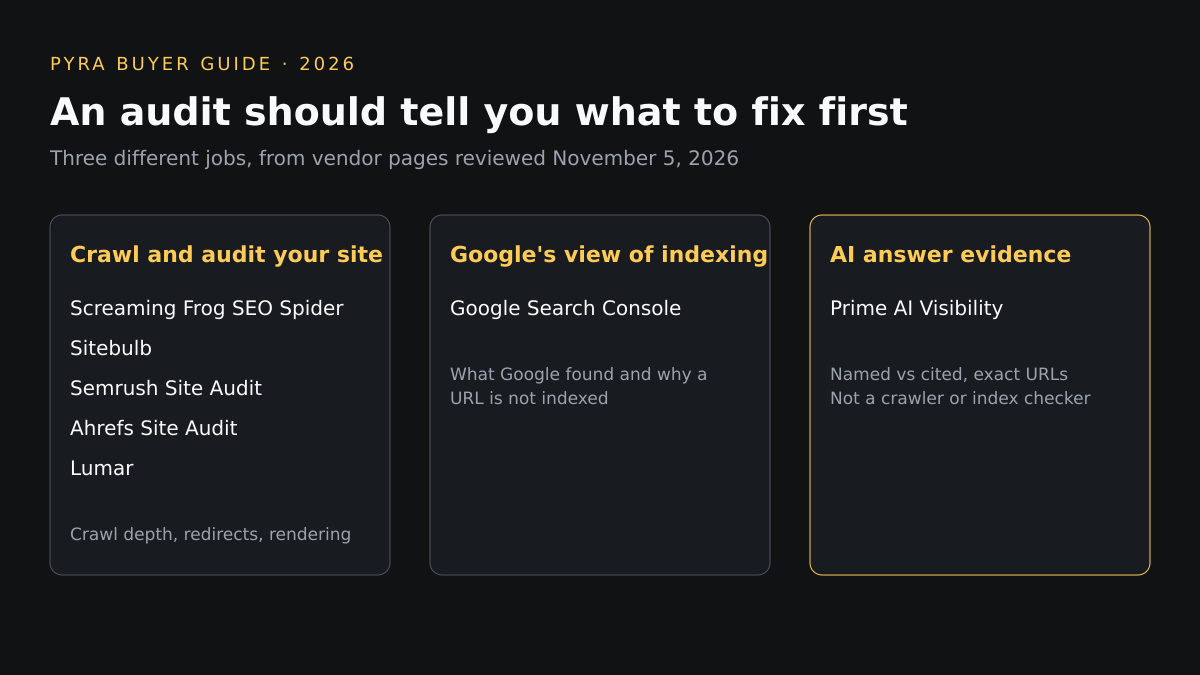
How we compared technical SEO audit tools
Search results for best SEO audit tools 2026 are mostly vendor-written or affiliate lists, and several, such as Semrush's May 22, 2026 guide, rank their publisher first. Semrush's list also covers SE Ranking, Netpeak Spider, JetOctopus and Conductor, which are not reviewed here. Each claim below is tied to the tool's own page. The same eight criteria were applied to every option. The order is editorial, by how directly each tool performs a site crawl; no hands-on scores were produced.
| Criterion | The question it answers |
|---|---|
| Crawl depth | How many URLs can it crawl, and how is the limit set? |
| Indexation diagnostics | Does it show what can and cannot be indexed, and why? |
| Redirect and canonical checks | Does it surface redirect chains, loops and canonical problems? |
| Structured data checks | Does it find or validate schema markup? |
| Rendering and JavaScript | Can it see content that only appears after scripts run? |
| Reporting | Can findings be scheduled, compared, exported or shared? |
| Automation safety | Does it report only, or change your site automatically? |
| Pricing | Is the price on the public page, and what does it include? |
Best SEO audit tools 2026 compared
Two tables, the same seven options. The first covers crawl, indexing, redirects and structured data; the second covers rendering, reporting, automation safety and price. Scroll sideways on small screens.
| Tool | Type | Crawl depth | Indexation | Redirects and canonicals | Structured data |
|---|---|---|---|---|---|
| Screaming Frog SEO Spider | Desktop crawler | Free version crawls up to 500 URLs; the paid version lists the limit as unlimited, bounded by allocated memory and storage | Meta robots and directives review; Search Console integration is listed; an index-status report is not described | Finds broken links, errors and redirects; canonicals are not itemized on the pricing page | Structured data and validation are on the feature list |
| Sitebulb | Desktop crawler | Lite: 10,000 URLs per audit; Pro: 500,000 URLs per audit; Sitebulb Cloud is listed for crawling at scale | Not itemized on the pricing page; Search Console, GA4 and Google Sheets integrations are listed | Not itemized on the pricing page | Not itemized on the pricing page |
| Semrush Site Audit | Suite module | Scans for 140+ technical issues per Semrush's October 15, 2026 guide; crawl limits are not stated on the feature page | Lists pages that block bots from AI systems such as ChatGPT and Google; an index-status report is not described | Not itemized on the feature page | Not itemized on the feature page |
| Ahrefs Site Audit | Suite module | Crawls all pages and scans for 170+ issues; Ahrefs states up to 170k URLs crawled each minute | An Indexability category and an indexability distribution chart | Finds temporary and permanent redirects, redirect loops and the spread of destination status codes; canonicals are not itemized | Structured Data is one of its issue categories |
| Lumar | Enterprise platform | Lumar states crawl speeds up to 450 URLs a second non-rendered and 350 a second rendered, built for enterprise-scale sites | Technical SEO metrics are listed; indexation reports are not itemized on the pages reviewed | Not itemized on the pages reviewed | Not itemized on the pages reviewed |
| Google Search Console | Search engine report | Not a crawler of your site; it reports what Google found | The Page indexing report shows which pages Google can find and index and the reasons others are not; example URLs are limited to 1,000 per status | Duplicate URLs and removed pages appear as reasons a URL is not indexed; other checks are not itemized on the help page | Not described on the help page |
| Prime AI Visibility | AI answer evidence | Not described; it asks AI engines your buyer questions rather than crawling your site | Not described; it does not report Google indexation | Not described | Not described |
| Tool | Rendering | Reporting | Automation safety | Pricing shown |
|---|---|---|---|---|
| Screaming Frog SEO Spider | JavaScript rendering is on the feature list | Scheduling, crawl comparison, saved crawls, XML sitemap generation and a Looker Studio crawl report | A crawler that reports findings; no automatic site changes are described | Free up to 500 URLs; £199 per licence per year for 1 to 4 licences, £169 for 20 or more; licences last a year |
| Sitebulb | JavaScript crawling on all plans, Lite included; included in Cloud at no extra cost | Pro adds audit comparisons, scheduled audits and customized PDF reports; Cloud adds automated recurring crawls and Data Studio | Prioritized hints; an MCP connection sends audits to Claude and other AI tools; no automatic site changes are described | Lite and Pro are per user with extra users from £7 a month; see Sitebulb's pricing page for current plan prices |
| Semrush Site Audit | Not described for Site Audit; Semrush lists JavaScript rendering under its separate Enterprise Site Intelligence offer | Daily, weekly and monthly refreshes, shareable exports, white-label reporting, automated email reports and real-time alerts | Issues are ranked by severity; findings can be pulled into Claude through the Semrush MCP; no automatic site changes are described | A 7-day free trial is offered; see Semrush's pricing page for current plans |
| Ahrefs Site Audit | States that it executes JavaScript | Overall health score, charts, errors, warnings and notices, with issue importance adjustable per project | Gives instructions for fixing each issue; no automatic site changes are described | Free for websites with verified ownership through Ahrefs Free; see Ahrefs' pricing page for current paid plans |
| Lumar | A rendered crawl speed is stated | Custom website analytics and dashboards, an API and integrations | Lists Monitor and Protect modules and a Website QA Testing use case | Pricing and demo are by request from Lumar |
| Google Search Console | Not described on the help page | In-product reports; the URL Inspection tool checks the index status of one page | Read-only reports; the help page describes no site changes | See Google Search Console for current terms |
| Prime AI Visibility | Not described | PDF and CSV reports; reading and exporting saved data costs no credits | Content drafts are for review; claims needing proof are flagged before export | Flash free (30 credits, one check a month); Starter $69, Growth $179, Agency $369, Enterprise $1,499 a month |
Profiles
Desktop crawler
Screaming Frog SEO Spider
Best fit: Technical SEOs who want a crawler they run on their own machine, with a free tier for small sites.
Evidence: crawl depth: Free version crawls up to 500 URLs; the paid version lists the limit as unlimited, bounded by allocated memory and storage. Rendering: JavaScript rendering is on the feature list. Redirects and canonicals: Finds broken links, errors and redirects; canonicals are not itemized on the pricing page.
Pricing: Free up to 500 URLs; £199 per licence per year for 1 to 4 licences, £169 for 20 or more; licences last a year.
Strength: Published per-licence price, a free tier, and rendering, structured data validation, scheduling and crawl comparison in one tool.
Limitation: Crawl size depends on your computer's memory and storage, and the pricing page does not itemize canonical checks.
What to verify: Whether your site's size fits the memory you can allocate, and how canonical issues are reported on a test crawl.
Source: screamingfrog.co.uk pricing (reviewed November 7, 2026).
Desktop crawler
Sitebulb
Best fit: SEOs and agencies who want prioritized, explained issues and client-ready reports from a desktop or cloud crawl.
Evidence: crawl depth: Lite: 10,000 URLs per audit; Pro: 500,000 URLs per audit; Sitebulb Cloud is listed for crawling at scale. Rendering: JavaScript crawling on all plans, Lite included; included in Cloud at no extra cost. Redirects and canonicals: Not itemized on the pricing page.
Pricing: Lite and Pro are per user with extra users from £7 a month; see Sitebulb's pricing page for current plan prices.
Strength: JavaScript crawling on every plan, 100+ hints on Lite and 300+ on Pro, and audit comparison for checking what changed.
Limitation: Lite is capped at 10,000 URLs per audit, and the pages reviewed do not itemize redirect, canonical or structured data checks.
What to verify: The current plan price for your user count, and a trial crawl of your template types for redirect and canonical findings.
Source: sitebulb.com/pricing (reviewed November 7, 2026).
Suite module
Semrush Site Audit
Best fit: Teams already on Semrush that want recurring audits, severity ranking and shareable reports in the same account.
Evidence: crawl depth: Scans for 140+ technical issues per Semrush's October 15, 2026 guide; crawl limits are not stated on the feature page. Rendering: Not described for Site Audit; Semrush lists JavaScript rendering under its separate Enterprise Site Intelligence offer. Redirects and canonicals: Not itemized on the feature page.
Pricing: A 7-day free trial is offered; see Semrush's pricing page for current plans.
Strength: Severity-weighted issue lists, a site health score and scheduled refreshes with white-label reports.
Limitation: The Site Audit feature page does not itemize rendering, redirect, canonical or structured data checks.
What to verify: Crawl limits and JavaScript handling on your plan, and whether redirect and canonical issues are separate reports.
Source: semrush.com/features/site-audit (reviewed November 7, 2026).
Suite module
Ahrefs Site Audit
Best fit: Teams on Ahrefs that want a fast cloud crawl with redirect and indexability views next to their backlink and keyword data.
Evidence: crawl depth: Crawls all pages and scans for 170+ issues; Ahrefs states up to 170k URLs crawled each minute. Rendering: States that it executes JavaScript. Redirects and canonicals: Finds temporary and permanent redirects, redirect loops and the spread of destination status codes; canonicals are not itemized.
Pricing: Free for websites with verified ownership through Ahrefs Free; see Ahrefs' pricing page for current paid plans.
Strength: Redirect monitoring, an indexability view, structured data checks and JavaScript execution on one page of stated features.
Limitation: Canonicals are not itemized on the feature page, and the monthly crawl allowance depends on the plan.
What to verify: The plan's monthly crawl allowance and whether JavaScript rendering counts against it.
Source: ahrefs.com/site-audit (reviewed November 7, 2026).
Enterprise platform
Lumar
Best fit: Large sites and enterprise teams that need a high-speed crawler, monitoring and QA testing across many properties.
Evidence: crawl depth: Lumar states crawl speeds up to 450 URLs a second non-rendered and 350 a second rendered, built for enterprise-scale sites. Rendering: A rendered crawl speed is stated. Redirects and canonicals: Not itemized on the pages reviewed.
Pricing: Pricing and demo are by request from Lumar.
Strength: Stated rendered and non-rendered crawl speeds, monitoring and QA testing alongside the audit.
Limitation: Indexation, redirect, canonical and structured data checks are not itemized on its crawler and platform pages.
What to verify: Which technical checks ship in your contract and the price at your URL volume.
Source: lumar.io/platform/website-crawler (reviewed November 7, 2026).
Search engine report
Google Search Console
Best fit: Checking what Google itself says it found and indexed, as a companion to any crawler.
Evidence: crawl depth: Not a crawler of your site; it reports what Google found. Rendering: Not described on the help page. Redirects and canonicals: Duplicate URLs and removed pages appear as reasons a URL is not indexed; other checks are not itemized on the help page.
Pricing: See Google Search Console for current terms.
Strength: It is Google's own view of indexing, with a per-URL inspection tool.
Limitation: It does not crawl your site on demand, and example lists are capped at 1,000 URLs per status.
What to verify: That your property is verified and that the pages you care about appear in the report.
Source: Google Search Console Help: Page indexing report (reviewed November 7, 2026).
AI answer evidence
Prime AI Visibility
Best fit: Seeing what ChatGPT, Claude and Perplexity name and cite for your buyer questions after the technical basics are sound; not a technical audit tool.
Evidence: crawl depth: Not described; it asks AI engines your buyer questions rather than crawling your site. Rendering: Not described. Redirects and canonicals: Not described.
Pricing: Flash free (30 credits, one check a month); Starter $69, Growth $179, Agency $369, Enterprise $1,499 a month.
Strength: Saves the exact answer, whether you were named or cited, and the cited URLs for each buyer question, then drafts the page that closes the gap.
Limitation: It is not a crawler or an indexing checker, and it covers five AI engines; Pyra makes it.
What to verify: That the AI engines it covers include where your buyers ask, and how credits map to your question count.
Source: primeaivisibility.com/pricing (reviewed November 7, 2026).
Beyond the audit: AI answers and buyers
A technical audit is not an AI-answer report. It answers one question: can search engines reach, render and index the page? What AI engines then name, cite and recommend is a separate measurement. Prime AI Visibility covers that second step on the engines it supports; it does not crawl or index pages, and the audit tools above do not record AI answers. Prime's AI visibility audit guide covers defining buyer prompts, recording citations and mentions per engine, benchmarking competitors, isolating citation gaps and re-measuring, as a dated snapshot rather than a guarantee. Our ChatGPT SEO analysis tools guide and Claude SEO checking guide compare that side of the market.
Neither job tells you which companies to approach. Not every SEO impression signals purchase intent. Lead Seeker handles B2B prospecting, verified contacts and buyer dossiers, and does not track AI answers. When intent signals need to become qualified account selection, campaign execution or sales activation, Percepture's B2B intent data services connect them to ICP targeting. Bob Generale, who wrote this guide, is Pyra's COO and co-founder and President of Percepture.
Best SEO audit tools 2026: questions buyers ask
Which technical SEO audit tool is best for a small site?
Start with what is free. On the pages reviewed on November 7, 2026, Screaming Frog's SEO Spider crawls up to 500 URLs in its free version, and Google Search Console's Page indexing report shows what Google found. Google's own help page says a site with fewer than 500 pages may not need that report and can check key pages with site: searches. Move to a paid crawler when the site outgrows 500 URLs or you need scheduling and comparison.
Do technical SEO audit tools measure AI visibility?
Not the answer itself. Semrush says Site Audit lists pages that block bots from AI systems such as ChatGPT and Google, and Lumar lists GEO metrics, but the pages reviewed do not say either one records what an AI engine answers or which URL it cites. Answer evidence comes from an AI visibility tool, which does not crawl or index your pages.
Does a JavaScript-heavy site need a rendering crawler?
If important content appears only after scripts run, yes. Screaming Frog, Sitebulb, Ahrefs and Lumar each describe JavaScript rendering or crawling on the pages reviewed; Semrush's Site Audit feature page does not describe it. Crawl a few template types with rendering on and compare the result with the raw HTML before you buy.
Are free SEO audit tools enough?
For a small site, often. On the pages reviewed, Screaming Frog's free version crawls up to 500 URLs, Google Search Console is free, and Ahrefs offers Site Audit free for websites whose ownership you verify. Semrush's May 22, 2026 audit guide says paid tools fit better once you need larger crawl limits, scheduled audits or alerts. Upgrade when you hit one of those limits, not before.
How often should I run an SEO audit?
Semrush's May 22, 2026 audit guide recommends a full audit at least every quarter, with weekly checks on high-priority issues for sites that change often. That is Semrush's advice, not a tested interval. Sites that release templates or redirects frequently benefit from scheduled crawls; Screaming Frog, Sitebulb Pro and Semrush Site Audit each list scheduling.
Sources
Vendor pages are linked from each profile. Semrush's issue count comes from its guide How to do an SEO audit with Claude and the Semrush MCP, dated October 15, 2026, and the free-versus-paid and audit-frequency answers come from its guide 9 best SEO audit tools for 2026, dated May 22, 2026. Vendor-stated figures are attributed to the vendor. All other pages reviewed November 7, 2026. Written by Bob Generale; reviewed by Alex Mannine.
Turn an audit into a fix list
Talk with Pyra about which audit findings come first, and what to measure in AI answers once the technical basics are sound.