Best CRM for Outside Sales Reps (2026): Ranked by Context Continuity
For most outside sales teams, SPOTIO is the best dedicated field CRM and Pipeline CRM is the best low-admin option. But every CRM we tested loses prospect context between stops — so we also ranked a separate category: the best AI intelligence layer to run alongside your CRM.
| # | Option | Best For | Why | Limitation | Price |
|---|---|---|---|---|---|
| 1 | SPOTIO Best dedicated field-sales CRM | Door-to-door and territory teams of 10+ | Purpose-built for the field: territory mapping, visit verification, rep activity tracking. Strongest Execute + Capture stages of any tool we compared. | Quote-based pricing and a field-only focus — inside sales and marketing live elsewhere. Weak on pre-visit context (Find/Verify/Contextualize). | Quote-based — confirm on spotio.com |
| 2 | Pipeline CRM Best simple pipeline for small field teams | Teams under 10 reps who want low admin | Fast setup, clean pipeline view, and per-seat pricing a small team can justify. Reps actually use it because it asks little of them. | Asking little also means capturing little — context continuity depends entirely on rep discipline in free-text notes. | From ~$29/user/mo — confirm on pipelinecrm.com |
| 3 | HubSpot Sales Hub Best when marketing and sales share one system | Companies already on HubSpot Marketing | Native marketing-to-sales handoff, solid mobile app, generous free tier to start. The Sync and Activate stages are its strength. | Not field-first: no route planning or visit verification without third-party add-ons, and costs climb steeply past the starter tiers. | Free tier; paid from ~$15/seat/mo — confirm on hubspot.com |
| 4 | Salesforce (Starter / Sales Cloud) Best for enterprise field orgs with admin support | Large orgs with dedicated Salesforce admins | Unmatched customization, reporting, and ecosystem (including field-service add-ons). If your org already runs on it, keep it. | Heavy admin burden for outside reps — the classic 22-field opportunity form is where field context goes to die without serious configuration work. | Starter from ~$25/user/mo — confirm on salesforce.com |
| 5 | SimplyDepo Best for CPG / distributor route sales | Brands and distributors doing retail visits | Order-taking, shelf photos, and route sales workflows in one app — a genuinely different job than generic CRMs attempt. | Narrow vertical fit: if you are not selling into retail shelves, most of the product is not for you. | Quote-based — confirm on simplydepo.com |
| ★ | Lead Seeker (Pyra) Best AI intelligence layer for an outside-sales CRM | Teams whose CRM records are accurate but useless | Not a CRM. Finds and verifies real local businesses, builds pre-visit context, and syncs enriched records into the CRM above — covering the Find, Verify, Contextualize, and Activate stages the CRMs skip. | It does not replace a CRM: no pipeline stages, forecasting, or system-of-record features. You need one of the tools above alongside it. | See /products/lead-seeker |
Prices last checked August 9, 2026 on vendor pricing pages; plans change — always confirm with the vendor. Quote-based vendors do not publish pricing.
The question every "best field CRM" list gets wrong
Search this keyword and you will find the same article nine times: mobile app, route planning, offline mode, visit logging, feature matrix, done. Those features matter. But they answer a narrow question — how efficiently can a rep log activity? — and skip the one that decides whether the quarter closes: how much useful context survives from finding a prospect to the follow-up that wins the deal?
Every CRM on this list stores records reliably. None of them stops what we call context decay: the rep found the business on Google Maps, verified it by driving past, learned the owner's situation in a doorway conversation — and thirty minutes later typed "spoke w/ owner, follow up" into a form. The record survived. The context died.
So we ranked these tools against a full loop, not a feature list.
The Field Revenue Continuity Loop
Outside sales revenue is a loop with seven stages. Break the loop anywhere and every stage after it degrades:
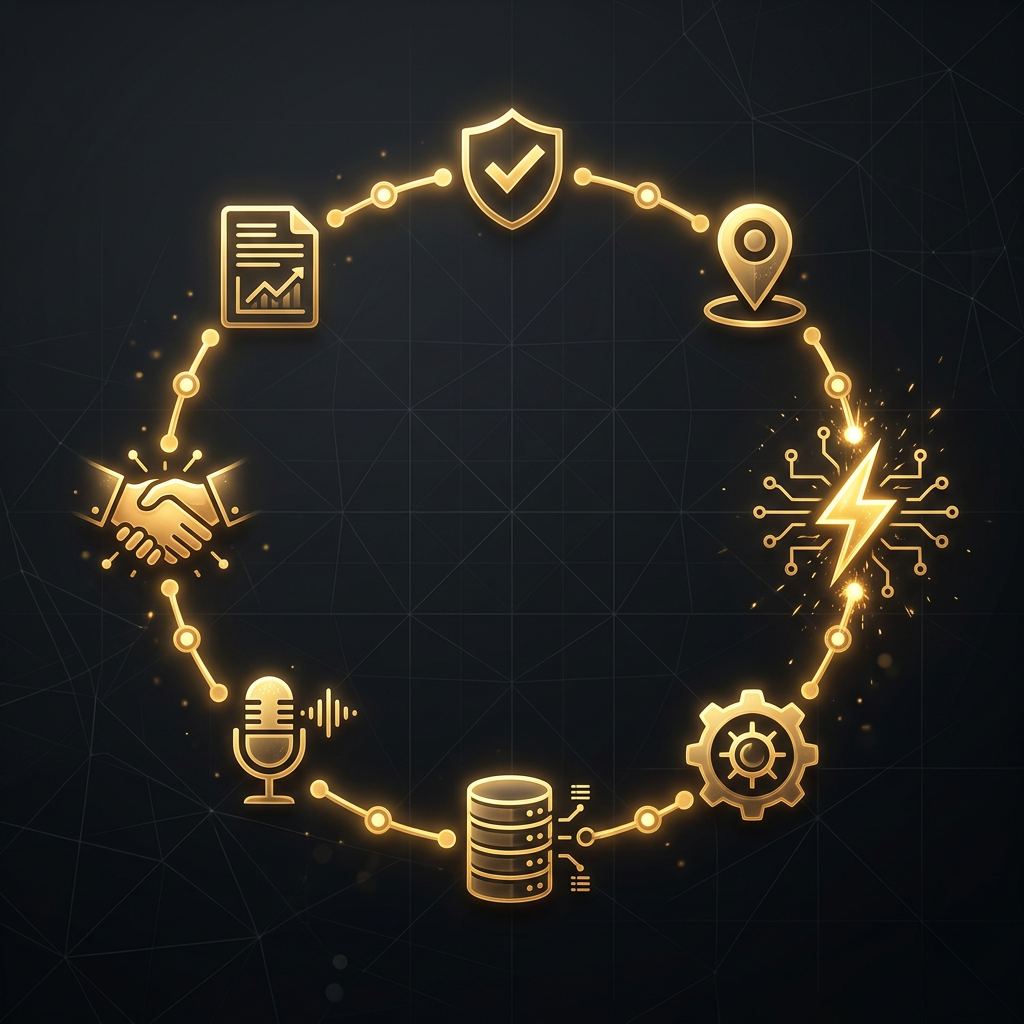
Here is the finding that shaped our rankings: every CRM we compared concentrates on stages 4–6 (Execute, Capture, Sync) and treats 1–3 and 7 as someone else's problem. That is why the comparison table has two categories. CRMs win the middle of the loop. The edges of the loop — where prospects are found, verified, contextualized, and reactivated — are a different job.
The CRM rankings, honestly
SPOTIO is the best pure field-sales CRM. Territory mapping, canvassing modes, and visit verification are genuinely field-first, not a desktop CRM with a mobile skin. If your team knocks doors or works territories, start here. The honest trade-off: pricing is quote-based, and it does nothing before the rep is standing in the territory — Find, Verify, and Contextualize are on you.
Pipeline CRM wins for small teams because it demands the least. Low admin is a real feature in the field: a CRM reps skip is worth exactly zero. But minimal structure means whatever context gets captured lives in free-text notes, and free-text context does not survive rep turnover.
HubSpot is the right call when marketing already lives there — the handoff from campaign to visit is the cleanest of any pairing in this list. It is not, however, a field tool; routing and visit workflows need add-ons.
Salesforce remains the enterprise answer, and with a good admin team it can model anything — including field operations. Without one, it is where outside reps go to spend Friday afternoons on data entry.
SimplyDepo is on the list because for retail route sales — orders, shelf photos, repeat visit cadences — it does a job the generalists genuinely do not.
The category nobody ranks: the intelligence layer
Lead Seeker is not a CRM, and we will not pretend otherwise to win a keyword. What it does is run the stages your CRM skips: it finds real local businesses, verifies they exist and match your profile, builds the pre-visit context a rep actually needs, and then syncs the enriched record into the CRM you already chose from the table above. When the follow-up comes due, the context is in the record — not in the rep's memory.
The design bet behind it is that field reps should approve intelligence, not produce paperwork. As Alex Mannine, Pyra's CTO, put it while building the review workflow:
"You're just going to be in a review seat and approve, confirm."
A rep in a parking lot between stops does not configure 22 filters. They glance, approve, drive. That is the whole interaction model — and it is why the intelligence layer complements rather than competes with every CRM in the table.
The stated limitation, again, because it matters: Lead Seeker has no pipeline stages, no forecasting, no system of record. It makes your CRM's records worth reading; it does not replace them. See the full breakdown on the Lead Seeker product page.
If you want to see what "context, not just records" looks like in practice, the Hunter Newby case study is the clearest example we have published: an AI system whose value came entirely from bounded, contextual knowledge — knowing why an answer mattered, and saying so when it did not have one — rather than from storing more data.
Methodology
Rankings reflect vendor documentation, public pricing pages, and hands-on product evaluation as of August 9, 2026, scored against the seven stages of the Field Revenue Continuity Loop. Weighting favors the stages a tool claims to own: field CRMs are judged hardest on Execute/Capture/Sync; the intelligence-layer category on Find/Verify/Contextualize/Activate. We do not accept payment for placement. Pyra's own product is confined to a category it can honestly win, its limitation is stated in the table, and no CRM ranking was influenced by it. Quote-based prices are labeled as such rather than estimated.
How to choose (60-second version)
- Territory or door-to-door team of 10+: SPOTIO.
- Small team that will abandon anything complicated: Pipeline CRM.
- Marketing already on HubSpot: HubSpot Sales Hub.
- Enterprise with admin support: Salesforce.
- Retail route sales: SimplyDepo.
- Any of the above, but your records are context-free: add an intelligence layer.
Related reading: if lead prioritization is the bottleneck rather than field context, see our guide to AI-powered lead scoring tools.
FAQs
What is the best CRM for outside sales reps?
For most outside sales teams, a field-first CRM like SPOTIO or a simple pipeline CRM like Pipeline CRM beats a general-purpose platform. The right pick depends on team size, route complexity, and how much admin your reps will actually tolerate.
Is Lead Seeker a CRM?
No. Lead Seeker is an AI intelligence layer that finds, verifies, and contextualizes prospects, then syncs that context into the CRM you already use. You still need a CRM as the system of record.
Why do outside sales CRMs fail in the field?
Most fail at context continuity: the CRM stores what happened but not why it matters. Notes typed in a parking lot lose the context that makes the next visit useful, so follow-up quality decays between stops.
Do outside sales reps need route planning in their CRM?
If reps make multi-stop days, yes — route planning and visit logging are table stakes. But routing only optimizes travel time. It does nothing for what reps know when they walk in the door, which is where deals are actually won.
See the loop run on your territory
Cold: read the methodology above. Warm: explore how the intelligence layer works on the Lead Seeker page. Ready: we will build a working prototype on your actual territory data in 48 hours — you bring a target area, we bring the loop.