AI SDR Tool Buyer Guide: Evaluate, Control and Measure
An AI SDR tool buyer guide: ICP inputs, a source-confidence rubric, contact verification, human approval, CRM handoff, monitoring and a hypothetical appointment-cost example.
An AI SDR tool is software that does part of a sales development rep's work, such as researching prospects, drafting first-touch messages and sorting replies, so people can spend their time on conversations with qualified buyers. The tool that fits you is the one whose evidence, permissions and approval steps you can inspect. This guide covers what to give the tool, how to score its sources, how to verify contacts, where a person must approve, how handoff and monitoring work, and how to price a qualified appointment.
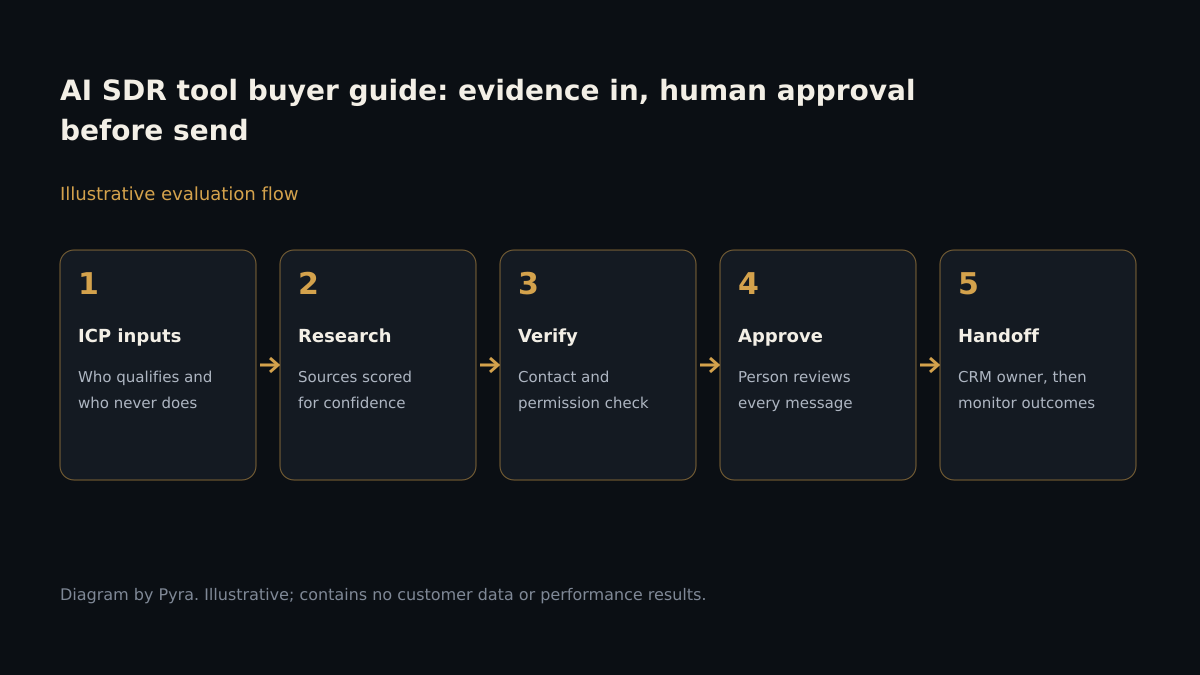
Sales development reps usually research accounts, find contacts, write outreach, follow up, and book meetings for account executives. An AI SDR tool can take on some of those tasks, but vendors differ widely on which ones, on what the tool may do without asking, and on what evidence it keeps. This guide does not rank products. It gives you a way to compare any AI SDR tool on the same terms. For a staged rollout plan, see how to automate SDR workflows with AI; for the build-or-buy question, see AI outbound agency vs in-house SDR team.
What to give an AI SDR tool: ICP inputs
The tool can only be as precise as the ideal customer profile (ICP) you hand it. Write the inputs down before a demo, so the vendor is tested on your definition and not its own.
ICP inputs to prepare before evaluating an AI SDR tool
| Input | What to write | Why it matters |
|---|---|---|
| Qualifying traits | Industry, size band, region, systems used | Defines which accounts the tool may research at all |
| Disqualifiers | Customers, competitors, active deals, restricted regions | Applied before any research or drafting |
| Buying roles | Titles that start, approve or block a purchase | Decides which contacts are searched |
| Trigger events | Public events that suggest a need, with a maximum age | Keeps outreach relevant and stops stale claims |
| Claims policy | What the message may say about you and about the prospect | Limits unsupported statements |
| Qualified appointment | Your written definition of a meeting worth counting | Fixes the success measure before results arrive |
Source-backed research and a confidence rubric for an AI SDR tool
Prospect research is useful only when each fact points to a source and a date. Ask the vendor to show the source for every fact in a sample dossier. The rubric below is an original scoring aid, with assumed values you should tune. It scores each fact, not each account, and sets a rule for whether the fact may appear in a message.
Source-confidence rubric: score each fact from 0 to 3 (assumed values)
| Score | Source type | Example | May the message use it? |
|---|---|---|---|
| 3 | First-party and recent: the company's own page, filing or announcement, within 90 days | A press release about a new facility | Yes, and cite it in the review record |
| 2 | Reliable third party, or first-party older than 90 days | A trade-press article, or an old careers page | Yes, but only after a person confirms it |
| 1 | Aggregated or inferred: a data vendor field, or a guess from job titles | Employee count from a directory | No. Use for ranking only, never as a claim |
| 0 | No source, or source cannot be opened | A summary with no link | No. Discard |
Rule of thumb: a message may state a fact about the prospect only if it scores 2 or 3, and a score of 2 needs a reviewer's confirmation. Lower scores can inform ranking but never reach the text.
If you want an external signal source to feed this step, Percepture's B2B intent data service is one example of a signal provider. Pyra and Percepture are related companies, so treat that mention as a disclosed interest, and score any signal it provides under the same rubric. Pyra's Lead Seeker is described on its page as returning verified contact data and a dossier for each lead; apply the rubric to those dossiers as you would to any other.
Contact verification and permissions in an AI SDR tool
Verification has two parts: whether the contact data is accurate, and whether you may contact the person. A good AI SDR tool handles both before it drafts, and it applies your suppression list, which holds customers, active deals, previous opt-outs and do-not-contact entries.
In the United States, the FTC's CAN-SPAM guide states that the law covers commercial email to businesses as well as consumers. It requires truthful sender and subject information, a valid postal address and a working opt-out. The FTC says opt-out requests must be honored within 10 business days, and the opt-out mechanism must work for at least 30 days after you send the message. The guide also says you cannot hand off that responsibility by hiring another company to send for you. Rules differ in other countries, so check each region you target. This is general information and not legal advice.
Human approval before an AI SDR tool sends anything
The two outreach examples below are illustrative drafts, invented for this guide. They were not written for a real prospect, and no person reviewed them. They show what a reviewer would be asked to check.
Illustrative outreach example A (invented company, not reviewed by a person)
| Part | Draft text |
|---|---|
| Subject | Question about Harbor Lane Supply's new warehouse |
| Body | Hello Dana, I saw Harbor Lane Supply announced a second warehouse on its own news page this month. Teams opening a second site often need quotes routed faster between locations. Would a short call to compare how you handle that be useful? If not, tell me and I will not write again. |
| Facts used | Second warehouse announcement (first-party page, score 3, within 90 days) |
| Reviewer decision | Not decided: this is an unreviewed example |
Illustrative outreach example B (invented company, not reviewed by a person)
| Part | Draft text |
|---|---|
| Subject | Quoting workflow at Kestrel Parts |
| Body | Hello Sam, Kestrel Parts looks like a company that quotes custom orders. Many teams in that position spend time rebuilding quotes by hand. Is that a problem for you right now? You can reply stop at any time. |
| Facts used | Industry guess from a directory field (score 1), not allowed as a claim |
| Reviewer decision | Not decided: a reviewer should remove the claim about quoting custom orders or find a score 2 or 3 source |
Example B shows why the rubric matters: it states something about the prospect that rests on a score of 1.
Human-review checklist for every message an AI SDR tool drafts
| Check | Pass condition |
|---|---|
| Facts | Every fact about the prospect has a source scoring 2 or 3, opened by the reviewer |
| Permission | The contact is not on the suppression list and is in a permitted region |
| Truthfulness | Sender, subject and claims are accurate; the message is identifiable as marketing as the law requires |
| Opt-out | A working opt-out is present and the postal address is included |
| Tone and fit | The offer matches the ICP and the person's role |
| Record | Approver name, time and the sources checked are saved |
CRM handoff and monitoring for an AI SDR tool
Handoff means every approved contact becomes a CRM record with an owner, source, score and status, and every reply goes to a named person. Ask which CRM the tool writes to, and in what mode: write directly, or propose changes for approval. Treat integration claims as unproven until the vendor names your system and shows its documentation. For comparison, Demandbase's own documentation says its integrations need an admin or permission-set access with integration credentials, and that synced data covers only the fields the integration user can see (setup, sync settings). Expect similar access questions from any CRM.
- Monitor each week: bounces, complaints, opt-outs, replies by type, and approvals rejected.
- Pause rule: name who can stop sending, and what rate of complaints or bounces triggers a pause.
- Audit sample: check ten sent messages a week against the review checklist.
Appointment economics of an AI SDR tool: a hypothetical example
Price it by cost per qualified appointment, using your own definition from the ICP step. Every number below is invented to show the arithmetic. They are not benchmarks, and no result is promised.
Hypothetical monthly cost per qualified appointment (invented numbers)
| Line | Hypothetical value | How it is calculated |
|---|---|---|
| Tool subscription | $1,500 | Quoted price |
| Data and sending infrastructure | $500 | Quoted price |
| Reviewer time | $800 | 20 hours × $40 per hour loaded cost |
| Total monthly cost | $2,800 | Sum |
| Meetings booked | 12 | Counted from your CRM |
| Meetings meeting your qualified definition | 5 | Counted by the rule you wrote first |
| Cost per qualified appointment | $560 | 2,800 ÷ 5 |
If only 3 of the 12 meetings qualified, the same cost gives about $933 per qualified appointment. Compare with what a qualified appointment is worth to you, and use the ROI calculator for the labor side.
Questions to ask any AI SDR tool vendor
- Can I see the source and date behind every fact in a sample dossier?
- What does the tool do without approval, and can I require approval for everything?
- How are suppression lists and opt-outs applied, and how fast?
- Which CRM does it connect to, in which mode, and where is that documented?
- What does it log, and can I export it?
- What happens at the end of the contract: do I keep lists, templates and sending history?
Pyra's AI sales agents page describes approval gates, audit trails and role-based access. Ask us the same questions as any other vendor.
Questions readers ask
What does an AI SDR tool do?
It automates parts of sales development work, such as researching prospects, drafting outreach and sorting replies. What it may do without approval, and what evidence it keeps, differs by product, so test both.
Can an AI SDR tool send email without a person approving it?
Some can, but this guide recommends recorded human approval of every message at first. Review the sources, the permission status and the opt-out before anything is sent.
Does CAN-SPAM apply to B2B cold email?
The FTC's guide says the law covers commercial email to businesses. It requires truthful sender and subject information, a valid postal address and a working opt-out honored within 10 business days. This is general information, not legal advice.
How should I measure an AI SDR tool?
Count qualified appointments using a definition you wrote before starting, then divide total monthly cost by that count. Treat meetings that do not meet the definition as misses.
Are the example emails real?
No. Both outreach examples use invented companies and people, and no person reviewed them. They show what a reviewer would check.
Sources
- FTC CAN-SPAM Act compliance guide for business covers B2B email; sender and subject accuracy; postal address; opt-out within 10 business days, available for 30 days; responsibility when others send. Read Nov 23, 2026.
- Demandbase: Set Up a Third-Party Integration admin or permission-set access and integration credentials, used here only as an example of CRM-style access requirements. Read Nov 23, 2026.
- Demandbase: Understanding Integration Data Sync Settings synced data limited to fields exposed to the integration user; frequency is not end-to-end availability; API quotas matter. Read Nov 23, 2026.
- Pyra Lead Seeker verified contact data and dossiers, as described by Pyra. Read Nov 23, 2026.
- Percepture B2B intent data example of a signal provider; related company, disclosed. Read Nov 23, 2026.
- Pyra AI sales agents approval gates, audit trails, role-based access. Read Nov 23, 2026.
About the author
Bob Generale is COO and co-founder of Pyra, with 20+ years of Fortune 500 operations experience. This guide explains source confidence, contact permissions, human approval and hypothetical appointment economics for AI SDR tools. The rubric, outreach examples and economics are invented illustrations, no product was tested for this article, and Pyra sells Lead Seeker and sales agents.
Test any AI SDR tool on your own definition
Write your ICP inputs and qualified-appointment definition first, then ask each vendor to show sources, approvals and handoff on one real account.
See Lead Seeker