AI Outbound Agency vs In-House SDR Team: Build-or-Buy Worksheet
AI outbound agency vs in-house SDR team: compare scope, people, tooling, control, compliance, ramp and exit with a hypothetical cost worksheet.
The AI outbound agency vs in-house SDR team question is a build-or-buy decision about who runs your prospecting and first-touch outreach: an outside firm that uses AI tooling and its own staff, or sales development reps you hire and manage. Neither is better in general. The right choice depends on cost per usable meeting, control over messaging and data, management time and how easily you can leave. This guide gives a hypothetical worksheet to put both options on the same lines.
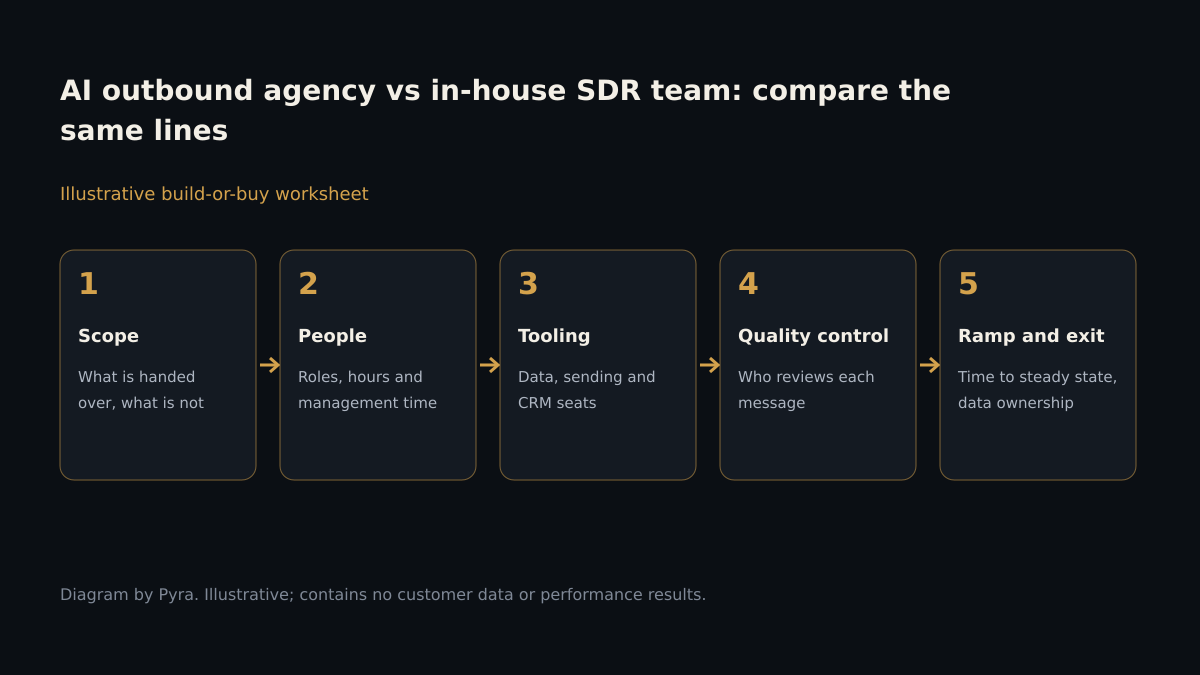
No benchmark in this AI outbound agency vs in-house SDR team guide says what an agency or a team costs or delivers. Every number below is a placeholder for you to replace with quotes and your own history. The purpose is to make the two options comparable, because proposals rarely arrive in the same shape.
AI outbound agency vs in-house SDR team: compare the same seven lines
AI outbound agency vs in-house SDR team comparison lines and what to ask for each
| Line | AI outbound agency: ask | In-house SDR team: ask |
|---|---|---|
| Scope | Exactly which tasks are included: list building, copy, sending, reply handling, booking | Which tasks reps do and which tools automate |
| People | Named roles, hours per week, who manages your account | Headcount, manager time, hiring and backfill time |
| Tooling and data | Which data sources and sending tools, and who owns the accounts and lists | License, data and sending costs you pay directly |
| Message control | Who writes copy, who approves it, how fast you can change it | You control it fully, with the effort that implies |
| Quality and compliance | Opt-out handling, suppression lists, review step before sending | Your policy, training and review process |
| Ramp time | Time to first sent message and to steady state | Hire, train, and tool setup time |
| Exit | Notice period, what you keep: lists, templates, domains, history | Severance, tool contracts, knowledge in people's heads |
AI outbound agency vs in-house SDR team cost worksheet (hypothetical)
Fill in monthly figures for each option over the same period, say six months, so ramp time is included. The example values are invented.
AI outbound agency vs in-house SDR team cost worksheet with invented example values (replace with your quotes)
| Item | AI outbound agency (example) | In-house (example) |
|---|---|---|
| Fees or salaries | $6,000 per month | $9,000 per month for two reps, loaded |
| Tools and data | Included per proposal | $1,500 per month |
| Management time | 4 hours per week x your hourly cost | 8 hours per week x your hourly cost |
| Setup or hiring cost | $2,000 one time | $4,000 one time |
| Months to steady state | 1 | 3 |
| Six-month total (your math) | Calculate | Calculate |
| Meetings that meet your criteria (record actual) | Count | Count |
| Cost per qualified meeting | Total divided by meetings | Total divided by meetings |
Only count meetings that match the criteria you wrote before starting. Counting all meetings rewards volume over fit.
Risks to weigh, not hide
- AI outbound agency: your brand and sender reputation are used by someone else. Ask who owns sending domains and what happens to them at exit.
- In-house: turnover resets knowledge, and a small team has no depth when someone leaves.
- Both: unsolicited commercial email is covered by the FTC's CAN-SPAM rules. The FTC states there is no exception for business-to-business email, and you remain responsible even if you hire another company to send for you.
Pyra's AI sales agents are a third option: software agents with approval gates that your team operates. Whichever path you take, estimate the labor side with the ROI calculator and keep the result labeled as an estimate.
A simple procedure for the AI outbound agency vs in-house SDR team decision
- Write the qualified-meeting criteria and the account list rules before collecting any proposal.
- Ask each agency for the same seven lines in writing and a trial of two to three months with an exit option.
- Price your in-house option with real recruiting and management time.
- Compare cost per qualified meeting, ramp time and exit terms together, not price alone.
- Choose a reversible option first if the numbers are close.
Questions readers ask
AI outbound agency vs in-house SDR team: which is cheaper?
It depends on quotes, ramp time and the meetings that meet your criteria. This guide gives a worksheet, not a benchmark, so compare cost per qualified meeting using your own numbers.
Who should own sending domains and lists?
Prefer that you own them, or have written terms that transfer lists, templates and history to you at exit.
Does CAN-SPAM apply to B2B cold email?
Yes. The FTC states the law makes no exception for business-to-business email, and you remain responsible even if another company sends on your behalf.
Can I try an agency before committing?
Ask for a short trial with written criteria, review of messages before sending, and clear exit terms.
Sources
- FTC CAN-SPAM Act compliance guide for business no B2B exception; you remain responsible when another company sends for you. Read Nov 23, 2026.
- Pyra AI sales agents approval gates, audit trails, role-based access. Read Nov 23, 2026.
About the author
Bob Generale is COO and co-founder of Pyra, with 20+ years of Fortune 500 operations experience. This guide explains how to compare an AI outbound agency and an in-house SDR team on the same lines. The numbers are invented, Pyra sells software agents that compete with both options, and nothing here is legal advice.
Price both options on the same lines
Fill the worksheet with real quotes, then use the ROI calculator to estimate the labor side of an agent-assisted approach.
Open the ROI calculator