AI Lead Qualification Agents for Inbound and Outbound Leads: What Changes by Origin
AI lead qualification agents inbound outbound leads: how to verify and route inbound requests, research outbound accounts first, and keep one owner in a mixed queue.
AI lead qualification agents inbound outbound leads each need a different job: for an inbound lead (a form, chat or demo request) the agent verifies the person, checks fit and exclusions, and routes it to an owner, while for an outbound lead (an account you chose) it must first find dated evidence of fit, because no buyer has asked for anything. In both cases the agent should prepare a record that a person can audit, and it should not assume that every inbound lead has purchase intent. This guide gives you a matrix, a mixed-queue rule, a worked example and a checklist.
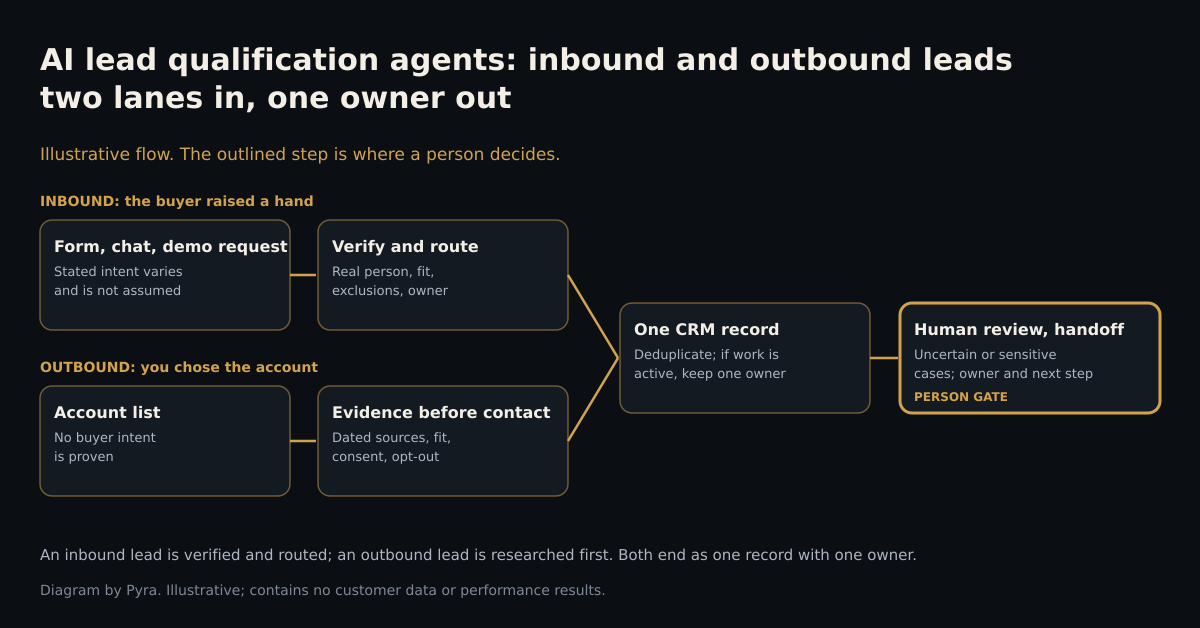
Teams often point one qualification agent at every lead and then wonder why it either insults a buyer who asked for a demo or contacts an account that never expressed interest. The origin of a lead changes what the agent has to prove. For the evidence method behind outbound research, read AI research agents for B2B lead qualification. For scoring weights, see ideal buyer fit scoring, and for the salesperson's day after handoff, see the AI powered sales assistant guide. This page covers only what differs by origin.
Disclosure: Pyra makes Lead Seeker, a prospecting product mentioned below as a disclosed interest. We tested none of the vendor products cited here, and this page does not rank any.
How AI lead qualification agents treat inbound and outbound leads differently
An inbound lead is a person who acted: they filled in a form, opened a chat or requested a demo. That is a signal, but it is not a standard strength. A demo request is stronger than a content download, and a form fill can come from a student, a competitor or a bot. The agent's job is to verify, classify and route fast, and to record how strong the stated intent actually is.
An outbound lead is an account or contact your team or a list chose. Nothing the buyer did proves interest, so any claim that the account "needs" your product must come from a cited, dated source. The agent's job is to research first and to hold contact until the evidence, the exclusions and the permission rules pass.
Matrix: AI lead qualification agents, inbound outbound leads side by side
Qualification matrix by lead origin (original template; thresholds are examples to replace with your own)
| Dimension | Inbound lead | Outbound lead |
|---|---|---|
| Starting evidence | The buyer's own action and the text they typed | Nothing from the buyer; only sources the agent can cite |
| Response priority | Fast, with a response-time target you set per intent level | Scheduled after review; speed matters less than accuracy |
| Evidence standard | Verify identity, company and role; record the stated request in the buyer's words | Dated source for each fact; this guide's example rule is 90 days for need signals |
| Exclusions | Customers, active deals, competitors, restricted regions, suppression entries; checked before routing | Same list, checked before research and again before any message |
| Unknowns | Missing company or role: ask or research, but do not reject a person who raised a hand | Missing fact is unknown, never a fail; research or park the account |
| Human review | Spam, competitor, ambiguous request, sensitive content in free text | Any inferred claim, conflicting sources, or anything about an individual |
| Consent and opt-out | Check what the form told the person and what they agreed to; honor opt-outs and suppression | Check the permission basis for the channel and region before contact; every message carries a working opt-out |
| Handoff | Owner, request text, verified fit and a response deadline | Owner, dossier link, rule results, reviewer and recommended first step |
| Measurement | Time to first response, accepted rate, and meetings by intent level | Share of accounts passing review, replies and meetings; cost per qualified account |
Consent and opt-out rules differ by country, state and channel. This matrix does not give legal advice, so have your counsel confirm the rules that apply to you.
Qualifying inbound leads without assuming intent
Treat the buyer's words as evidence and the form as context. A request titled "pricing for 200 seats" carries more information than an email entered to download a template. Have the agent record three things in the dossier: what the person asked for, what the page or form promised them, and what the agent verified independently. Only the third can disqualify, and only against a written exclusion.
- Verify: is this a real person at a real company, and does the role fit your ICP?
- Classify intent: map the request to your own levels, such as demo request, pricing question, resource download, support question. The levels are yours; do not copy a vendor's.
- Route: to the owner for that account or segment, with a response deadline.
- Park, do not delete: low-intent or unclear submissions go to a nurture or review queue, not to a rejection.
Qualifying outbound leads from evidence
Because an outbound list proves no intent, the agent works as a researcher. It should cite a source and a date for each fact, separate unknown from disqualified, and hold contact until a person approves anything uncertain. The full method, including the freshness rule and the scoring of evidence, is in the dossier guide and is not repeated here. Messages must not rely on sensitive inferences about an individual, and no message should claim a need the sources do not show.
Mixed queues for AI lead qualification agents: inbound, outbound leads, one owner
The hardest case is an inbound submission from a person already being worked outbound. Two owners, two agents and two messages create the double contact that buyers notice. Use one rule: the CRM record is the single source of truth, and an existing active record takes precedence over a new one.
- Match first: before routing, search for the person, company and domain across contacts, companies and open deals.
- Merge or link: if the match is clear, attach the new submission to the existing record. If it is partial, a person reviews it before any merge.
- Name the owner: if outbound work is active, that owner receives the inbound request with its text and deadline, and the outbound sequence pauses until they decide.
- Respect the buyer's action: the person asked, so reply to the request. Do not send the next scheduled outbound message.
- Log the decision: record who owned the record, why and when.
Most CRMs include tools for this, but they differ in what they match on. HubSpot's documentation says its duplicates manager compares contact properties such as name, email address, phone number and company name, and company properties such as domain name, and lets you merge or reject pairs (HubSpot duplicates). Matching rules like these need testing against your own data, because a shared company name does not prove two people are the same.
What vendor documentation says about AI lead qualification agents, inbound outbound leads
Microsoft's Learn documentation describes the Sales Qualification Agent in Dynamics 365 Sales as working on leads assigned to it by selection criteria, evaluating fit against a target customer profile, and handing leads to sellers. It also describes a mode that sends outreach and follow-ups, and says the agent notifies supervisors about disqualified leads and does not replace the seller's judgment (overview). HubSpot's page on its prospecting agent says enrollment can be automated by events such as a form submission or a page view, or done manually (prospecting agent). HubSpot's forms documentation says forms collect information to create or update CRM records and trigger follow-up actions, and it describes data privacy and consent elements you can add to a form (forms).
Read together, they show two questions to put to any vendor. What event starts the agent: an assignment, a form submission, a list? And what stops it from sending something to a person who already has an owner or has opted out? These are vendor descriptions read on November 23, 2026. We did not test any product, and we make no claims about how they perform.
Hypothetical worked example: AI lead qualification agents, inbound outbound leads in one week
Every input below is assumed and invented to show the arithmetic. It is not a benchmark, a customer result or a prediction. Replace each number with your own.
Hypothetical weekly queue for AI lead qualification agents handling inbound and outbound leads (invented inputs)
| Group | Leads | Assumed handling | Assumed review minutes each | Minutes |
|---|---|---|---|---|
| Inbound, demo or pricing request | 10 | Verify, route; human reads the request | 6 | 60 |
| Inbound, resource download | 14 | Verify, classify, nurture; human samples 4 | 3 | 12 |
| Inbound, spam or competitor | 6 | Agent flags; human confirms | 1 | 6 |
| Outbound accounts with evidence passing review | 12 | Dossier checked, then handed off | 5 | 60 |
| Outbound accounts with unknowns | 13 | Research task, no contact | 4 | 52 |
| Inbound matching an active outbound record | 5 | Merge, pause sequence, route to existing owner | 8 | 40 |
| Total | 60 | 230 |
230 minutes is 3.83 hours. At an assumed $50 loaded hourly cost that is about $192 of review time. Add an assumed $400 weekly tool cost and the total is about $592. The queue produced 10 + 12 + 5 = 27 handoffs under these assumptions, so the cost is about $22 per handoff. Compare the inbound and outbound lanes separately: 10 demo-type requests cost $50 of review and 12 outbound handoffs cost $50, but the outbound lane also carries the 13 unknowns that have not yet become leads.
Buyer checklist for AI lead qualification agents, inbound outbound leads
- Can the agent tell which lane a lead came from and apply different rules to each?
- Does it record the buyer's own words for inbound leads and a dated source for every outbound fact?
- Does it avoid assuming that an inbound lead has purchase intent?
- Are exclusions and suppression entries checked before routing and before any message?
- Does it search for existing records and active deals before creating or contacting anyone?
- Can an active owner pause the agent's outbound sequence when an inbound request arrives?
- Does every message carry an honest sender and a working opt-out, and does your counsel confirm the consent rules?
- Does it keep sensitive inferences about individuals out of qualification and messages?
- Does it report response time and results separately for each lane?
Limits of this guide
- The matrix, thresholds and worked example are our own illustration, not an industry standard or a benchmark.
- We read vendor documentation and did not test products, so we cannot say how well any of the AI lead qualification agents, inbound outbound leads included, follow these rules.
- We had no access to search ranking, People Also Ask or Search Console data for this topic, so we make no claim about how the page performs.
- Consent law varies, and this page is not legal advice.
Questions readers ask
How should AI lead qualification agents treat inbound and outbound leads differently?
For inbound leads, the agent verifies the person, checks fit and exclusions, records the stated request and routes it fast. For outbound leads, it must first find dated, cited evidence of fit, because nothing the buyer did shows interest.
Does every inbound lead have purchase intent?
No. A demo request signals more than a content download, and some submissions come from students, competitors or bots. Record the stated intent in your own levels and let a person review ambiguous cases.
What should happen when an inbound lead is already being worked outbound?
Match it to the existing record, let the active owner receive the request, pause the outbound sequence and reply to what the person asked. Log who owns the record and why.
Should an agent disqualify an inbound lead for a missing fact?
No. A missing fact is unknown. Only a sourced fact that breaks a written exclusion disqualifies, and a person who asked for contact should be parked for review rather than silently dropped.
How do consent and opt-out differ between inbound and outbound?
Inbound leads share a form and what it told them, while outbound contact needs a permission basis for the channel and region. Both need a working opt-out, and the rules vary, so confirm them with counsel.
Is the worked example real?
No. The 60 leads, review times and costs are invented to show the arithmetic. They are not benchmarks or customer results.
Sources
- Microsoft Learn: Sales Qualification Agent overview assigned leads, fit against a target customer profile, handoff, outreach mode, supervisor notice of disqualified leads. Read Nov 23, 2026.
- HubSpot Knowledge Base: Prospecting agent enrollment automated by events such as form submission or page view, or manual. Read Nov 23, 2026.
- HubSpot Knowledge Base: Create and customize forms forms create or update CRM records and trigger follow-up; data privacy and consent elements. Read Nov 23, 2026.
- HubSpot Knowledge Base: Review and manage duplicate records default matching properties for contacts and companies; merge or reject pairs. Read Nov 23, 2026.
- Pyra Lead Seeker prospecting product made by Pyra; a disclosed interest. Read Nov 23, 2026.
About the author
Bob Generale is COO and co-founder of Pyra, with 20+ years of Fortune 500 operations experience. This guide explains how AI lead qualification agents should handle inbound and outbound leads differently, including mixed queues. The matrix, thresholds and worked example are invented illustrations, no vendor product was tested for this article, and Pyra sells Lead Seeker.
Review your own lead queue
Take one week of inbound submissions and one outbound list, and mark each against the matrix. Pyra will walk through the workflow review with you.
Talk with Pyra