AI Powered Sales Assistant: Test the Daily Handoff Before You Buy
An AI powered sales assistant buyer guide built on the daily handoff: evidence, verified contact, meeting prep, human approval, CRM updates and qualified appointments.
An AI powered sales assistant is software that prepares a salesperson's day by researching accounts, checking contacts, briefing meetings, drafting outreach and proposing CRM updates, while the person stays responsible for what is sent and what is recorded. Choose one by testing its daily handoff, not its feature list: the evidence it starts from, what it proposes, where a person approves and how accurately the result reaches your CRM. This guide gives you a matrix, a checklist and a hypothetical cost example to run that test.
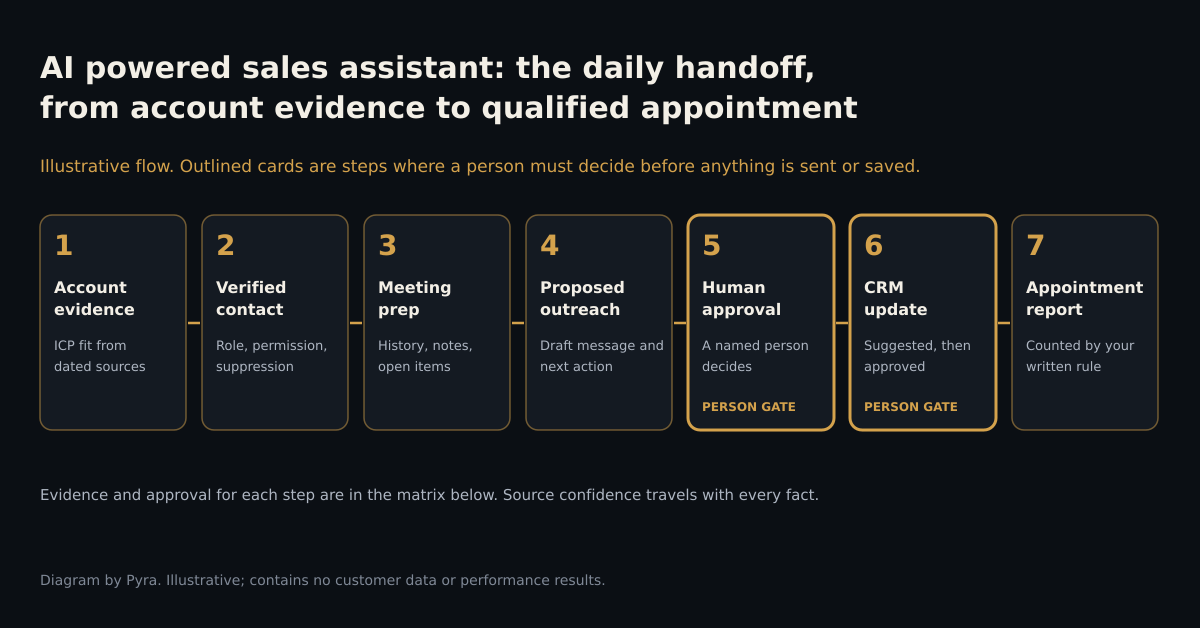
An AI powered sales assistant is not the same purchase as an AI SDR tool. An SDR tool mostly works before the first meeting, while the assistant described here follows the salesperson through preparation, outreach and record keeping. For the SDR purchase see the AI SDR tool buyer guide, and for a staged rollout see how to automate SDR workflows with AI.
Disclosure: Pyra sells Lead Seeker and AI sales agents, which are mentioned below as disclosed interests. This page compares ways to evaluate products and does not rank any.
The handoff an AI powered sales assistant has to get right
A demo shows a clever answer. What matters is the chain behind it: account evidence, a verified contact, meeting preparation, proposed outreach, human approval, an accurate CRM update and a report of qualified appointments. If one link is weak, the salesperson inherits the repair, and the hero diagram above marks the two steps where a person must decide.
Evidence and approval matrix for an AI powered sales assistant
Evidence and approval matrix for an AI powered sales assistant (original template)
| Step | What the assistant may produce | Evidence to require | Who approves | Failure to test |
|---|---|---|---|---|
| 1. Account evidence | ICP fit summary | Source and date for each fact; score from your rubric | Salesperson confirms facts used in messages | A confident claim with no source |
| 2. Verified contact | Contact and role | Verification method; permission and suppression check | Salesperson, before drafting | An opted-out or customer contact slips through |
| 3. Meeting preparation | Brief with history, open items, questions | Links to the CRM records and messages it used | Salesperson reads before the meeting | A summary of data the user cannot actually see |
| 4. Proposed outreach | Draft message and next action | Every statement traced to a step 1 fact | Salesperson edits and approves | A statement about the prospect with no source |
| 5. Human approval | Nothing sent yet | Approver name and time stored | A named person | Sending without a recorded approval |
| 6. CRM update | Suggested field and note changes | Before-and-after values and source context | Record owner, until error rates are known | A wrong stage or date saved silently |
| 7. Appointment report | Counts by your definition | Written definition of a qualified appointment | Sales manager samples the count | Meetings counted that do not meet the rule |
Source-confidence rule used in step 1: score 3 is a first-party source under 90 days old, 2 is a reliable third party or older first-party page, 1 is inferred, 0 is unsourced. Only scores 2 and 3 may appear in a message, and 2 needs the salesperson's confirmation.
What public documentation says about assistants inside a CRM suite
Two large vendors document assistants in this area, and each page shows what to ask any AI powered sales assistant. Microsoft's Learn pages describe a Sales agent in Microsoft 365 Copilot that answers questions from CRM data and, with the right license, recent Outlook emails, Teams meetings and messages. Microsoft states that it surfaces only information the user has permission to access (use the Sales agent). Setup requires the agent to be installed, connected to a CRM (Dynamics 365 Sales or Salesforce) and supported by assigned privileges (set up the Sales agent). Its overview lists meeting preparation and help adding contacts and updating CRM records in Outlook (functional overview).
Salesforce's Help documentation says its Sales agent can keep opportunity and account fields updated from sources such as notes, call transcripts and emails, and that you can apply updates autonomously or require a sales rep to approve them (Agentforce Sales Management). Its product page describes suggestive and autonomous modes and says source context is shown for each (Salesforce AI sales agent). These are vendor descriptions read on November 23, 2026, not tests, and we have not tested either product for this guide.
The questions they raise apply to every AI powered sales assistant: which data can it read, whose permissions apply, and are updates proposed or applied automatically?
Prospect sourcing is a separate job from AI search visibility
Prospect sourcing answers who you should contact. Pyra's Lead Seeker is a prospecting product whose page describes verified contact data and a dossier for each lead, and Pyra makes it, so check its sources on your own accounts like any other. Whether AI answer engines mention your brand is a different measurement, which Pyra's sister product Prime AI Visibility addresses. Do not let one demo blur the two.
Two illustrative outreach drafts for human review
Both drafts below are invented for this guide. The companies and people are fictional, no person reviewed the drafts, and they are not client examples, field tests or proven messages.
Illustrative draft A (invented company, not reviewed by a person)
| Part | Draft text |
|---|---|
| Subject | Alder Creek Foods: question before your Tuesday call |
| Body | Hello Priya, ahead of our call on Tuesday I read Alder Creek Foods' own announcement about a second packing line. Teams adding a line often ask how quotes are routed between sites. Could we spend ten minutes on that? Reply stop and I will not write again. |
| Statements to check | Second packing line announced on the company's own site (score 3, within 90 days); the call exists in the CRM |
| Status | Unreviewed example |
Illustrative draft B (invented company, not reviewed by a person)
| Part | Draft text |
|---|---|
| Subject | Birchfield Components follow-up |
| Body | Hello Marcus, Birchfield Components probably struggles with slow quote turnaround. We help teams like yours fix that. Can I send times for a call? Reply stop to opt out. |
| Statements to check | "Probably struggles" has no source (score 0) and must be removed; "teams like yours" implies customers that may not exist |
| Status | Unreviewed example: a reviewer should reject or rewrite it |
Draft B shows what the approval step is for. Before approving any draft, confirm that each statement has a source, the contact is permitted, and the message carries an honest sender, subject, postal address and opt-out as email law requires.
Decision checklist before you buy an AI powered sales assistant
- Can it show the source and date behind every fact it uses?
- Does it respect each user's CRM permissions, and can an admin limit what it reads?
- Does a person approve every outbound message, with the approver recorded?
- Are CRM updates suggested first, with before-and-after values, and can you choose automatic updates field by field later?
- Can you export what it drafted, what was approved and what was changed in the CRM?
- Does it count appointments by a definition you wrote, not its own?
- Is the connection to your CRM documented by the vendor for your system?
Appointment economics of an AI powered sales assistant: an editable example
Price the assistant by cost per qualified appointment. Every value below is assumed and invented to show the arithmetic. Replace each with your own numbers. Nothing here is a benchmark or a promised result.
Hypothetical monthly appointment economics (invented inputs)
| Line | Assumed value | Formula |
|---|---|---|
| Assistant subscription | $1,200 | Your quote |
| Setup and integration, spread monthly | $300 | Quote ÷ months of use |
| Approval and review time | $800 | 16 hours × $50 loaded hourly cost |
| Total monthly cost | $2,300 | 1,200 + 300 + 800 |
| Qualified appointments | 6 | Counted by your written definition |
| Cost per qualified appointment | $383 | 2,300 ÷ 6, rounded |
Sensitivity with the same cost: 4 qualified appointments gives $575 each, and 9 gives about $256 each. Compare the result with what a qualified appointment is worth to you, and see the AI sales agent ROI calculator guide for the labor side.
Monitoring an AI powered sales assistant after purchase
- Each week: sample ten approved messages and ten CRM updates against the matrix.
- Track: how often drafts are edited or rejected, CRM corrections, opt-outs and meetings that fail your definition.
- Pause: name who can switch off sending or automatic updates, and what triggers it.
Questions readers ask
What is an AI powered sales assistant?
It is software that helps a salesperson prepare accounts, verify contacts, brief meetings, draft outreach and propose CRM updates, with the person approving what is sent and recorded. Products differ on which of those steps they cover.
How is an AI powered sales assistant different from an AI SDR tool?
An AI SDR tool mostly handles research and first-touch outreach before a meeting. The assistant in this guide supports the salesperson across preparation, outreach, CRM records and appointment reporting. Some products cover both.
Should an AI powered sales assistant update the CRM on its own?
Start with suggested updates that a record owner approves. Salesforce's documentation describes both autonomous and approval-based modes, so check which your product offers and test accuracy before allowing automatic updates.
How do I measure an AI powered sales assistant?
Count qualified appointments using a definition you wrote first, divide total monthly cost by that count, and track edits, CRM corrections and opt-outs alongside it.
Are the sample emails real?
No. Both drafts use invented companies and people, no person reviewed them, and they are not client examples or proven messages.
Sources
- Microsoft Learn: Use Sales agent in Microsoft 365 Copilot CRM and Microsoft 365 data questions; meeting preparation and follow-up; surfaces only information the user can access. Read Nov 23, 2026.
- Microsoft Learn: Set up Sales agent in Microsoft 365 Copilot install, CRM connection (Dynamics 365 Sales or Salesforce) and privilege prerequisites. Read Nov 23, 2026.
- Microsoft Learn: Functional overview of Sales agent meeting preparation, adding contacts and updating CRM records in Outlook. Read Nov 23, 2026.
- Salesforce Help: Agentforce Sales Management field updates from notes, transcripts and emails; autonomous or rep-approved. Read Nov 23, 2026.
- Salesforce: AI sales agent suggestive and autonomous modes with source context. Read Nov 23, 2026.
- Pyra Lead Seeker verified contact data and dossiers, as described by Pyra. Read Nov 23, 2026.
- Prime AI Visibility AI answer-engine visibility tracking, a separate measurement from prospect sourcing. Read Nov 23, 2026.
About the author
Bob Generale is COO and co-founder of Pyra, with 20+ years of Fortune 500 operations experience. This guide explains how to test an AI powered sales assistant by its daily handoff, from account evidence to CRM updates and qualified-appointment reporting. The outreach drafts and economics are invented illustrations, no product was tested for this article, and Pyra sells Lead Seeker and AI sales agents.
Test one day of the handoff
Pick one real account and ask each vendor to take it through the seven steps, showing sources, approvals and the CRM before-and-after.
See Lead Seeker