B2B Sales Research AI Agent: Ideal Buyer Fit Scoring Rubric
A B2B sales research AI agent should score ideal buyer fit with a transparent rubric: sources, freshness, confidence, weights, exclusions and a human override.
Ideal buyer fit scoring ranks accounts by how closely they match the customers you serve best, using evidence a person can inspect. A B2B sales research AI agent can gather that evidence and apply a rubric, but the rubric must be yours: each criterion needs a source, a date, a confidence level and a weight, exclusions apply before any score, and a salesperson can override the result and say why. This guide gives a rubric and two clearly synthetic dossiers.
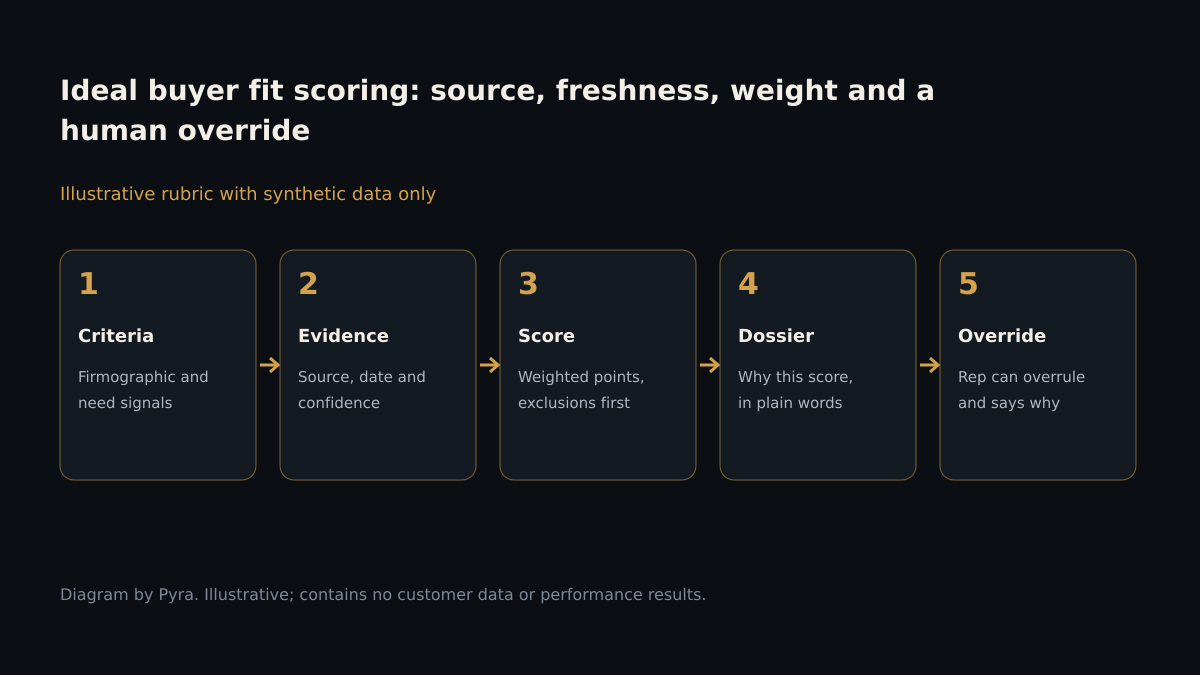
Ideal buyer fit scoring is only useful if a rep can ask "why this number?" and get an answer. Many scoring approaches fail that test because they combine hidden signals into one opaque figure. The rubric below keeps every input visible. For prospect research that produces dossiers from live sources, Pyra's Lead Seeker is described on its page as an agent that searches live on each pull and returns contact data and a dossier per lead; use any research tool with the same discipline of showing sources.
Apply exclusions before ideal buyer fit scoring
Exclusions are yes-or-no rules that remove an account from outreach, whatever its score. Typical examples are existing customers, accounts in an active deal, anyone on a do-not-contact list, competitors, and regions you cannot serve or contact lawfully. Run exclusions first so a high score never overrides a permission problem.
The rubric for B2B sales research AI agent ideal buyer fit scoring
Weights below are assumptions. Set yours from a review of your best and worst past customers, and write the reason for each weight.
Ideal buyer fit scoring rubric (assumed weights; sum to 100)
| Criterion | Weight | Example evidence | Source type to record |
|---|---|---|---|
| Industry fit | 20 | Operates in a segment you serve well | Company website, filings |
| Size fit | 15 | Employee or revenue band you handle | Directory or filing |
| Systems fit | 15 | Uses systems you integrate with | Job posts, vendor pages |
| Need signal | 25 | Public event that suggests a problem you solve | Press release, news, filing |
| Buying role present | 15 | A person in a relevant role is identifiable | Public profile or company page |
| Serviceable region | 10 | Located where you can sell and support | Company website |
Each criterion first gets a raw fit between 0 and 1. It is then multiplied by an evidence multiplier made of two parts, so weak or old evidence cannot produce a strong score.
Evidence multiplier = confidence x freshness
| Factor | Setting | Multiplier |
|---|---|---|
| Confidence | High: direct first-party statement | 1.0 |
| Confidence | Medium: indirect or third-party | 0.7 |
| Confidence | Low: inferred | 0.4 |
| Freshness | 90 days old or less | 1.0 |
| Freshness | 91 to 180 days | 0.7 |
| Freshness | Older than 180 days | 0.4 |
Criterion points = weight x raw fit x confidence x freshness. Total score = sum of criterion points. Suggested bands, also assumptions: 70 or more goes to human review for outreach; 50 to 69 needs more research; below 50 is held.
Synthetic dossiers for ideal buyer fit scoring
Both accounts are invented for illustration. No real company or person is described.
Synthetic dossier 1: Northwind Fasteners (invented). Score 74, goes to human review
| Criterion | Raw fit | Source and age | Confidence x freshness | Points |
|---|---|---|---|---|
| Industry fit (20) | 1.0 | Company site, 30 days | 1.0 x 1.0 | 20.0 |
| Size fit (15) | 0.8 | Directory, 200 days | 0.7 x 0.4 | 3.4 |
| Systems fit (15) | 0.5 | Job post, 60 days | 0.7 x 1.0 | 5.3 |
| Need signal (25) | 1.0 | Press release, 20 days | 1.0 x 1.0 | 25.0 |
| Buying role (15) | 1.0 | Public bio page, 45 days | 0.7 x 1.0 | 10.5 |
| Region (10) | 1.0 | Company site, 30 days | 1.0 x 1.0 | 10.0 |
Total 74.1, shown as 74. The weak points are an old size source and partial systems evidence, so a rep would refresh those before outreach.
Synthetic dossier 2: Contoso Logistics (invented). Score 43, held
| Criterion | Raw fit | Source and age | Confidence x freshness | Points |
|---|---|---|---|---|
| Industry fit (20) | 0.5 | Company site, 30 days | 1.0 x 1.0 | 10.0 |
| Size fit (15) | 1.0 | Filing, 30 days | 1.0 x 1.0 | 15.0 |
| Systems fit (15) | 0.0 | No evidence found | n/a | 0.0 |
| Need signal (25) | 0.4 | News inference, 150 days | 0.4 x 0.7 | 2.8 |
| Buying role (15) | 0.5 | Public page, 20 days | 0.7 x 1.0 | 5.3 |
| Region (10) | 1.0 | Company site, 30 days | 1.0 x 1.0 | 10.0 |
Total 43.1, shown as 43. A rep who knows the account personally may override with a written reason.
Human override in ideal buyer fit scoring
Let the rep move any account up or down, and require a short reason that is saved with the dossier. Review overrides monthly: if reps keep raising a certain kind of account, the rubric is missing something. Avoid publishing or storing private contact data you are not entitled to hold, and keep dossiers to information from sources you may lawfully use.
Checks before trusting ideal buyer fit scoring
- Back-test the rubric on twenty past customers and twenty lost or poor-fit accounts and see whether it separates them.
- Re-run on the same account after thirty days to confirm freshness rules change the score as intended.
- Sample ten high-scoring dossiers and verify the cited sources say what the agent claims.
Questions readers ask
What is ideal buyer fit scoring?
It is a ranking of accounts by how closely they match your best customers, built from inspectable criteria, weights and evidence rather than a hidden model.
Why apply exclusions before ideal buyer fit scoring?
Exclusions such as existing customers, do-not-contact entries and unserviceable regions are permission or fit problems that a high score should never override.
Are the weights in this guide correct for my company?
No. They are assumptions for illustration. Set your own weights from a review of your best and worst past customers.
Are the example prospects real?
No. Both dossiers are synthetic and show how the arithmetic works.
Sources
- Pyra Lead Seeker describes a live-search agent returning contact data and a dossier per lead. Read Nov 23, 2026.
About the author
Bob Generale is COO and co-founder of Pyra, with 20+ years of Fortune 500 operations experience. This guide explains how to build an ideal buyer fit rubric whose score a rep can inspect and override. The rubric and dossiers are invented examples, not a validated model.
Back-test the rubric on your own accounts
Score twenty known good and twenty known poor accounts with this rubric, adjust the weights, then decide how much research to automate.
See Lead Seeker