AI Research Agents for B2B Lead Qualification: A Source-Backed Workflow
AI research agents for B2B lead qualification, tested by their evidence: cited dossiers, unknown versus disqualified, freshness limits, human review and CRM handoff.
Using AI research agents for B2B lead qualification only pays off when every conclusion carries a source that a seller can open. AI research agents for B2B lead qualification are software agents that gather public and CRM evidence about an account, compare it with your written ideal customer profile (ICP), and return a cited dossier with a recommendation, while a person decides on anything uncertain or sensitive. This guide shows how to test the evidence, the sorting rules and the handoff before you rely on one.
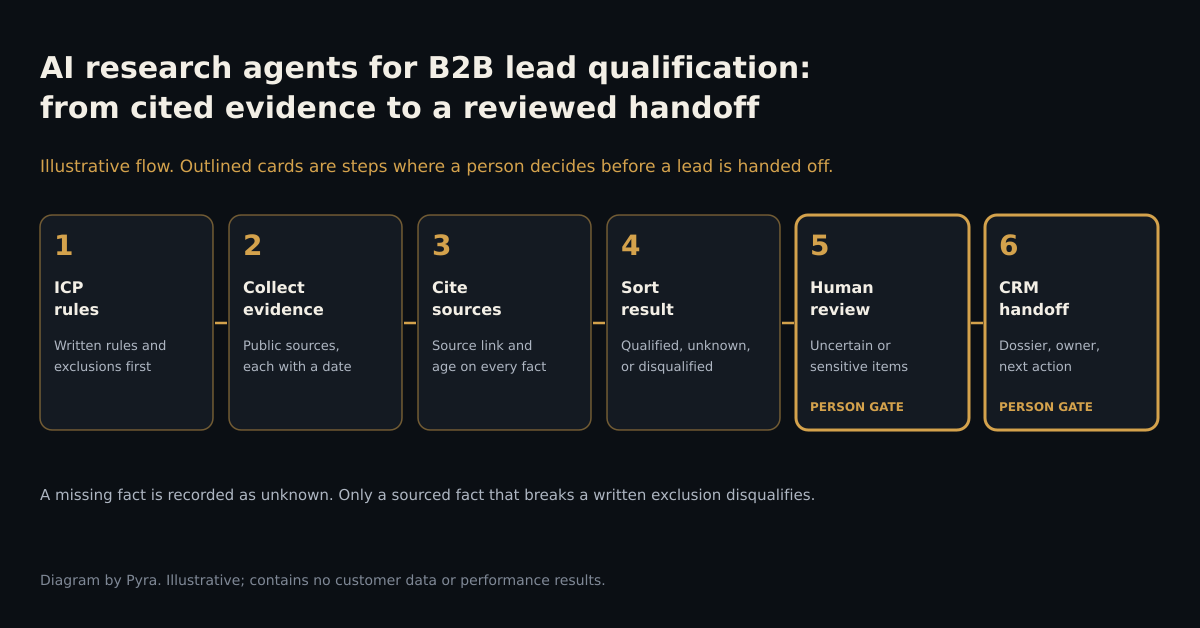
Most buyers meet this category as a demo that produces a confident summary. The harder question is what happens when the agent cannot find a fact, finds an old one, or reaches a conclusion about a person. This page is a workflow for that question and does not rank products. For choosing among tools that carry a salesperson through a whole day, see the AI powered sales assistant guide, and for scoring weights see ideal buyer fit scoring.
Disclosure: Pyra makes Lead Seeker, a prospecting product mentioned below as a disclosed interest. We have not tested the other vendors named in this guide.
What a source-backed dossier contains in AI research agents for B2B lead qualification
A dossier is the record the agent hands a seller. It should list each fact as a claim, a source link, the date the source was published or last confirmed, and the date the agent read it. It should also state which ICP rules the account passed, failed or could not be checked. A paragraph of fluent prose with no links is a summary, not a dossier, and a seller cannot audit it.
Evidence and qualification matrix
Evidence and qualification matrix for AI research agents for B2B lead qualification (original template; ages and thresholds are assumed)
| Dossier item | What the agent records | Evidence rule | Missing or failed result | Person reviews when |
|---|---|---|---|---|
| Company fit | Industry, size band, region, systems used | First-party or filing source, read within 180 days | Unknown if no source. Never counted as a fail | Sources disagree |
| Exclusions | Existing customer, active deal, competitor, restricted region, do-not-contact entry | Checked against your CRM and suppression list first | A sourced match is a disqualifier, with the match shown | Match is partial, such as a similar company name |
| Need signal | A public event that suggests the problem you solve | Dated first-party or reliable third-party source, under 90 days | No signal means unknown, not a low score | The event is inferred, not stated |
| Buying role | A named person in a relevant role | Company page or public profile, with the date seen | Role not found means unknown, and a research task | Title is ambiguous or recently changed |
| Contact and permission | Verification method; suppression and region check | Verified before drafting anything | Unverified contact is held, not discarded | Any opt-out or legal question |
| Sensitive inference | Anything about an individual's traits, health, finances or job security | Not used in qualification or messages | Flag and drop the inference | Always a person, before anything is saved |
Rule used throughout: score each fact 3 (first-party and recent), 2 (reliable third party, or first-party older than 90 days), 1 (inferred) or 0 (unsourced). Only scores 2 and 3 can support a qualification, and a 2 needs a seller's confirmation.
Missing facts versus disqualifiers in AI research agents for B2B lead qualification
The most common error in agent output is treating silence as a no. A disqualifier is a sourced fact that breaks a written exclusion: the company is already a customer, sits in a region you cannot serve, or appears on your do-not-contact list. A missing fact is the absence of evidence. It should be recorded as unknown, shown to the seller, and either researched further or accepted as a risk. If you let unknowns lower a score silently, good accounts in thinly documented markets disappear from your pipeline with no trace.
- Disqualified: a source is cited and the rule it breaks is named.
- Unknown: no usable source was found. The dossier says what was searched.
- Stale: a source exists but is older than your limit for that type of evidence. Treat it as unknown until refreshed.
- Qualified for review: enough current evidence passes the rules, and a seller still owns the decision.
Evidence freshness in AI research agents for B2B lead qualification
Freshness belongs in the rules, because accounts change quickly. A funding announcement can be accurate and still too old to justify an opening line a year later. Set a maximum age per evidence type, show the age next to every fact, and require a refresh before outreach when the age passes the limit. Ask a vendor whether its research runs when you request it or draws on stored records, and what date the agent attaches to each field.
What public vendor documentation says about AI research agents for B2B lead qualification
Two large CRM vendors document agents in this area, and each shows questions to ask any product. Microsoft's Learn documentation describes the Sales Qualification Agent in Dynamics 365 Sales as an AI agent that automates lead qualification and does not replace the seller's judgment. It has a research-only mode, in which the agent researches leads, evaluates fit against a target customer profile and drafts an outreach email, and a research-and-engage mode, in which it also sends emails and hands promising leads to sellers (overview). Its concepts page says fit is categorized as high, moderate or low by the share of target customer profile attributes a lead matches, with stated cut-offs at more than 70% and under 50% (concepts).
HubSpot's Knowledge Base describes a prospecting agent that identifies good-fit companies from real-world triggers, sources contacts and drafts outreach for plays you define. Its page lists the engagement history it considers (up to the past year) and says it uses HubSpot Credits (prospecting agent). These are vendor descriptions read on November 23, 2026. We did not test either product, and we make no claim about how well they perform.
Both pages raise the questions in the checklist below: what the agent can read, what it writes, and where a person steps in.
Where a person must review AI research agents for B2B lead qualification output
Require review for any dossier whose evidence is a 1 or a 2, whose sources disagree, or that touches a person. Review should be fast for clear cases and thorough for the rest: open the cited source, confirm the date, confirm the rule result, then accept, edit or reject. Record the reviewer and the time. Do not let the agent contact anyone before that record exists.
Handing off a qualified opportunity from AI research agents for B2B lead qualification
A handoff is a CRM record that a seller can act on without redoing the research: the account and contact, the dossier link, the rule results, the reviewer, the recommended next action and an owner. Ask how the product writes to your CRM, whether it proposes changes or applies them, and how it handles an account that is already in a deal. For prospecting context, Pyra describes Lead Seeker as searching live and returning a dossier per lead with HubSpot and Salesforce connections, and its product site is theleadseeker.com. Check any dossier it produces with the same rules, including its inferred fields such as a personality read, which this guide treats as score 1 and keeps out of messages. Percepture, a related company, offers B2B intent data as one example of a signal source. Score its signals under the same rubric.
Hypothetical worked example: one batch of 40 accounts
Every input below is assumed and invented to show the arithmetic. It is not a benchmark, a customer result or a prediction. Replace each number with your own.
Hypothetical review workload for AI research agents for B2B lead qualification (invented inputs)
| Outcome after agent research | Accounts | Assumed review minutes each | Minutes |
|---|---|---|---|
| Qualified for review | 12 | 5 | 60 |
| Unknown (missing or stale evidence) | 14 | 4 | 56 |
| Disqualified (sourced exclusion) | 8 | 1 | 8 |
| Sensitive or conflicting evidence | 6 | 12 | 72 |
| Total | 40 | 196 |
196 minutes is 3.27 hours. At an assumed $50 loaded hourly cost, review costs about $163. Add an assumed $300 tool cost for the batch to get $463. Divided by 12 accounts handed off, that is about $39 each. If only 8 accounts qualified, the same cost is about $58 each. Compare the figure with what a qualified opportunity is worth to you, and keep the 14 unknowns on a research list.
Buyer checklist for AI research agents for B2B lead qualification
- Does every fact in a sample dossier link to an openable source with a date?
- Does the agent separate unknown, stale and disqualified results, and show what it searched?
- Are your exclusions and suppression list checked before research and drafting?
- Can you set a maximum evidence age per type, and does the dossier show each age?
- Is a person required to review uncertain or sensitive results, with the reviewer recorded?
- Are inferences about individuals kept out of qualification and messages?
- Does handoff create a CRM record with owner, dossier link and rule results, as a proposal first?
- Is the connection to your CRM documented by the vendor for your system, not just claimed?
- Can you export what it found, what was approved and what changed?
Questions readers ask
What are AI research agents for B2B lead qualification?
They are software agents that collect and cite evidence about an account, compare it with your written ICP and return a dossier with a recommendation. A person decides on uncertain or sensitive results and approves the handoff.
In AI research agents for B2B lead qualification, how is a missing fact different from a disqualifier?
A disqualifier is a sourced fact that breaks a written exclusion, such as an existing customer or a region you cannot serve. A missing fact is only the absence of evidence, so it is recorded as unknown and researched or accepted as a risk.
How fresh should evidence be in AI research agents for B2B lead qualification?
Set a limit for each evidence type and show every fact's age. This guide assumes 90 days for need signals and 180 days for company fit, which you should adjust from your own history.
Does a person need to review the dossiers from AI research agents for B2B lead qualification?
Yes for uncertain, conflicting or sensitive results, and for any outbound message. Public vendor documentation also describes the agents as assisting the seller, not replacing their judgment.
Is the worked example real?
No. The batch of 40 accounts, the review times and the costs are invented to show the arithmetic. They are not benchmarks or customer results.
Sources
- Microsoft Learn: Sales Qualification Agent overview research-only and research-and-engage modes; fit against a target customer profile; handoff to sellers; the agent does not replace judgment. Read Nov 23, 2026.
- Microsoft Learn: Sales Qualification Agent concepts high, moderate and low fit by share of target customer profile attributes matched. Read Nov 23, 2026.
- HubSpot Knowledge Base: Prospecting agent triggers, plays, engagement history considered, HubSpot Credits. Read Nov 23, 2026.
- Pyra Lead Seeker live search, dossier per lead, HubSpot and Salesforce connections, as described by Pyra. Read Nov 23, 2026.
- The Lead Seeker product site for Lead Seeker, as described by Pyra's sister brand. Read Nov 23, 2026.
- Percepture B2B intent data example of a signal source; related company, disclosed. Read Nov 23, 2026.
About the author
Bob Generale is COO and co-founder of Pyra, with 20+ years of Fortune 500 operations experience. This guide explains how to test AI research agents for B2B lead qualification by their evidence, sorting rules and handoff. The matrix, thresholds and worked example are invented illustrations, no vendor product was tested for this article, and Pyra sells Lead Seeker.
Review one account against the matrix
Take one real account, apply your exclusions, and ask any vendor to show the cited evidence, ages and handoff for it. Pyra will walk through the same workflow on your account.
Talk with Pyra