AI Agents for Trend Analysis: What They Can (and Can't) Tell You
AI agents for trend analysis detect signals humans miss. But they're not crystal balls. Here's what they actually do well—and where you still need human judgment.
AI Agents for Trend Analysis watch your data so you don't have to. They catch patterns humans miss. They flag changes before they become problems. But—and this is important—they don't predict the future. At Pyra, we build AI agents that detect signals, not crystal balls that guess what happens next.
This guide explains what AI agents for trend analysis actually do. What they're good at. What they're terrible at. And why the difference matters more than most vendors want you to know. Our platform architecture exists because we saw too many businesses mistake pattern detection for prophecy. If you're wondering how this connects to AI agents versus agentic AI systems, you're asking the right question.
AI Agents for Trend Analysis: The Real Problem
Here's the thing about trends: humans are terrible at spotting them in real time. We're drowning in data. Dashboards everywhere. Reports stacking up. But ask someone to identify a meaningful shift before it's obvious? That's where things fall apart.
The problem isn't lack of data. It's too much data and not enough signal. We see patterns that aren't there. We miss patterns that are. We build narratives around noise and call it insight.
According to Harvard Business Review research, most data-driven decisions fail not because the data is wrong, but because humans misinterpret what the data means. We're pattern-matching machines with a serious overfitting problem.
"AI agents for trend analysis don't replace human judgment. They give human judgment something worth judging."— Bob Generale, COO at Pyra
Why AI Agents for Trend Analysis Beat Dashboards and Reports
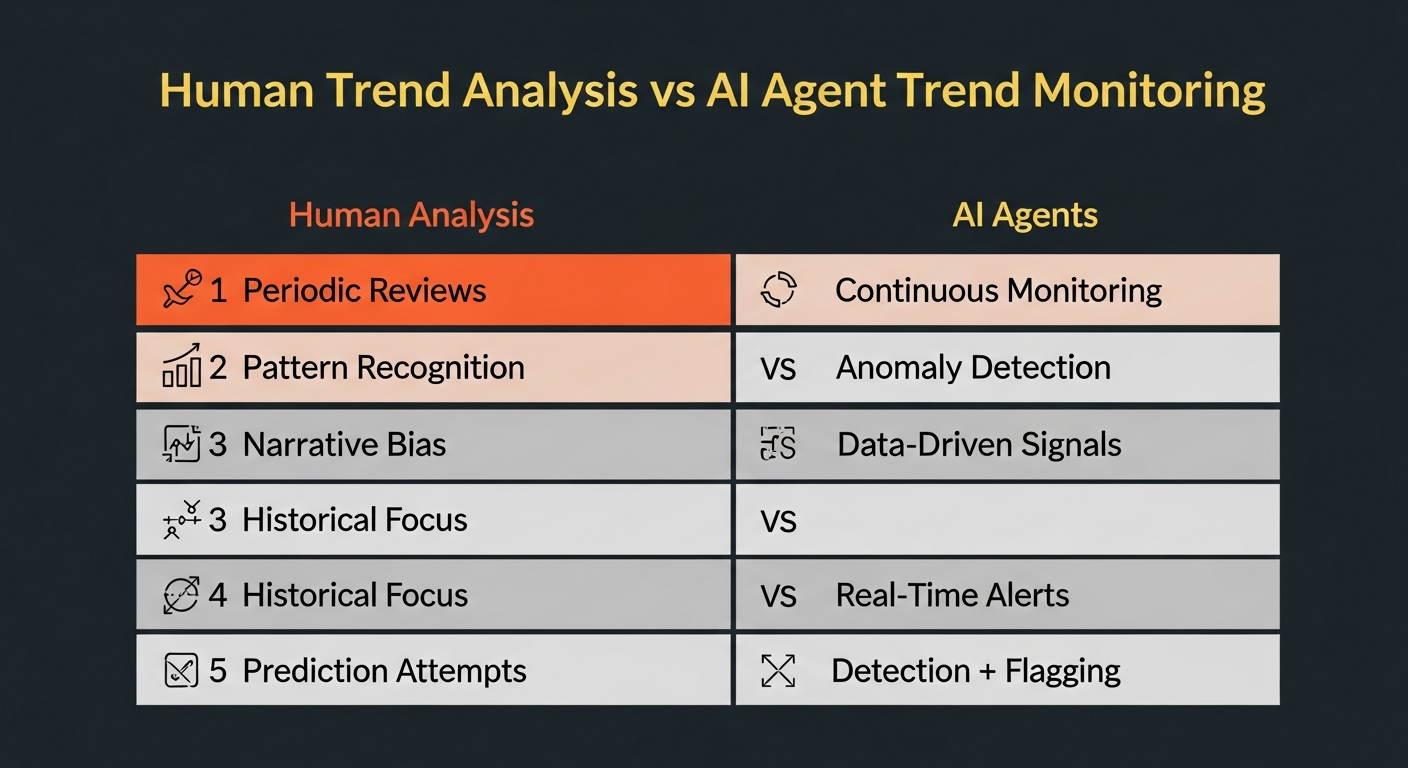
Dashboards look great. They feel productive. But they have a fatal flaw: they show you what already happened. By the time a trend shows up in your monthly report, you're already behind.
- Lagging indicators. Most dashboards track outcomes, not leading signals. You see the result after the cause.
- Human bias. We look for data that confirms what we already believe. AI agents for trend analysis don't have confirmation bias.
- Overfitting. Analysts find patterns in historical data that don't repeat. The pattern was noise. The forecast was fiction.
- Narrative fallacy. We turn random data points into stories. Stories feel true even when they're not.
AI Agents for Trend Analysis: The Better Approach
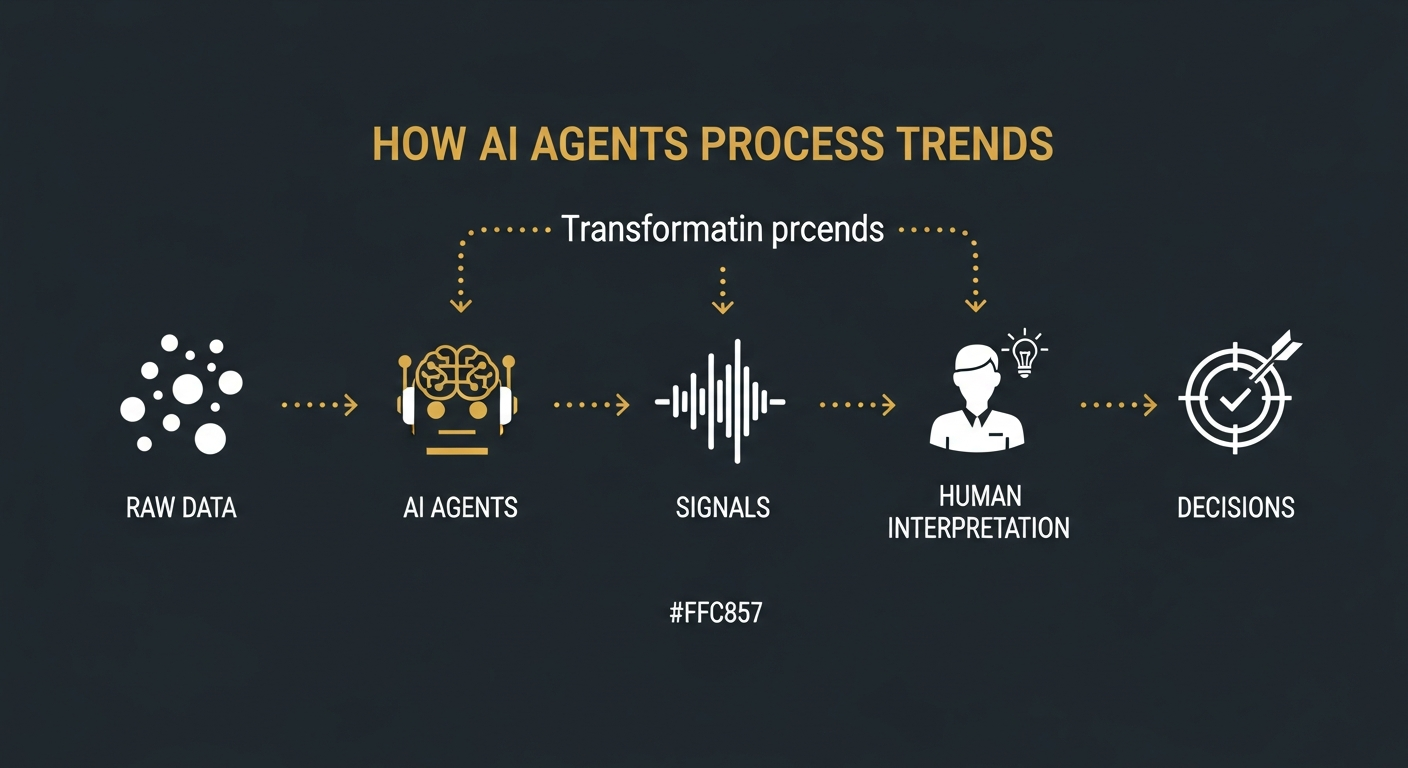
AI agents for trend analysis work differently. They don't try to predict the future. They watch for changes in the present. Think of them as continuous signal monitors, pattern detectors, and anomaly flaggers—not fortune tellers.
This connects directly to Pyra's Zero-Touch Operations™ philosophy: AI should detect and flag, humans should decide and act. The AI agent watches everything. The human reviews what matters.
- Continuous monitoring. They watch data streams 24/7. No coffee breaks. No blind spots.
- Anomaly detection. They notice when something changes from the baseline. Even small shifts.
- Pattern recognition. They identify correlations across data sets humans couldn't process simultaneously.
- Early-signal flagging. They alert you to emerging changes before they become obvious trends.
Practical Examples
- Market signals. Detect shifts in competitor pricing, customer sentiment, or supply chain patterns before they hit your revenue.
- Buyer behavior. Spot changes in how prospects engage with your content, products, or sales team.
- Sales motion shifts. Identify when your sales cycle lengthens, win rates drop, or deal sizes change—and flag the pattern early.
- Operational drift. Notice when process metrics slowly degrade. The kind of slow decline humans miss until it's a crisis.
"The goal isn't to predict the future. The goal is to see the present more clearly than anyone else."— Bob Generale, COO at Pyra
Limits and Tradeoffs
What AI agents for trend analysis can reliably detect:
- Anomalies from established baselines
- Correlations between data sets
- Velocity changes in metrics
- Pattern breaks that signal something new
What AI agents for trend analysis should never decide autonomously:
- Strategic responses to detected signals
- Causal explanations for patterns
- Future outcomes based on current trends
- Business decisions with significant consequences
The detection is reliable. The interpretation requires human judgment. Any vendor telling you otherwise is selling overconfidence.
Key Takeaways
- AI agents detect signals, not futures. They see changes humans miss. They don't predict what comes next.
- Continuous monitoring beats periodic review. Real-time detection catches trends earlier than monthly reports.
- Detection is AI territory. Decision is human territory. Let agents flag. Let humans decide.
- Dashboards lag. AI agents lead. By the time it's on your dashboard, the trend is old news.
- Skepticism is healthy. Any AI claiming to predict the future is overpromising. Period.
Conclusion
AI agents for trend analysis don't give you superpowers. They give you better vision. They watch what you can't. They notice what you'd miss. They flag what matters before it's obvious.
The companies winning at trend analysis aren't the ones with the best predictions. They're the ones who see changes fastest and respond while competitors are still reviewing last month's report.
FAQs
Can AI agents for trend analysis predict market crashes or major disruptions?
No. AI agents detect anomalies and pattern changes, but they cannot reliably predict specific future events like market crashes. They can flag unusual patterns that warrant human investigation, but the interpretation and response require human judgment.
How do AI agents for trend analysis differ from traditional business intelligence tools?
Traditional BI tools show you what happened through static reports and dashboards. AI agents for trend analysis continuously monitor data streams, detect anomalies in real-time, and flag emerging patterns before they become obvious trends.
How quickly can AI agents for trend analysis detect meaningful changes?
Detection speed depends on the data refresh rate and the magnitude of the change. Most well-configured AI agents can detect significant anomalies within hours of occurrence, compared to weeks with traditional reporting approaches.