AI Agents vs. Agentic AI: The Simple Explanation Nobody Gave You
AI agents and agentic AI sound the same but work very differently. Here's the plain-English explanation of what each one does and when you actually need them.
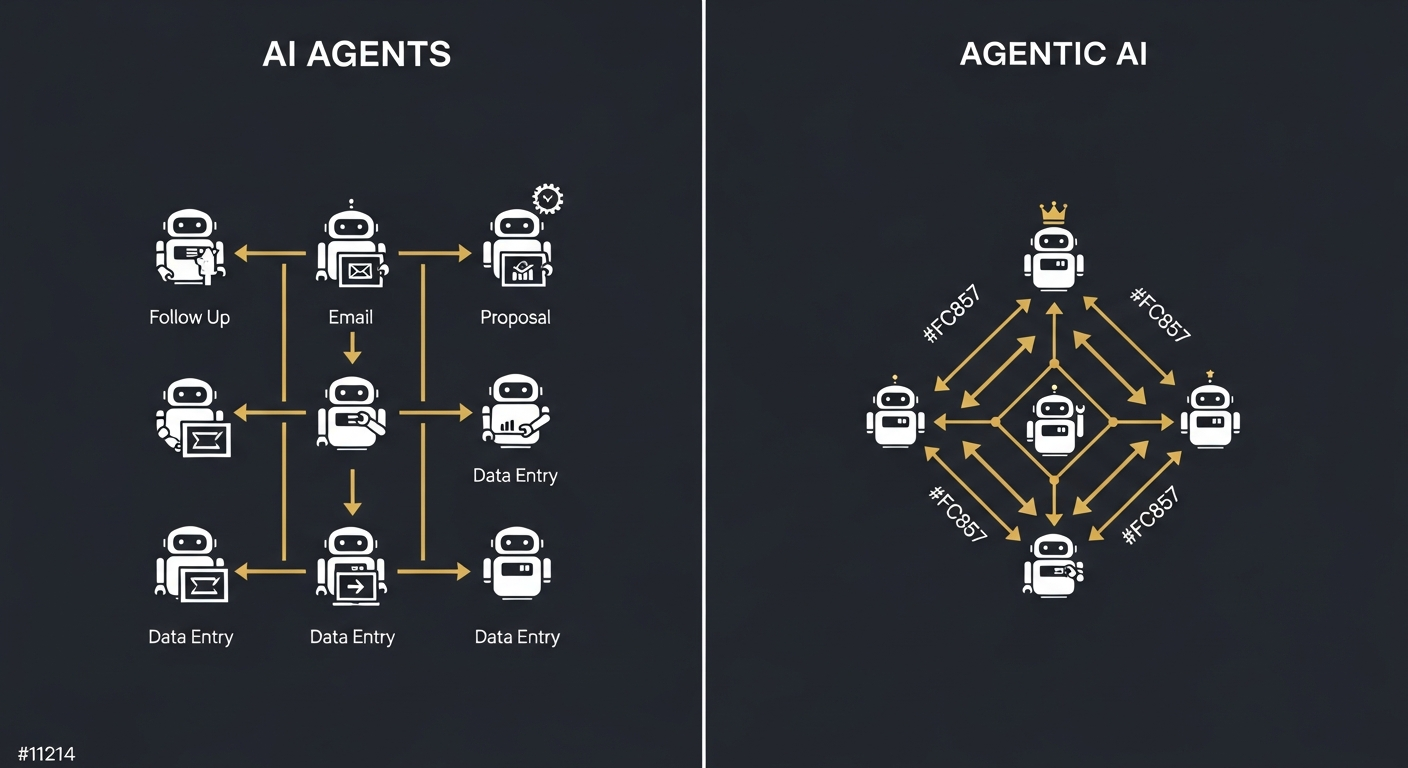
AI agents vs. agentic AI: Here's the short version. AI agents are individual tools that do one thing well. Agentic AI is when those tools start working together, making decisions, and running entire workflows on their own. Think of AI agents as employees. Agentic AI is the whole department, with a manager included.
If you've been confused by these terms, you're not alone. The AI industry has a habit of making simple things sound complicated. Let's fix that.
The Real Problem
The problem isn't that people don't understand AI. The problem is that everyone uses these terms differently. One vendor says "AI agent" and means a chatbot. Another says "agentic AI" and means the same thing. It's a mess.
At Pyra, we see this constantly. A client asks for "agentic AI" when they actually need a simple automation. Or they dismiss AI agents as too basic when that's exactly what would solve their problem.
AI Agents handle single tasks. Agentic AI orchestrates multiple agents to achieve complex goals.
The Simple Way to Understand AI Agents vs. Agentic AI
Let's use an analogy everyone understands: a restaurant.
AI Agents = Individual Staff Members. One person takes orders. Another cooks. Someone else cleans tables. Each does their job well, but they need coordination.
Agentic AI = The Whole Restaurant. The kitchen, front-of-house, reservations, and inventory all work together. The system notices you're running low on ingredients and orders more. It sees a busy Friday coming and schedules extra staff. It handles problems without the owner stepping in.
That's the difference. AI agents do tasks. Agentic AI runs operations. Our platform architecture is built on this distinction.
"Most companies don't need agentic AI. They need three or four really good AI agents that actually work. Start there. Scale up when you're ready."
Real Examples in Action
Scenario: A sales demo gets cancelled.
What an AI Agent does: Logs the cancellation. Sends a pre-written email asking to reschedule. Waits for someone to tell it what to do next.
What Agentic AI does: Looks at the pipeline. Delays the next outreach automatically. Notifies the account manager. Reprioritizes follow-up tasks across the system. Adjusts strategy based on customer behavior patterns.
See the difference? The AI agent completed a task. The agentic system managed a situation. According to McKinsey's research, this autonomous decision-making is where the real productivity gains come from.
When to Use Each
Use AI Agents when:
- You have specific, well-defined tasks that repeat
- Predictability matters more than flexibility
- You're automating one function at a time
- Budget is limited and you want quick wins
Consider Agentic AI when:
- Multiple systems need to coordinate in real-time
- Decisions require context from different sources
- You want the system to adapt without constant human input
- Complex workflows span multiple departments
Most companies should start with AI agents and add agentic capabilities later. Learn more about this approach in our enterprise digital ops guide.
The Limits
AI Agent Limits: They can't handle ambiguity. They need clear rules. If something unexpected happens, they stop and wait for instructions.
Agentic AI Limits: More autonomy means more risk. If the system makes a bad decision, it can cascade. You need monitoring, guardrails, and clear boundaries.
The honest truth is that true agentic AI—with full autonomy and self-improving goals—is still emerging. Most 2025 deployments are sophisticated multi-agent systems with guardrails, not fully autonomous operations.
"The question isn't AI agents vs. agentic AI. It's: what problem are you actually solving? Start with that, and the right architecture becomes obvious."
Key Takeaways
- AI agents are individual tools that complete specific tasks
- Agentic AI orchestrates multiple agents to run complex workflows autonomously
- Start with AI agents for quick wins and predictable automation
- Add agentic capabilities when you need real-time coordination across systems
- Most companies should crawl before they run—get AI agents working first
Frequently Asked Questions
What is the main difference between AI agents and agentic AI?
AI agents are individual software tools that complete specific tasks. Agentic AI is a system where multiple AI agents work together autonomously, making decisions and adapting without constant human oversight.
Which is better for my business: AI agents or agentic AI?
It depends on your needs. AI agents are better for specific, repeatable tasks with clear rules. Agentic AI is better for complex workflows that require real-time coordination and adaptive decision-making.
How do I get started with AI agents?
Start with one well-defined process that's currently manual and repetitive. Implement a single AI agent to handle it. Measure results. Then expand to additional agents and eventually coordinate them into agentic workflows.
Conclusion
AI agents vs. agentic AI isn't a competition. It's a spectrum. You don't have to choose one or the other—you use both, strategically. AI agents handle the individual tasks. Agentic AI coordinates them into something greater.
The real question isn't which technology is better. It's: what problem are you solving? Answer that first, and the right approach becomes obvious.