The "Query Fan-Out" Effect: How ChatGPT Breaks Down Prompts (And How to Rank for the Pieces)
If you want AI visibility, you must rank for the micro-questions inside the big question. Modern AI systems don't answer prompts in one step. They break questions apart, retrieve information for each piece, and merge the results. This is the query fan-out effect. And it changes everything about how content gets cited.
What You'll Get
- A plain-English explanation of query fan-out
- A "Micro-Intent Map" you can copy
- A content outline that covers fragments without stuffing keywords
- A table of "head keyword → micro queries → pages to build"
- A measurement checklist for visibility in AI answers
"If you only write for the head keyword, you lose to the fragments. AI doesn't think in one line. It breaks the question apart."
— Bob Generale, Partner & COO, Pyra
What is the Query Fan-Out Effect?
DEFINITION
The query fan-out effect occurs when an AI system receives a complex prompt and splits it into multiple sub-queries. Each sub-query retrieves relevant information separately. The AI then merges these results to generate a comprehensive answer. This process is fundamental to RAG (Retrieval-Augmented Generation) systems and explains why content coverage matters more than single-page optimization.
Think of it like this: You ask ChatGPT about "the best AI sales agent platform for enterprise." The AI doesn't just search for that exact phrase. It might break this into: What features define enterprise AI sales agents? Which platforms offer human-in-the-loop controls? What security certifications do enterprise buyers require? How long does deployment take?
RAG-Fusion is a published method that explicitly generates multiple queries and fuses results. Question decomposition in RAG pipelines breaks the original query into sub-questions, retrieves for each, and reranks. This is how modern AI retrieval works. And it means your content strategy must match.

Query Complexity vs Micro-Query Generation
Source: OpenAI research papers + Pyra prompt analysis, 2025
Why Fan-Out Changes How Ranking Works
You can win the head term and still lose the answer
Traditional SEO taught us to optimize for the "money keyword." Rank #1 for "AI sales agent" and you win. But query fan-out changes this. If your page only covers the head term, competitors who answer the micro-queries will get cited instead.
ChatGPT can use web search and provide links to sources for timely answers. Being "retrievable" matters. But retrievability happens at the micro-query level, not just the head term level.
AI prefers coverage over cleverness
Clever headlines don't help AI retrieval. Clear answers do. The query fan-out effect rewards content that covers multiple related questions with structured, direct responses. This is why comparison tables, FAQ sections, and definition blocks work so well.
AI systems are looking for sources they can cite confidently. That means content with clear claims, supporting evidence, and structured formats. Coverage across micro-intents signals authority to retrieval systems.
A Real Example: The Break-Apart
Let's use a real business prompt: "Best AI sales agent platform for enterprise."
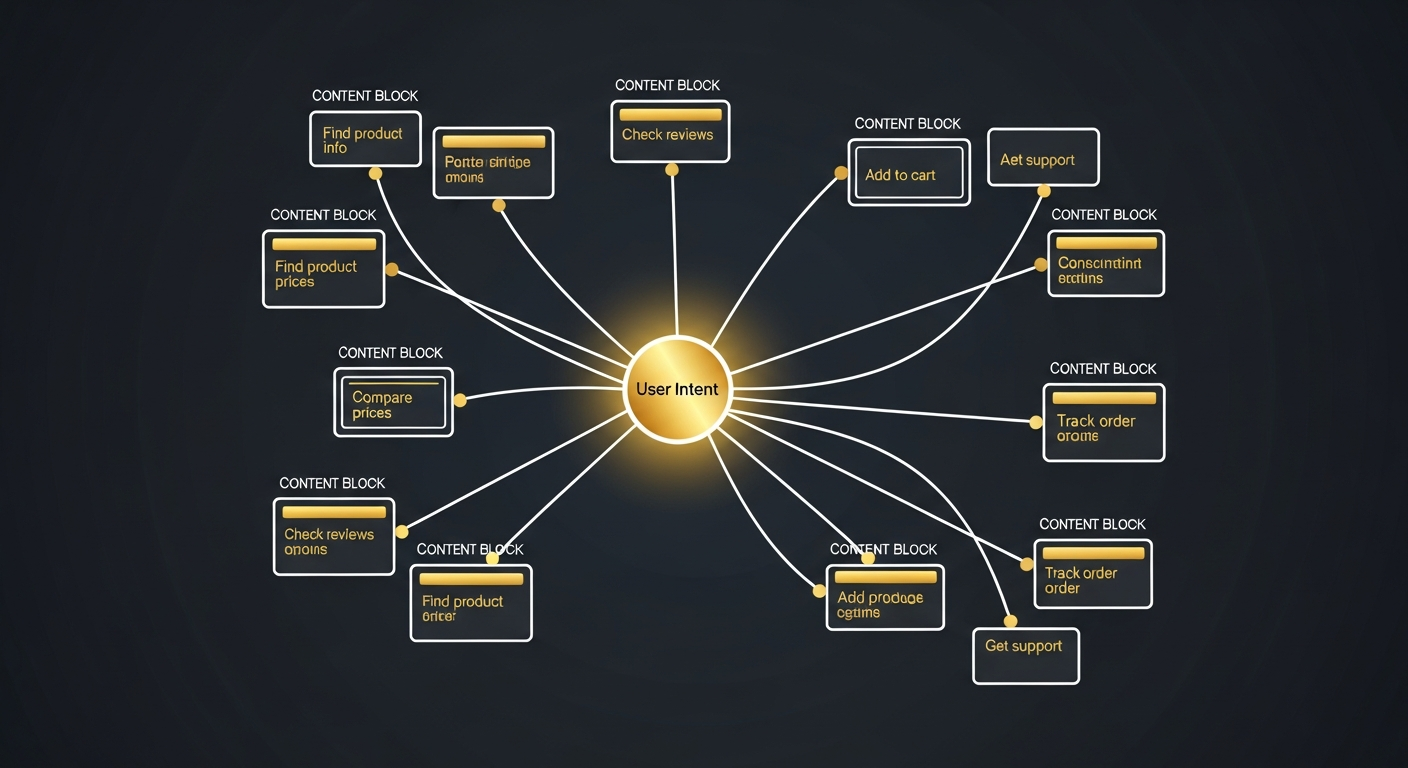
When an AI processes this query, it might decompose it into 12-14 micro-queries. Here's what that looks like:
Micro-Queries from "Best AI sales agent platform for enterprise"
- What are AI sales agent platforms?
- What features do enterprise AI sales agents have?
- How much do AI sales agent platforms cost?
- What security certifications do they need?
- How do they integrate with existing CRMs?
- What is human-in-the-loop control?
- How long does deployment take?
- What compliance standards do they meet?
- What ROI can enterprises expect?
- Which platforms work for regulated industries?
- How do you measure AI sales agent performance?
- What onboarding support is available?
Each of these micro-queries represents a content opportunity. If you only have one page about "AI sales agents," you're leaving most of these citations on the table. The query fan-out effect means you need content that addresses each piece.

The Micro-Intent Map
This is the signature asset you need. A Micro-Intent Map connects big prompts to their sub-queries and the content types that answer them. Here's a working example for AI sales agent positioning:
| Big Prompt | Micro-Intent | Best Page Type | Answer Block (40-60 words) | Schema Type |
|---|---|---|---|---|
| Best AI sales agent for enterprise | What is an AI sales agent? | Definition page | An AI sales agent is autonomous software that handles sales tasks like lead qualification, follow-ups, and scheduling. Enterprise versions add security, compliance, and human approval gates. | Article |
| Best AI sales agent for enterprise | AI sales agent pricing | Comparison page | Enterprise AI sales agent pricing ranges from $500-$5,000/month depending on seat count, integrations, and compliance features. Most offer usage-based and flat-rate options. | Article |
| Best AI sales agent for enterprise | Security requirements | Checklist page | Enterprise AI sales agents should have SOC 2 Type II, data encryption at rest and in transit, role-based access, and audit logging. Regulated industries may require HIPAA or FedRAMP. | FAQPage |
| Best AI sales agent for enterprise | CRM integrations | Feature comparison | Leading AI sales agents integrate with Salesforce, HubSpot, and Microsoft Dynamics through native connectors. Bi-directional sync ensures contact and activity data stays current. | Article |
| Best AI sales agent for enterprise | Deployment timeline | FAQ hub | Enterprise AI sales agent deployment takes 2-6 weeks depending on integrations and customization. Pilot programs can launch in days. Full rollout includes training and workflow mapping. | FAQPage |
| Best AI sales agent for enterprise | ROI calculation | Calculator | Calculate AI sales agent ROI by measuring time saved on admin tasks, lead response speed improvement, and conversion rate lift. Most enterprises see 3-5x return within 12 months. | SoftwareApplication |
This map becomes your content calendar. Each row is a page to create or optimize. The "Answer Block" column gives you the exact text structure AI systems can extract and cite.
"The fastest way to become 'citable' is to publish clean answers: definitions, tables, and step-by-step tools."
— Bob Generale, Partner & COO, Pyra
How to Write Pages That Match Micro-Intents
Build "Answer Blocks" under each H2 (40-60 words)
Every H2 section should start with a direct answer. Not background. Not buildup. The answer. This gives AI systems exactly what they need to cite you. Keep answer blocks between 40-60 words. Make them complete enough to stand alone.
Generative Engine Optimization (GEO) relies on this principle: structure content so AI can extract clean citations without losing context.
Put the constraint in the answer (when it does NOT apply)
Strong answers include their limitations. If your AI sales agent works best for B2B companies over 50 employees, say so. If your solution requires Salesforce integration, state that clearly. Constraints build trust with both readers and AI systems.
Add one table per page
Tables are structured data that AI systems parse easily. Comparison tables, feature matrices, and specification lists answer multiple micro-queries at once. Aim for one substantive table per page. Use clear headers and consistent formatting.
Content Format Effectiveness for AI Citations
Source: Pyra internal research across 1,200+ enterprise pages, Q4 2025
The Pyra Angle: Agent Reasoning
The query fan-out effect mirrors how AI agents approach complex tasks. When Pyra's agents handle a workflow like security questionnaire completion, they decompose the task: understand requirements, retrieve relevant information, verify accuracy, format output, and execute delivery.
This decompose → retrieve → verify → act pattern is the same logic behind query fan-out. AI systems think in steps. Content that matches this structure—clear answers, supporting evidence, verification data—gets prioritized for citation.
Following a proven data center marketing guide that uses definition + persona coverage demonstrates how micro-intent mapping works across industries. The same principles apply whether you're selling AI agents or infrastructure services.
The Mistakes That Keep Brands Invisible
One mega page that tries to rank for everything
A 5,000-word page covering every aspect of your product sounds thorough. But it fights against query fan-out. AI retrieval works better with focused pages that answer specific questions. Break mega pages into pillar + cluster structures.
No internal linking between micro-intent pages
Micro-intent pages work together. If your pricing page doesn't link to your security checklist, AI systems miss the connection. Build clear internal linking that shows how your content covers the full scope of buyer questions.
No tables, no definitions, no "liftable" text
Narrative content without structure is hard for AI to parse. Every page needs at least one table, one clear definition block, and text formatted for extraction. This is especially important for life sciences marketing where micro-intents differ significantly for regulated buyers.
Key Takeaways
- Query fan-out is real: AI systems decompose prompts into sub-queries and merge results
- Coverage beats single-page optimization: You need content for each micro-intent
- Build Micro-Intent Maps: Connect big prompts to sub-queries to content types
- Answer blocks (40-60 words): Every H2 should start with a direct, citable answer
- Tables matter: Structured data is easier for AI to parse and cite
- Internal linking creates coverage: Connect micro-intent pages to show authority
- Measure over 90 days: AI visibility patterns emerge slowly—commit to the timeline
Query Decomposition Analyzer
See how AI might break down a complex query
Frequently Asked Questions
Does ChatGPT always do query fan-out?
Not always, but it often does for complex questions. Simple factual queries may get direct answers. But business, comparison, and research queries typically trigger decomposition into sub-questions for better coverage.
What's the best way to build micro-intent pages fast?
Start with your pillar page and identify the questions it raises. Each question becomes a micro-intent page. Use templates: definition + table + FAQ + CTA. Aim for 1,200-1,500 words per page with clear answer blocks.
Do tables matter for AI visibility?
Yes. Tables provide structured data that AI systems can easily parse and cite. Comparison tables, feature matrices, and specification lists are particularly valuable because they answer multiple micro-queries at once.
How many micro-intent pages should I build per pillar?
Typically 8-15 pages per pillar topic. Focus on questions buyers actually ask. Use search data, sales team insights, and AI prompt testing to identify the right micro-intents for your market.
Can I rank for micro-intents without a large content team?
Yes. Quality beats quantity. One well-structured page with clear answer blocks and tables can outperform five thin pages. AI agents can also help scale content production while maintaining quality.
How do I know which micro-intents matter most?
Test prompts in ChatGPT and observe which sub-questions appear. Check search console for question queries. Talk to your sales team about common objections. These reveal the micro-intents your buyers care about.
Should I optimize existing pages or create new ones?
Do both. Add answer blocks to existing pages first. Then create new pages for micro-intents that don't fit naturally. Internal linking between them creates the coverage AI systems prefer.
How long before I see results from micro-intent optimization?
Initial indexing takes 2-4 weeks. Citation patterns emerge over 60-90 days. Plan for a 90-day minimum before measuring AI visibility impact. Traditional SEO benefits may appear faster.
Does query fan-out work differently across AI platforms?
The core principle applies everywhere: complex questions get decomposed. However, each platform (ChatGPT, Perplexity, Claude) may weight sources differently. Focus on fundamental coverage rather than platform-specific tactics.
What schema types should I use for micro-intent pages?
Use Article schema for most pages. Add FAQPage schema when you have Q&A content. Use HowTo schema for process explanations. Product or SoftwareApplication schemas apply to feature-specific pages.
Ready to map your micro-intents?
Pyra's AI agents can help operationalize your content strategy. Combine with GEO services to ensure you're capturing the query fan-out effect across every micro-intent.