Best SEO Techniques and Strategies for AI-Focused Companies 2026
The best SEO techniques and strategies for AI-focused companies in 2025 and 2026: seven strategies compared on evidence, start point and how to check them, with Google's guidance and sources dated Nov 2026.
Short answer: the best SEO techniques and strategies for AI-focused companies in 2025 and 2026 start with what Google still documents: indexed pages, non-commodity content and a clear technical structure. Add pages for buyer decisions, answer-first sections with sourced figures and genuine third-party mentions, then measure Google's AI features in Search Console and other engines through saved answers.
Technical SEO feeds discoverability; evidence earns confidence. This guide is for founders, heads of marketing and SEO leads at AI product companies deciding what to do first. It compares seven strategies from Google's own guide and from two agency sources, each dated, and says where the sources disagree. Pyra makes Prime AI Visibility, which measures AI answers and is not a crawler or a Google rank tracker, so it appears only in the measurement step. Most pages that rank for this query are agency guides, so each claim below names its source.
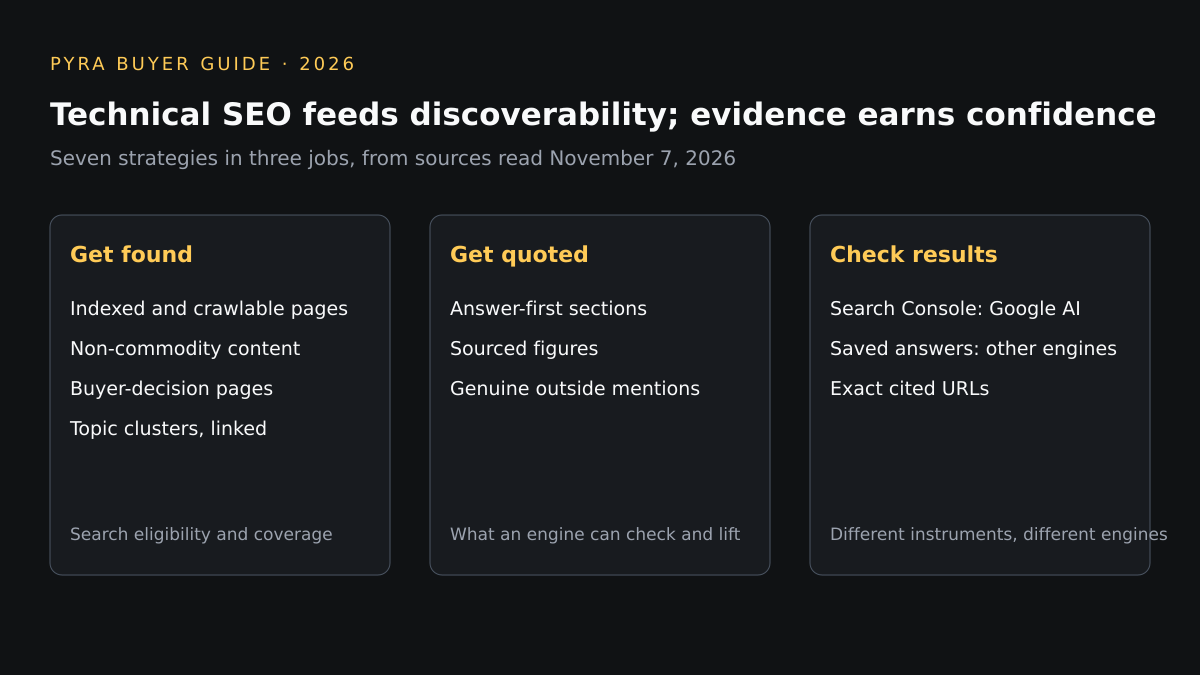
How we compared these SEO strategies
Five criteria, applied to every strategy from its public sources: the job it does, the evidence behind it, when to start, how to check it, and its limit. The nine tracker criteria used in our AI visibility tools comparison do not fit strategies, so they are applied only to the one measurement product reviewed below. The order is an editorial judgement of what an AI company should do first. There are no scores, and no strategy was tested by Pyra for this guide. Sources: Google Search Central's guide to optimizing for generative AI features (updated July 10, 2026), RZLT (March 23, 2026) and The Rank Masters (published September 11, 2025, updated November 5, 2026), all read November 7, 2026.
Best SEO strategies for AI-focused companies compared
In recommended order. Scroll sideways on small screens.
| Strategy | Job it does | Evidence behind it | Start when | How to check it |
|---|---|---|---|---|
| Make every key page indexed and crawlable | Gets pages eligible to appear at all, including in Google's AI features | Google's guide for generative AI features (updated July 10, 2026): a page must be indexed and eligible to show in Search with a snippet; content must be crawlable | Pages are new, rendered with JavaScript, or not appearing in Search Console | Search Console indexing reports; a crawler audit |
| Publish non-commodity content from first-hand product knowledge | Gives engines and buyers a reason to prefer your page over a summary of other pages | Google's guide says a unique point of view and non-commodity content will likely matter more over time than its other suggestions; RZLT (March 23, 2026) advises original benchmarks from product data and named authors with linked profiles | Your pages restate what other pages in the category already say | Whether each page contains data, a method or an experience nobody else can publish |
| Own category and problem-level queries with comparison, integration and use-case pages | Puts a page next to each buying decision, not only next to the category term | RZLT (March 23, 2026) recommends category keywords, comparison pages, integration guides and use-case walkthroughs for AI startups; The Rank Masters (updated November 5, 2026) recommends one page per use case, serious competitor and role | You rank for broad terms but are absent when buyers compare vendors or ask about a use case | Search Console queries per page; saved answers to your buyer questions |
| Lead each section with the answer and a sourced figure | Makes a passage easy to quote without rewriting the page for machines | The Rank Masters reports a Princeton study of 10,000 queries where adding statistics, quotations and citations raised visibility in generative engine answers by up to 40 percent, and calls that a best-case ceiling. Google says you do not need to chunk content or write specially for AI systems | Long pages bury the answer, or claims carry no source | Read the first two sentences under every heading; confirm each number links to its source |
| Earn genuine third-party corroboration | Lets engines check your claims against sources you do not control | The Rank Masters orders it as reviews, trade press, relevant backlinks and consistent entity facts; RZLT recommends distribution where buyers already read. Google says seeking inauthentic mentions is not as helpful as it seems | Your pages are strong but nobody else describes your product | Where your company is named and described outside your domain, and whether the facts match |
| Build topic clusters with deliberate internal links | Shows depth on one subject instead of isolated posts | RZLT (March 23, 2026) recommends a pillar page with supporting comparison, integration and technical pages linked together; no measured result is given | You have several related pages that do not link to each other | Internal links to and from the pillar; whether each supporting page answers a distinct question |
| Measure each engine with the right instrument | Separates Google's AI features from ChatGPT, Claude and Perplexity answers | Google points to the Generative AI performance report in Search Console for its own features; answer-engine visibility needs saved questions, answers and cited URLs | You cannot say where you appear today | Search Console for Google; saved question-and-answer records for other engines |
Strategy profiles
Strategy 1
Make every key page indexed and crawlable
Best for: AI companies whose marketing site is a JavaScript app or a recent rebuild.
Evidence: Google's guide for generative AI features (updated July 10, 2026): a page must be indexed and eligible to show in Search with a snippet; content must be crawlable.
Strength: Gates every other strategy, and Google documents it directly.
Limitation: Eligibility is not ranking or citation.
Verify before relying on it: That the page text is in the HTML a crawler receives, and that robots.txt allows the bots you want.
Strategy 2
Publish non-commodity content from first-hand product knowledge
Best for: Companies with product usage data, engineering knowledge or real customer outcomes.
Evidence: Google's guide says a unique point of view and non-commodity content will likely matter more over time than its other suggestions; RZLT (March 23, 2026) advises original benchmarks from product data and named authors with linked profiles.
Strength: The only strategy here that both Google and a vendor source name as the main lever.
Limitation: It needs real data and real experts, and it is slow to produce.
Verify before relying on it: That every figure has a source you can show and every claim about a customer is approved for publication.
Strategy 3
Own category and problem-level queries with comparison, integration and use-case pages
Best for: Early AI companies in categories still being defined.
Evidence: RZLT (March 23, 2026) recommends category keywords, comparison pages, integration guides and use-case walkthroughs for AI startups; The Rank Masters (updated November 5, 2026) recommends one page per use case, serious competitor and role.
Strength: Matches how buyers evaluate, and each page can double as sales material.
Limitation: Google says creating separate content for every query variation to manipulate rankings violates its scaled content abuse policy.
Verify before relying on it: That each page serves a real decision, not a rephrased keyword, and that rival strengths are stated accurately.
Strategy 4
Lead each section with the answer and a sourced figure
Best for: Comparison, pricing and how-it-works pages.
Evidence: The Rank Masters reports a Princeton study of 10,000 queries where adding statistics, quotations and citations raised visibility in generative engine answers by up to 40 percent, and calls that a best-case ceiling. Google says you do not need to chunk content or write specially for AI systems.
Strength: Good for readers whichever engine they use.
Limitation: Google does not require it, and the 40 percent figure is a ceiling from one study, not a forecast.
Verify before relying on it: That the answer is true on its own and that the cited source says what you claim.
Strategy 5
Earn genuine third-party corroboration
Best for: Companies with real customers, reviewers or press-worthy data.
Evidence: The Rank Masters orders it as reviews, trade press, relevant backlinks and consistent entity facts; RZLT recommends distribution where buyers already read. Google says seeking inauthentic mentions is not as helpful as it seems.
Strength: Addresses the one signal you cannot create by editing your own site.
Limitation: It cannot be forced, and bought or staged mentions run against Google's guidance.
Verify before relying on it: That each mention is real, current and consistent on name, category and product description.
Strategy 6
Build topic clusters with deliberate internal links
Best for: AI companies competing with larger domains on one core topic.
Evidence: RZLT (March 23, 2026) recommends a pillar page with supporting comparison, integration and technical pages linked together; no measured result is given.
Strength: Cheap to fix on pages you already have.
Limitation: The evidence is a vendor's recommendation, not a study.
Verify before relying on it: That every link helps a reader take the next step, not only pass a keyword.
Strategy 7
Measure each engine with the right instrument
Best for: Any team about to change content and needing a before-and-after.
Evidence: Google points to the Generative AI performance report in Search Console for its own features; answer-engine visibility needs saved questions, answers and cited URLs.
Strength: Turns the other six strategies into something you can date and compare.
Limitation: Each instrument covers different engines; none covers all of them.
Verify before relying on it: Which engines each instrument queries, how often, and whether exact cited URLs are kept.
For the first strategy, a crawler audit shows what a bot receives; the SEO audit tools comparison covers those tools. Pyra's digital infrastructure case study shows the same sequence on a client site, and the ChatGPT SEO analysis tools guide applies the evidence standard used here to ChatGPT.
What AI-focused companies can skip
Google's guide lists tactics it says are not needed for Google Search. Read each as a statement about Google, not about every engine.
| Tactic | What the sources say |
|---|---|
| llms.txt and other special files | Google says Google Search does not use them. That statement covers Google Search only; other engines have not published the same. |
| Chunking content or rewriting only for AI | Google says neither is required; write for the audience. |
| Schema as a citation switch | Google says no special markup is required. RZLT reports an Ahrefs May 2026 controlled study that found adding schema alone produced no measurable citation lift; keep schema for clean markup and rich results. |
| Inauthentic mentions | Google says they are not as helpful as they seem. |
Measuring answers beyond Google
Search Console's Generative AI performance report covers Google's AI features. For ChatGPT, Claude and Perplexity, you need the question, the answer and the cited URL kept for each run. Prime AI Visibility does that for questions you choose; it does not crawl or index your pages and does not track Google organic positions. Prime's guide to choosing an AI visibility tool scores six axes (engines covered, refresh cadence, prompt ownership, metric definitions, raw-data export and pricing) and suggests trialing with ten of your own buyer prompts. Prime on the nine criteria, from primeaivisibility.com/pricing on November 7, 2026:
| Criterion | What the Prime pages state |
|---|---|
| Engine coverage | ChatGPT, Claude, Perplexity on Flash; Gemini and an AI Overview-style preview start on Starter |
| Named vs cited | Separates named (brand in answer text) from cited (source link) for every answer |
| Exact cited source | Yes: saved answers show the exact source URLs each engine returned |
| History and trend | One check per month on Flash; paid plans can run weekly and keep every run |
| Competitor comparison | Competitors named or cited in the same answer are recorded |
| Question tracking | Buyer questions are the unit: 5 on Flash, 25 on Starter, 50 on Growth |
| Reporting, export, API | Exports from saved data; Word, HTML and Markdown drafts from Content Fix |
| Pricing transparency | Flash free; Starter $69/mo, Growth $179/mo, Agency $369/mo, Enterprise from $1,499/mo (primeaivisibility.com, Nov 7, 2026) |
| Diagnosis to action | Identify the missed question, research, draft, review, export, recheck; claims needing proof are flagged before export |
Prime is the only product here that Pyra makes. For a Perplexity-specific comparison of trackers, see the Perplexity rank tracker guide.
From visibility to pipeline
Visibility is not pipeline, and an impression does not show purchase intent. Lead Seeker handles B2B prospecting, verified contacts and buyer dossiers; it does not monitor AI citations or Google rankings. When intent signals need to become qualified account selection, campaign execution or sales activation, Percepture's B2B intent data services connect signal interpretation to ICP targeting. Percepture's generative engine optimization services cover the content side of the same loop. Bob Generale, who wrote this guide, is Pyra's COO and co-founder and President of Percepture; Pyra's homepage describes the agents and products it builds.
SEO for AI-focused companies: questions buyers ask
Does SEO still matter for AI-focused companies?
Yes. Google's guide to generative AI features (updated July 10, 2026) says SEO best practices remain relevant because those features rely on its core Search ranking and quality systems. A page still has to be indexed and eligible to show with a snippet before it can appear in AI Overviews or AI Mode.
Do AI companies need an llms.txt file?
Not for Google. Google's guide says Google Search does not use llms.txt or other special AI files. Other engines have not published a matching statement in the sources reviewed, so treat it as optional and never as a replacement for indexable pages and clear content.
How do I measure AI search visibility for my company?
Use two instruments. Search Console's Generative AI performance report covers Google's AI features. For ChatGPT, Claude and Perplexity, save your buyer questions, the answers and the cited URLs on a fixed schedule, by hand or with a tracker that stores each run, and record whether you were named, cited or neither.
Should I publish a page for every question buyers ask?
No. Google says creating separate content for every query variation, primarily to manipulate rankings or AI responses, violates its scaled content abuse policy. Publish one page per real buying decision, such as a use case, an integration or a named competitor comparison, and answer the related questions inside it.
What is the right order for an AI company starting from zero?
Get key pages indexed and crawlable, publish content only you can write, add comparison and use-case pages for buyer decisions, then earn outside corroboration and measure. The Rank Masters recommends a similar order, extractable pages first, then entity signals, then third-party corroboration; both are editorial judgement, not measured results.
Sources
Google Search Central: Optimizing your website for generative AI features on Google Search (updated July 10, 2026). RZLT: How to Build an SEO Strategy for AI Startups (March 23, 2026). The Rank Masters: Best SEO Strategies for AI Visibility Tools (updated November 5, 2026). Prime facts: primeaivisibility.com/pricing. All pages read November 7, 2026. Written by Bob Generale, COO and co-founder of Pyra; reviewed by Alex Mannine.
Plan your SEO and AI visibility sequence
If you want Pyra to review your indexing, buyer-decision pages and measurement plan, book a strategy call. Prime's free Flash plan checks up to five buyer questions across ChatGPT, Claude and Perplexity if you want a baseline first.