Best SEO Forecasting Tools 2026: 5 Compared by Assumptions and Controls
What are the best SEO forecasting tools in 2026? SEOmonitor, BrightEdge, SE Ranking, Percepture's calculators and Search Console compared on seven criteria. Reviewed Nov 6, 2026.
Short answer: what are the best SEO forecasting tools in 2026? It depends on how many assumptions you need to control. Of five reviewed on November 6, 2026, SEOmonitor documents the most, BrightEdge adds scenario bands inside an enterprise platform, SE Ranking estimates traffic from current positions, and Percepture's calculators and Search Console with a spreadsheet are free. None forecasts AI answer visibility.
A forecast is a scenario, not a guarantee. This guide is for SEO leads, marketing managers and founders who must put a traffic, lead or revenue number in front of someone who approves budget. Pyra builds AI agents, and the author, Bob Generale, is Pyra's COO and co-founder and President of Percepture, whose free calculators are one of the five options and are held to the same seven criteria as the rest. The order is editorial, from most documented method to simplest, and is not a ranking. Findings are what each vendor's own pages showed on November 6, 2026, and "not described" means those pages did not say.
What an SEO forecast actually shows
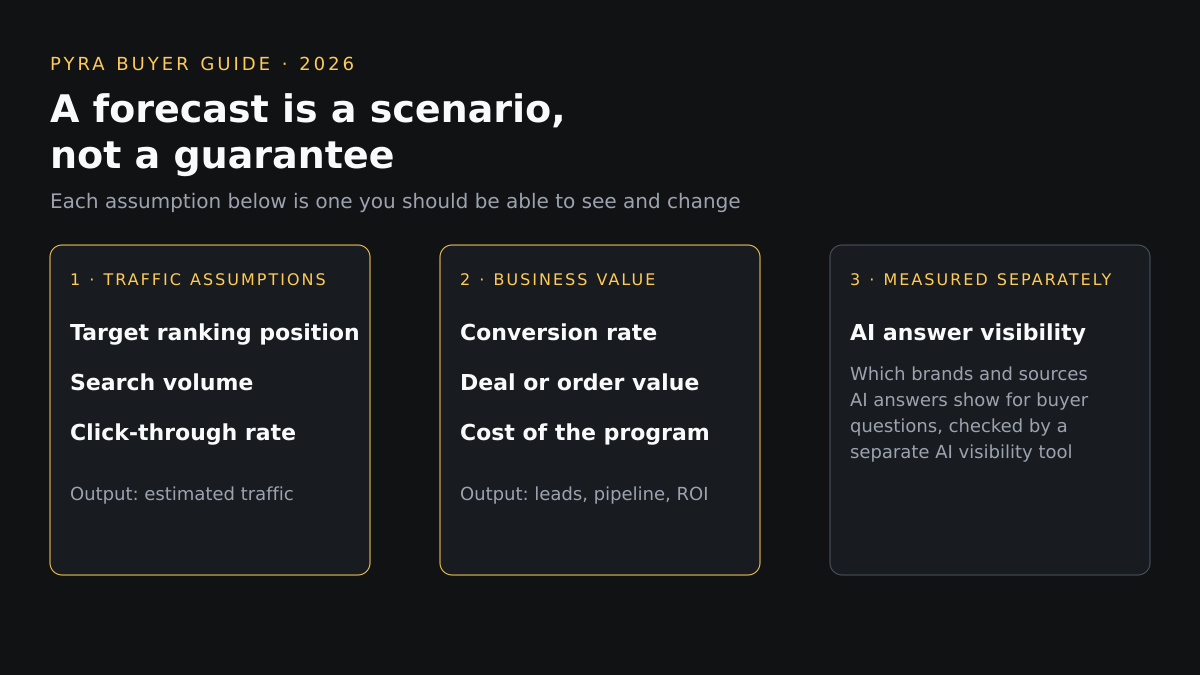
Every tool here follows the same chain: a target ranking position and a search volume produce clicks through a click-through rate, and a conversion rate turns clicks into leads or revenue. The tools differ in how visible and editable each link in that chain is. A number you cannot trace to an assumption cannot be defended when finance asks where it came from.
Search impressions also are not purchase intent. A forecast tells you how much traffic a ranking could earn, not whether the visitors are buyers, which is why the conversion assumption deserves as much scrutiny as the traffic one. The same idea applies to technical health: a forecast assumes the site can rank, so if indexing or speed problems are open, start with our technical SEO audit tools guide.
How we compared these tools
Seven criteria were applied to every option using only public vendor pages, help articles and pricing pages. No hands-on scores, accuracy tests or customer counts are used, and claims a vendor makes about itself are attributed to it. The set covers the options that recur in current search results for this query and that publish enough to compare; it is not exhaustive.
| Criterion | The question it answers |
|---|---|
| Input transparency | Can you see the formula, data source and defaults behind the number? |
| Scenario controls | Can you set target rankings or compare conservative and aggressive cases? |
| Ranking and traffic assumptions | How are click-through rate, search volume and SERP features handled? |
| Conversion assumptions | Can you enter or connect conversion rate, order value or deal value? |
| Confidence ranges | Does it show a range, a probability or only a point estimate? |
| Exportability | Can you take the forecast or data out of the tool? |
| Pricing | Is a price published? |
Best SEO forecasting tools compared
Two tables, the same five options in profile order. The first covers what you can see and change; the second covers conversion, confidence, export and price. Scroll sideways on small screens.
| # | Option | Input transparency | Scenario controls | Ranking and traffic assumptions |
|---|---|---|---|---|
| 1 | SEOmonitor | A documented algorithm: start date, timeframe, keyword groups, a target rank between 2 and 10 per group, and a progression speed, run on rank-tracker keyword data | Multiple scenarios, each with its own goal, budget and difficulty; progression speed is Conservative, Moderate, Optimistic or custom | Default organic-only click-through curve from SEOmonitor's own 4-million-keyword research, discounted for SERP features, with year-over-year search volume and a long-tail effect; custom click-through values can be entered |
| 2 | BrightEdge Opportunity Forecasting | The page lists the variables you can customize but does not document the underlying algorithm | Aggressive, medium or conservative scenarios for each keyword group | Customization variables include search volume increase and ranking improvement for selected keywords; click-through assumptions are not described |
| 3 | SE Ranking traffic forecast | A published formula for tracked projects: Google Keyword Planner search volume, current ranking, a search-engine index and a maximum-traffic index by position | Not described; the guide shows the metric by site, search engine, region, keyword and competitor rather than target-rank scenarios | Stand-alone tools use an AI-powered estimate that considers rankings, search volume and click-through rate, with SERP features, branded keywords and intent taken into account |
| 4 | Percepture SEO forecasting calculators | Formulas are shown on the page. The ranking tool uses your domain authority, keyword difficulty, current ranking, a 1 to 10 topical authority score and whether internal links and PR support exist | Change any input and rerun; there are no saved scenarios | You enter search volume and an expected click-through rate by position; the page's example uses 8% for position 3 |
| 5 | Google Search Console plus a spreadsheet | Everything is visible because you build it from your own impressions, clicks and position data | As many as you build; you set each assumption yourself | Your own click-through rate by position from your own data, instead of a population average |
| Option | Conversion assumptions | Confidence ranges | Exportability | Pricing |
|---|---|---|---|---|
| SEOmonitor | Conversion rate from Search Console and Analytics data where connected (keyword, then page, then overall non-brand rate), or a custom rate and order value | A Chance Indicator labels each scenario Realistic, Ambitious or Too Ambitious; this is a feasibility label, not a statistical interval | The Starter plan lists unlimited users and exports; the forecast export format is not described | Starter €79 a month for one small or medium website (500 tracked keywords); Pro €299 a month for a portfolio. Whether Forecast is in each plan is not stated on the pricing page |
| BrightEdge Opportunity Forecasting | Revenue estimates for conversions and conversion rate are customizable | Scenario bands only; no interval or probability is described | Not described on the page | Not published; the page directs to a demo request |
| SE Ranking traffic forecast | Not described; the guide covers traffic only | Not described; SE Ranking's guide says no solution predicts traffic with 100% accuracy | The Core plan lists 50,000 exportable data rows | Core $129 a month ($103.20 a month billed annually) and Growth $279 a month ($223.20 annually); whether the forecast views are in each plan is not stated |
| Percepture SEO forecasting calculators | You enter conversion rate, average deal value and monthly SEO spend; outputs include leads, annual revenue, paid-search equivalent, break-even and ROI multiple | A 0 to 100 ranking probability score and time-to-rank bands of 30, 60, 90 and 180+ days, from Percepture's own heuristic; not a statistical interval | Results can be copied from the page; a file export is not described | Free |
| Google Search Console plus a spreadsheet | Your own conversion rate from your analytics | Whatever ranges you add; nothing is built in | The Performance report has an export button for chart and table data | Free |
Profiles
1. Rank tracker with a forecast module
SEOmonitor
Best fit: Agencies and in-house teams that need to pitch or defend a budget with a documented method.
Input transparency: A documented algorithm: start date, timeframe, keyword groups, a target rank between 2 and 10 per group, and a progression speed, run on rank-tracker keyword data.
Scenario controls: Multiple scenarios, each with its own goal, budget and difficulty; progression speed is Conservative, Moderate, Optimistic or custom.
Ranking and traffic assumptions: Default organic-only click-through curve from SEOmonitor's own 4-million-keyword research, discounted for SERP features, with year-over-year search volume and a long-tail effect; custom click-through values can be entered.
Conversion assumptions: Conversion rate from Search Console and Analytics data where connected (keyword, then page, then overall non-brand rate), or a custom rate and order value.
Confidence ranges: A Chance Indicator labels each scenario Realistic, Ambitious or Too Ambitious; this is a feasibility label, not a statistical interval. Exportability: The Starter plan lists unlimited users and exports; the forecast export format is not described.
Pricing: Starter €79 a month for one small or medium website (500 tracked keywords); Pro €299 a month for a portfolio. Whether Forecast is in each plan is not stated on the pricing page.
Strength: The most fully documented method of the five, with editable click-through, progression and conversion assumptions.
Limitation: It starts from your tracked keywords and non-brand traffic, so a site with no tracked keywords has little to forecast from, and the feasibility label is not a range.
What to verify: Whether Forecast is included in the plan you would buy, the export format, and how the Chance Indicator treats your topical authority.
Source: SEOmonitor forecasting algorithm help page (updated September 15, 2026) (reviewed November 6, 2026).
2. Enterprise SEO platform module
BrightEdge Opportunity Forecasting
Best fit: Enterprise SEO teams that already run BrightEdge and need a business case by keyword group.
Input transparency: The page lists the variables you can customize but does not document the underlying algorithm.
Scenario controls: Aggressive, medium or conservative scenarios for each keyword group.
Ranking and traffic assumptions: Customization variables include search volume increase and ranking improvement for selected keywords; click-through assumptions are not described.
Conversion assumptions: Revenue estimates for conversions and conversion rate are customizable.
Confidence ranges: Scenario bands only; no interval or probability is described. Exportability: Not described on the page.
Pricing: Not published; the page directs to a demo request.
Strength: Revenue, conversion and traffic views for each keyword group, tied to the platform's recommendations.
Limitation: The method is not documented on the page, and it sits inside a platform sold by demo.
What to verify: The click-through curve used, how volume growth is modeled, export options and the price for your keyword volume.
Source: BrightEdge Opportunity Forecasting page (reviewed November 6, 2026).
3. All-in-one SEO platform metric
SE Ranking traffic forecast
Best fit: Teams already tracking rankings that want a quick potential-traffic number per keyword, site or competitor.
Input transparency: A published formula for tracked projects: Google Keyword Planner search volume, current ranking, a search-engine index and a maximum-traffic index by position.
Scenario controls: Not described; the guide shows the metric by site, search engine, region, keyword and competitor rather than target-rank scenarios.
Ranking and traffic assumptions: Stand-alone tools use an AI-powered estimate that considers rankings, search volume and click-through rate, with SERP features, branded keywords and intent taken into account.
Conversion assumptions: Not described; the guide covers traffic only.
Confidence ranges: Not described; SE Ranking's guide says no solution predicts traffic with 100% accuracy. Exportability: The Core plan lists 50,000 exportable data rows.
Pricing: Core $129 a month ($103.20 a month billed annually) and Growth $279 a month ($223.20 annually); whether the forecast views are in each plan is not stated.
Strength: A transparent formula for tracked keywords and the forecast sits beside rank tracking, competitors and audits in one platform.
Limitation: It estimates traffic from current positions, not from a target position, and has no conversion or revenue layer in the guide reviewed.
What to verify: Whether you can set target positions, and how the stand-alone click-through estimate treats AI Overviews. The guide is dated October 31, 2024.
Source: SE Ranking traffic forecast guide (October 31, 2024) and pricing page (reviewed November 6, 2026).
4. Free calculators on a guide page
Percepture SEO forecasting calculators
Best fit: Marketing leaders who want a directional keyword-reach and ROI estimate before choosing a paid tool.
Input transparency: Formulas are shown on the page. The ranking tool uses your domain authority, keyword difficulty, current ranking, a 1 to 10 topical authority score and whether internal links and PR support exist.
Scenario controls: Change any input and rerun; there are no saved scenarios.
Ranking and traffic assumptions: You enter search volume and an expected click-through rate by position; the page's example uses 8% for position 3.
Conversion assumptions: You enter conversion rate, average deal value and monthly SEO spend; outputs include leads, annual revenue, paid-search equivalent, break-even and ROI multiple.
Confidence ranges: A 0 to 100 ranking probability score and time-to-rank bands of 30, 60, 90 and 180+ days, from Percepture's own heuristic; not a statistical interval. Exportability: Results can be copied from the page; a file export is not described.
Pricing: Free.
Strength: Every formula and default is visible, so a team can see what drives the answer.
Limitation: The scoring is a published rule of thumb, with no validation against outcomes shown, and it works on keywords you enter by hand rather than tracked data.
What to verify: Replace the defaults with Search Console and rank-tracker data, and treat the probability score as a prompt for discussion, not a prediction.
Source: Percepture SEO forecasting tool guide (May 21, 2026) (reviewed November 6, 2026).
5. Free data source and a model you build
Google Search Console plus a spreadsheet
Best fit: Solo operators and small sites that can build and own a simple model.
Input transparency: Everything is visible because you build it from your own impressions, clicks and position data.
Scenario controls: As many as you build; you set each assumption yourself.
Ranking and traffic assumptions: Your own click-through rate by position from your own data, instead of a population average.
Conversion assumptions: Your own conversion rate from your analytics.
Confidence ranges: Whatever ranges you add; nothing is built in. Exportability: The Performance report has an export button for chart and table data.
Pricing: Free.
Strength: Uses your own query data, so no third-party volume estimate is involved.
Limitation: You build, maintain and document the model, and there is no feasibility or ranking-probability layer.
What to verify: That the model separates brand from non-brand queries, and that its date range covers any seasonality.
Source: Google Search Console Performance report help page (reviewed November 6, 2026).
How to choose an SEO forecasting tool
Choose by the question you must answer. To win or defend a budget with a client or finance, pick the tool whose method you can explain line by line. To size a single opportunity, a free calculator or a spreadsheet built on your own Search Console data is usually enough. For recurring reporting against tracked keywords, a platform with saved scenarios saves rebuilding the model each quarter.
Whichever you pick, change the defaults. Replace generic click-through rates with your own, separate brand from non-brand queries, and set conversion from your own analytics. For analyzing the pages that must rank, see our guide to ChatGPT SEO analysis tools.
Beyond the forecast: AI answers and qualified accounts
A traffic forecast does not tell you what AI assistants say when your buyers ask a question. That is a different measurement: Prime AI Visibility saves the answers that ChatGPT, Claude, Perplexity and, on paid plans, Gemini give to questions you choose, along with the brand names and website links in them. Against the seven criteria above it is not a forecaster: it has no ranking target, traffic or conversion model, it does not track Google rankings, and it reports repeat checks rather than projections. If you are weighing tools in that category, Prime's guide to choosing an AI visibility tool sets out six axes (engine coverage, query cadence, prompt-set ownership, metric definitions, data export and pricing) and suggests trialing with ten of your own buyer questions.
The demand journey after a forecast has two more separate jobs. Lead Seeker handles B2B prospecting, verified contacts and buyer dossiers, and does not monitor rankings or AI answers. When intent signals must become qualified account selection, campaign execution or sales activation, Percepture's B2B intent data services connect those signals to target accounts and campaigns. These are separate tools and services, not one product.
What are the best SEO forecasting tools? Questions buyers ask
What are the best SEO forecasting tools?
It depends on how much of the forecast you need to control. Of the five reviewed on November 6, 2026, SEOmonitor documents the most assumptions, BrightEdge adds scenario bands inside an enterprise platform, SE Ranking estimates traffic from current positions, Percepture's calculators are free and show their formulas, and Search Console with a spreadsheet uses your own data. The order is editorial, not a ranking.
How accurate are SEO forecasts?
A forecast is only as accurate as its assumptions. SEOmonitor's own documentation says its forecasts are not magical predictions, and SE Ranking says no solution predicts traffic with 100% accuracy. Treat the output as a scenario, and recheck it against Search Console after each quarter.
Can an SEO forecasting tool predict AI search visibility?
None of the forecast outputs reviewed describe a projection of how often AI answers will mention or cite you. Checking what ChatGPT, Gemini, Claude and Perplexity say about your buyer questions is a separate measurement, and it is reported after the fact, not forecast.
Is a free forecast good enough?
For a single site with Search Console access, often yes. Search Console and a spreadsheet, or Percepture's free calculators, make every assumption visible. A paid tool earns its cost when you need saved scenarios, tracked keywords, conversion data from Analytics, or a documented method to show a client or finance team.
Sources
Each option's source page is linked from its profile and was reviewed November 6, 2026; the SEOmonitor method page is dated September 15, 2026, Percepture's guide May 21, 2026, and SE Ranking's forecast guide October 31, 2024. Prices change, and a stated price is the one shown on the vendor's page on that date. Written by Bob Generale; reviewed by Alex Mannine.
Turn the forecast into a plan
Talk with Pyra about which assumptions your forecast depends on, what to measure after launch and how AI search fits the plan.