Best AI Prospecting Tools 2026: 7 GTM Sales Tools Compared
The best AI prospecting tools and GTM sales prospecting companies compared on nine criteria: ZoomInfo, Apollo.io, Cognism, Lusha, UpLead, Clay and Lead Seeker, with pricing. Reviewed Nov 5, 2026.
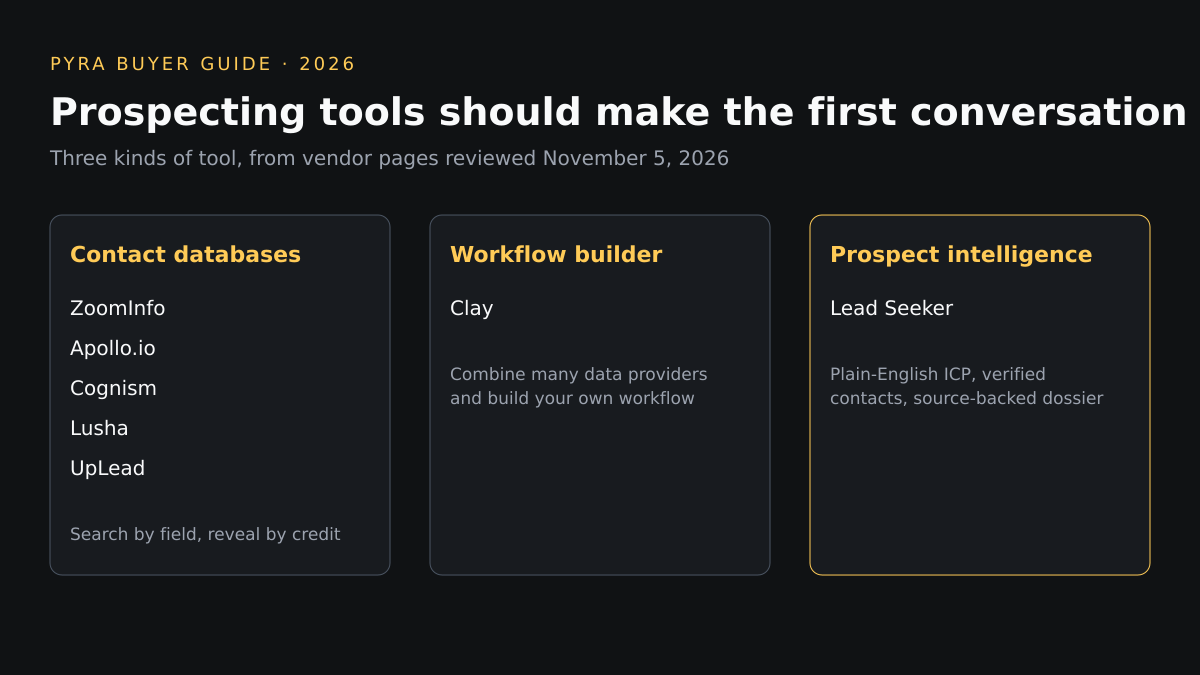
Short answer: the best AI prospecting tools, and the best companies for GTM sales prospecting tools, depend on how you want to find buyers. ZoomInfo, Apollo.io, Cognism, Lusha and UpLead sell searchable contact databases, Clay lets you build a workflow from many data providers, and Lead Seeker starts from a plain-English description of the buyer. Prospecting tools should make the first conversation less cold. Of seven reviewed, ZoomInfo and Cognism are quoted through sales.
This guide is for B2B sales and revenue teams choosing where prospect data and context come from. Pyra makes Lead Seeker, which is held to the same nine criteria and listed last; Bob Generale, who wrote this guide, is also President of Percepture. Prices are what each vendor displayed on November 5, 2026, and "not itemized" means the pages reviewed did not list it, not that it is absent.
How we compared GTM prospecting companies
The same nine criteria were applied to every option, using only its public pricing and product pages. No hands-on scores were produced, and the order is editorial, from broad databases to prospect intelligence. Each factual vendor claim below is tied to its published product or pricing page.
| Criterion | The question it answers |
|---|---|
| Data and source transparency | Where does each record come from, and can you see it? |
| Contact verification | Is the contact checked, or only matched? |
| Intent and buying signals | Does it show why this account is worth contacting now? |
| ICP filtering | Can you describe the buyer you want, not only filter by fields? |
| Dossier and context depth | Does each prospect come with reasons to act? |
| CRM and export workflow | Does the result reach your CRM or leave as a file? |
| Automation controls | What runs on its own, and what spends credits? |
| Pricing | Is the price on the public page, and what does it include? |
| Small versus enterprise fit | Does the plan structure suit your team size? |
Best AI prospecting tools and GTM sales prospecting companies compared
Two tables, the same seven options. The first covers source, verification, signals and ICP filtering; the second covers context, CRM and export, automation, price and team fit. Scroll sideways on small screens.
| Tool | Type | Data source | Contact verification | Intent and signals | ICP filtering |
|---|---|---|---|---|---|
| ZoomInfo | Contact database | Says it resolves your records and external records into one current record; individual data sources are not itemized | Describes its data as verified and current; the verification method is not itemized | Intent, live signals and in-market buyer plays are listed, with buying-committee mapping for outbound prospecting | Outbound prospecting is framed as finding in-market buyers; filter types are not itemized on the pricing page |
| Apollo.io | Contact database | States a database of 240M contacts and 30M companies; the source of each record is not itemized | Not itemized on the pricing page; waterfall enrichment is a listed feature | Not itemized on the pricing page | Not itemized on the pricing page; a record selection limit caps how many records you can pick per action |
| Cognism | Contact database | Emails, mobiles, titles and work history, plus company revenue, headcount and technology usage; individual sources are not itemized | Premium mobile filter on both packages; on-demand mobile verification on Pro | Hiring, funding and M&A, job changes and intent data are listed; the FAQ places intent data on Pro | Firmographic, technographic and signal-based filters, AI search and an AI persona builder |
| Lusha | Contact database | Describes verified contacts, company data and dated buying signals; data source and accuracy pages are linked from its site | Calls its contacts verified; the accuracy method sits on a separate page | Intent and buying signals, buying group mapping, daily AI recommendations and website visitor identification | Lead prioritization ranks accounts by fit and signals; lookalike prospecting is listed |
| UpLead | Contact database | Sources are not itemized; it states a 95% email data accuracy rate as its own claim | Verified emails and mobile direct dials on every plan, with the 95% rate stated by the vendor | Buyer intent data on the custom top tier; technographics across 16,000+ technologies from Plus | Advanced filters from Plus; suppression list uploads from Plus |
| Clay | Enrichment workflow builder | Combines data from 200+ providers; each provider's source is not itemized | Waterfall enrichment combines providers for coverage; a verification method is not itemized | Tracks job changes, promotions and other signals | You build the list in a table; Claygent, its AI agent, researches target companies on the web |
| Lead Seeker | Prospect intelligence | Each prospect shows the public signal that surfaced them, with a source named on the dossier | Each saved prospect arrives with a verified contact | Watches public signals such as hires, funding, stack changes and statements; Lead Compass turns them into target-account suggestions | You describe the buyer in plain English; Lead Compass takes your website, ICP and intent themes |
| Tool | Dossier and context | CRM and export | Automation controls | Pricing shown | Team fit |
|---|---|---|---|---|---|
| ZoomInfo | Committee mapping is listed; a per-contact dossier is not itemized | Enrichment across your systems; API, MCP and CLI access; warehouse delivery to Snowflake, Databricks, BigQuery and S3 | Forty ready-made plays and agent teams, with governance scoped to each use case | Custom packages by use case; a free trial is offered; API, MCP and CLI access is priced on usage | Packages are scoped per use case, and its customer proof is large enterprises |
| Apollo.io | AI-researched data is a credit use; a per-contact dossier is not itemized | Salesforce, HubSpot, Outreach, SalesLoft and Marketo integrations; API access on Custom plans | Email sequencing on every account; admins can set per-user credit caps; unused credits expire each billing cycle | Free, Basic, Professional and Custom plans with pooled team credits; see apollo.io/pricing for current prices | Says it fits small businesses and large enterprises; every seat on an account shares one plan level |
| Cognism | AI company research is listed; a per-contact dossier is not itemized | CSV enrichment, MCP and API access, and a CRM Enrichment add-on that is also sold alone | One credit reveals one contact; a revealed contact is reused through the contract unless the person changes jobs | Standard and Pro are quoted through sales, with 5 seats included; credits are 1 per revealed contact | Standard for core prospecting, Pro for advanced targeting; pages cover SMB, mid-market and enterprise |
| Lusha | A per-contact dossier is not itemized | Workspace, Chrome extension, CRM sync, API, MCP and workflows | Per-user credit limits on Scale plans; monthly credits roll over up to twice the plan limit | Free plan with up to 40 credits a month; an email costs 1 credit and a phone number 5; see lusha.com/pricing for paid plans | Teams over five users go through sales; Scale plans are customizable |
| UpLead | Company data and email pattern intel; a per-contact dossier is not itemized | Salesforce, HubSpot, Zoho, Pipedrive, Dynamics 365, Outreach and others, plus 1,500+ apps through Zapier | One credit unlocks one contact for download or CRM export | Essentials $99 a month for 170 credits ($74 a month billed annually for 2,040 a year); Plus $199 for 400 ($149 annual for 4,800 a year); a custom top tier; 7-day trial with 5 credits | Self-serve Essentials and Plus; seats and credits are custom on the top tier |
| Clay | Claygent produces web research per row; fields are whatever you configure | Auto-sync and CRM enrichment on Growth; Clay Sequencer for email | Workflows run on actions and data credits; the Free plan includes 100 data credits and 500 actions a month | Free plan; paid Launch and Growth plans billed by actions and data credits (Launch is $167 a month on the plan table and from $185 in its FAQ, so check the billing term) | Free has unlimited seats; Launch for individuals and small teams, Growth for CRM-based workflows |
| Lead Seeker | A source-backed page with verified contact, a DISC read from public writing, the trigger, and an editable opening line | Native Salesforce and HubSpot sync on every paid plan and the Pilot; spreadsheet, PDF and Word exports; other CRMs via spreadsheet | Lead credits are used only when you choose to run a search; Lead Compass refreshes weekly or on demand | Pilot $99 one-time (50 Lead Units, 14 days); Starter $149, Growth $499, Scale $1,299 a month; Enterprise from $4,500 a month; 5 leads free | Pilot and Starter for small teams; Enterprise from 20 seats |
Profiles
Contact database
ZoomInfo
Best fit: Enterprise revenue teams that want one data layer for prospecting, account marketing and enrichment, scoped per use case.
Evidence: data source: Says it resolves your records and external records into one current record; individual data sources are not itemized. Contact verification: Describes its data as verified and current; the verification method is not itemized. Signals: Intent, live signals and in-market buyer plays are listed, with buying-committee mapping for outbound prospecting.
Pricing: Custom packages by use case; a free trial is offered; API, MCP and CLI access is priced on usage.
Strength: The broadest scope here: prospecting, signals, committee mapping, enrichment and warehouse delivery from one vendor.
Limitation: No price is shown, and source-level detail and verification method are not itemized.
What to verify: What your package includes per use case, which signals are in it, and how a record's source and age are shown.
Source: zoominfo.com/pricing (reviewed November 5, 2026).
Contact database
Apollo.io
Best fit: Small and mid-sized teams that want a contact database and email sequencing in the same account.
Evidence: data source: States a database of 240M contacts and 30M companies; the source of each record is not itemized. Contact verification: Not itemized on the pricing page; waterfall enrichment is a listed feature. Signals: Not itemized on the pricing page.
Pricing: Free, Basic, Professional and Custom plans with pooled team credits; see apollo.io/pricing for current prices.
Strength: A free plan, built-in sequencing and published credit controls make it easy to test.
Limitation: Intent signals, verification method and ICP filters are not itemized on the pricing page, and credits do not roll over.
What to verify: Credit cost per email and phone reveal on your plan, and how its enrichment verifies a contact before you send.
Source: apollo.io/pricing (reviewed November 5, 2026).
Contact database
Cognism
Best fit: Teams that need verified mobile numbers and compliance-first contact data, with intent on the Pro package.
Evidence: data source: Emails, mobiles, titles and work history, plus company revenue, headcount and technology usage; individual sources are not itemized. Contact verification: Premium mobile filter on both packages; on-demand mobile verification on Pro. Signals: Hiring, funding and M&A, job changes and intent data are listed; the FAQ places intent data on Pro.
Pricing: Standard and Pro are quoted through sales, with 5 seats included; credits are 1 per revealed contact.
Strength: Mobile verification, signal filters and a reveal-once credit model are described on the pricing page.
Limitation: Prices are quoted rather than listed, and per-contact context beyond the data fields is not itemized.
What to verify: Credits per seat, which signals are on Standard versus Pro, and the mobile verification process.
Source: cognism.com/pricing (reviewed November 5, 2026).
Contact database
Lusha
Best fit: Teams that want contact reveals by credit with buying signals and prioritization in the same workspace.
Evidence: data source: Describes verified contacts, company data and dated buying signals; data source and accuracy pages are linked from its site. Contact verification: Calls its contacts verified; the accuracy method sits on a separate page. Signals: Intent and buying signals, buying group mapping, daily AI recommendations and website visitor identification.
Pricing: Free plan with up to 40 credits a month; an email costs 1 credit and a phone number 5; see lusha.com/pricing for paid plans.
Strength: A free plan and a per-reveal credit price for email versus phone make cost easy to estimate.
Limitation: Dossier depth and the verification method are not itemized on the pricing page.
What to verify: Credit use for your email and phone mix, and which signals come on your plan.
Source: lusha.com/pricing (reviewed November 5, 2026).
Contact database
UpLead
Best fit: Smaller teams that want credit-based contacts, a stated email accuracy rate and published monthly prices.
Evidence: data source: Sources are not itemized; it states a 95% email data accuracy rate as its own claim. Contact verification: Verified emails and mobile direct dials on every plan, with the 95% rate stated by the vendor. Signals: Buyer intent data on the custom top tier; technographics across 16,000+ technologies from Plus.
Pricing: Essentials $99 a month for 170 credits ($74 a month billed annually for 2,040 a year); Plus $199 for 400 ($149 annual for 4,800 a year); a custom top tier; 7-day trial with 5 credits.
Strength: Monthly and annual prices, credit counts and the plan where each feature starts are all on the page.
Limitation: Intent data is only on the custom tier, and filters and technographics start at Plus.
What to verify: How the 95% accuracy figure is measured, and which filters you lose on Essentials.
Source: uplead.com/pricing (reviewed November 5, 2026).
Enrichment workflow builder
Clay
Best fit: RevOps-minded teams that want to build their own prospecting workflow from many data providers.
Evidence: data source: Combines data from 200+ providers; each provider's source is not itemized. Contact verification: Waterfall enrichment combines providers for coverage; a verification method is not itemized. Signals: Tracks job changes, promotions and other signals.
Pricing: Free plan; paid Launch and Growth plans billed by actions and data credits (Launch is $167 a month on the plan table and from $185 in its FAQ, so check the billing term).
Strength: Provider choice and workflow control are larger than in a fixed database, and the Free plan includes waterfalls.
Limitation: You design and maintain the workflow, and cost depends on actions and credits.
What to verify: Which providers feed your waterfall, and how actions and data credits map to your list size.
Source: clay.com/pricing (reviewed November 5, 2026).
Prospect intelligence
Lead Seeker
Best fit: Teams that want to describe the buyer in plain English and get verified contacts with source-backed context.
Evidence: data source: Each prospect shows the public signal that surfaced them, with a source named on the dossier. Contact verification: Each saved prospect arrives with a verified contact. Signals: Watches public signals such as hires, funding, stack changes and statements; Lead Compass turns them into target-account suggestions.
Pricing: Pilot $99 one-time (50 Lead Units, 14 days); Starter $149, Growth $499, Scale $1,299 a month; Enterprise from $4,500 a month; 5 leads free.
Strength: Dossiers name their sources, contacts arrive verified, and CRM sync is on every paid plan.
Limitation: It does not run sequences or book meetings, and it does not track AI answers.
What to verify: Which signals matter for your ICP, and how many Lead Units your weekly searches use.
Source: theleadseeker.com pricing page (reviewed November 5, 2026).
What the AI does in each prospecting tool
"AI" covers different jobs here: searching, researching, prioritizing and writing. This is what each vendor's page described when reviewed, not a measure of how well it works.
- ZoomInfo: Forty ready-made plays and agent teams, with API, MCP and CLI access.
- Apollo.io: AI-researched data, which uses credits, and waterfall enrichment.
- Cognism: AI search, an AI persona builder and AI company research.
- Lusha: Daily AI recommendations and lead prioritization by fit and signals.
- UpLead: No AI feature is recorded in this guide's review of its pricing page.
- Clay: Claygent, an AI agent that researches target companies on the web for each row.
- Lead Seeker: Plain-English ICP search, weekly Lead Compass account suggestions, a DISC read from public writing and an editable opening line.
For teams weighing whether AI should also draft and send the outreach, our AI sales agents page covers that separate step.
From discovery to outreach
Prospecting starts after a buyer already knows your category. What AI answer engines name, cite and recommend during that research shapes early discovery, and that is a separate measurement from the tools above. Prime AI Visibility covers the AI-answer side on the engines it supports; it does not find contacts, and none of the tools here record AI answers. Prime's guide to choosing an AI visibility tool scores six axes (engines covered, refresh cadence, prompt ownership, metric definitions, raw-data export and pricing); our B2B AI visibility tools comparison applies similar questions to eleven products.
Research, ICP fit and verification are the prospecting job. Lead Seeker handles B2B prospecting, verified contacts and buyer dossiers, and does not track AI answers; its product page on Pyra describes the same workflow. If you need warm paths into accounts, see our relationship intelligence tools guide.
Signals only help once they become a list of qualified accounts and a plan for who acts. Lead Seeker's guide to using intent data in sales covers picking signals to act on, scoring accounts, timing the touch, personalizing the why-now and proving lift. When signals must become qualified account selection, campaign execution or sales activation, Percepture's B2B intent data services design that signal-to-sales workflow. These are separate offerings, not one tool.
Best companies for GTM sales prospecting tools: questions buyers ask
Which are the best AI prospecting tools?
It depends on what the AI does. On the pages reviewed on November 5, 2026, Clay's Claygent researches companies on the web, Lusha lists daily AI recommendations, Cognism lists AI search and a persona builder, Apollo.io lists AI-researched data, ZoomInfo lists agent teams, and Lead Seeker searches from a plain-English buyer description and writes an editable opening line. Compare what the AI changes in your workflow, not whether a product uses the word.
What is the difference between a contact database and prospect intelligence?
A contact database lets you search records by fields such as title, industry or technology and reveal contact details by credit. Prospect intelligence starts from a description of the buyer and returns people with the signal that surfaced them and context for a first message. Apollo.io, ZoomInfo, Cognism, Lusha and UpLead describe database-style search; Lead Seeker describes natural-language search with source-backed dossiers. Choose by whether your bottleneck is list volume or knowing why to reach out.
How do credit-based prospecting tools charge?
Most charge a credit per revealed contact, and some charge more for phone numbers. On the pages reviewed on November 5, 2026, Lusha charges 1 credit for an email and 5 for a phone number, Cognism uses 1 credit per revealed contact, and UpLead gives one credit per contact on Essentials ($99 a month for 170 credits). Check whether unused credits expire, roll over or can be capped per user.
Do I need intent data for B2B prospecting?
Intent data is useful when you have more accounts than your team can contact and need to rank them by timing. It does not replace ICP fit or verified contacts. Among the tools reviewed, Cognism places intent on its Pro package, UpLead on a custom top tier, Lusha lists buying signals, and Lead Seeker uses public signals through Lead Compass. A team without a clear ICP gets little from signals.
Which prospecting tool is best for a small team?
Small teams usually need a low entry cost and a way to test before committing. Apollo.io and Lusha list free plans, Clay has a free plan for building workflows, UpLead lists a 7-day trial and Essentials from $74 a month billed annually, and Lead Seeker offers a $99 one-time Pilot and 5 free leads. ZoomInfo and Cognism are quoted through sales. Run a trial on your own ideal-customer list before you pay.
Does a prospecting tool replace outreach or a CRM?
No. A prospecting tool finds and qualifies people; sending, sequencing and deal tracking happen in your outreach tool and CRM. Apollo.io includes email sequencing and Clay has a sequencer, while Lead Seeker is a research layer that syncs to Salesforce and HubSpot and does not run sequences. Decide which step you are buying before comparing prices.
Sources
Vendor pages are linked from each profile. Vendor-stated figures, such as database size and email accuracy, are attributed to the vendor. All pages reviewed November 5, 2026. Written by Bob Generale; reviewed by Alex Mannine.
Start with five prospects you would actually contact
Talk with Pyra about your ICP, which signals matter and how prospect context should reach your CRM and your first message.