AI Sales Automation for Distributors: Workflow and Exceptions
AI sales automation for distributors: a workflow for SKU matching, territory ownership, reorder signals, stock checks and margin-aware approval, with an exception table.
AI sales automation for distributors means using software agents to prepare the repetitive parts of a distributor's selling work, such as matching a request to a catalog item, finding the account owner and drafting a quote, while people keep control of price, margin and exceptions. It works only where the agent can read clean catalog, account and stock data from systems you authorize. This guide gives a workflow and an exception table you can adapt before you buy or build anything.
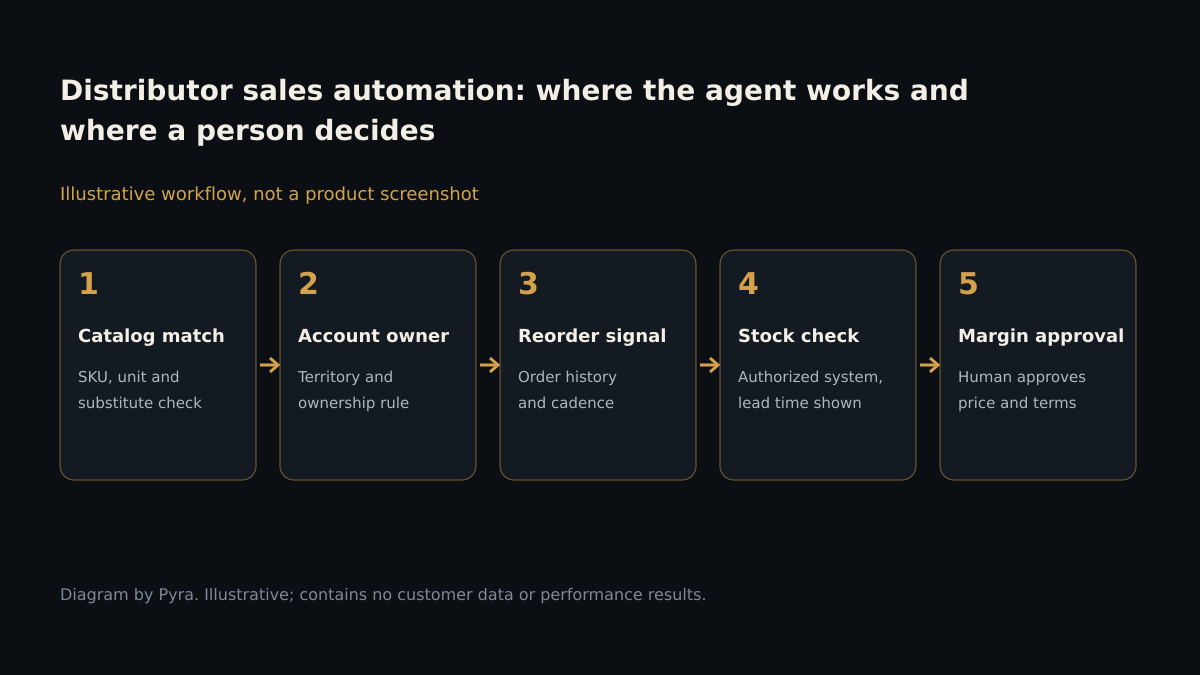
AI sales automation for distributors differs from software-sales automation in one way that matters: the hard part is rarely finding a prospect. It is matching what a customer asks for to a sellable SKU, deciding who owns the account, checking stock, and quoting a price that still earns a margin. Each step depends on data that lives in your own systems. No outside tool can supply it, and no article can tell you which of your systems an agent can safely read.
Scope of this guide: It describes a workflow design and its exceptions. It does not claim that any named product connects to your ERP, catalog or pricing system, and it contains no customer results.
A five-step workflow for AI sales automation for distributors
Start from the order of work a salesperson already follows, then decide for each step what an agent may prepare, what it may never decide, and what evidence it must show. The table is a design aid, not a feature list of any vendor.
AI sales automation for distributors workflow: what the agent prepares, what it needs, and who decides
| Step | Agent may prepare | Data it needs (from authorized systems) | Human decides |
|---|---|---|---|
| 1. Catalog and SKU match | Propose the SKU, unit of measure and pack size for a free-text request | Current catalog, supplier part numbers, cross-reference and substitution rules | Any substitution, and any request with no confident match |
| 2. Account and territory | Find the account, owner and ship-to; flag duplicates | CRM account records, territory assignments, house-account rules | Ownership disputes and new accounts that fit two territories |
| 3. Replenishment signal | List items an account usually reorders and when a gap appears | Order history by SKU and date, with returns and credits removed | Whether to contact the customer at all, and what to say |
| 4. Stock and lead time | Show on-hand quantity and quoted lead time with the system and timestamp | Read access to the inventory or ERP view you permit | Backorders, partial shipments and any promised date |
| 5. Margin-aware quote | Draft a quote inside a price band you define | Customer price lists, cost floor, contract terms | Anything below the floor or outside contract terms |
Rows are a template. Add your own steps, such as credit hold or hazardous-material rules, before relying on it.
Design the exceptions first in AI sales automation for distributors
A distributor's workflow is mostly exceptions. An agent that handles the easy case and guesses on the rest creates quotes someone must find and fix later. Write the exception rule before the happy path, and make the agent stop and hand over with its evidence.
Exception table: what should stop the agent
| Exception | Why it matters | Agent behavior to require |
|---|---|---|
| Ambiguous SKU or unit | A wrong pack size changes the price and the shipment | Ask or hand off; show the two closest matches and the difference |
| Discontinued or substituted item | Substitution may break a customer specification | Hand off with the supplier notice or catalog note attached |
| Stale stock data | A quote built on old stock can promise what you do not have | Show the read time; refuse to quote if the read is older than your limit |
| Price below the margin floor | The quote could lose money | Block the draft and route to the approver you name |
| Contract or rebate pricing | Special terms are easy to miss | Apply only terms stored in the pricing system; otherwise hand off |
| Customer on credit hold | Quoting may conflict with finance policy | Stop and notify the account owner |
Data access comes before any AI sales automation for distributors tool
Before choosing a tool, list each system the workflow touches and decide the access level: none, read, or draft-write. For most distributors, read access to catalog and inventory plus draft-only access to quotes is a sensible first boundary, because it lets an agent prepare work without changing records. Ask any vendor in writing which of your systems it can read, how access is granted and revoked, and whether every read and draft is logged. Treat an answer of "we integrate with everything" as unproven until a vendor names your system and shows the documentation.
Pyra describes its sales agents as execution agents with approval gates, audit trails and role-based access on the AI sales agents page. That page does not state integrations for any specific distributor system, so confirm scope in a scoping conversation rather than assuming it.
AI sales automation for distributors, worked example: a synthetic reorder gap
This example is invented to show the logic and is not a customer result. A distributor of fasteners notices that Account A usually reorders a particular bolt about every six weeks, and the last order was nine weeks ago.
- The agent flags the gap and shows the three prior orders it used, with dates.
- It checks the catalog: the bolt has a new supplier part number, so it marks the match as "needs review" instead of quoting.
- The salesperson confirms the replacement, and the agent checks stock from the permitted inventory view and records the time of the read.
- The agent drafts a quote at the customer's contract price. The price is above the margin floor, so no approval is needed.
- The salesperson reviews and sends it. The agent logs the draft, the sources and who approved.
The value in this example comes from the salesperson spending time on review instead of lookup. Whether that is worth the cost depends on your volume and on how clean your data is. Put your own numbers into our ROI calculator as a starting point and treat the result as an estimate.
What to measure in an AI sales automation for distributors pilot
- Match accuracy: the share of SKU matches a salesperson accepts without change, counted on a sample you pick before the pilot starts.
- Exceptions handed over: how many drafts stopped, and whether each stop was correct.
- Review time per quote: measured before and during the pilot on the same type of request.
- Margin leakage: quotes that reached a customer below your floor. The target is zero.
Set these measures before the pilot so the pilot cannot be judged on whatever looks good afterward.
Questions readers ask
What does AI sales automation for distributors do first?
The safest first step is preparation work with read-only access: matching requests to SKUs, finding the account owner, and drafting a quote for a person to review. Pricing, substitutions and promises of delivery stay with people.
Can AI sales automation for distributors set prices?
It can draft inside a price band you define, but price changes, margin exceptions and contract terms should require a named human approver.
Does this guide say which tools connect to my ERP?
No. It does not claim integrations for any product. Ask each vendor to name your ERP or inventory system and show its documentation.
How do I check data quality before AI sales automation for distributors?
Sample a set of recent requests, match them to SKUs by hand, and note how many need a substitution, a unit fix or a duplicate-account fix. That share tells you how much cleanup comes first.
Sources
- Pyra AI sales agents describes approval gates, audit trails and role-based access; no distributor-specific integrations are stated. Read Nov 23, 2026.
- Pyra AI agent ROI calculator estimates hours and loaded labor cost saved from the inputs you enter. Read Nov 23, 2026.
About the author
Bob Generale is COO and co-founder of Pyra, with 20+ years of Fortune 500 operations experience. This guide explains where automation can help distributor sales and where a person should decide, such as stock, pricing and margin. It was not tested against any distributor's systems, and the workflow is a design template.
Map your own distributor workflow
Bring one real quote request and your system list to a scoping conversation, and ask which steps can be prepared safely with read-only access.
Talk with Pyra