AI RFP Writer: Cited Answers, Source Expiry and Approval
An AI RFP writer for vendors: build a cited answer library, trace each answer to a requirement, handle source expiry, and route legal and finance approval.
An AI RFP writer is software that drafts answers to a request for proposal from material your company has already approved, so a response team spends its time on review instead of assembly. For a vendor, the useful version cites its source for every answer, links each answer to a numbered requirement, and stops when a source is missing or out of date. This guide shows how to set that up and gives a requirements-to-evidence matrix you can copy.
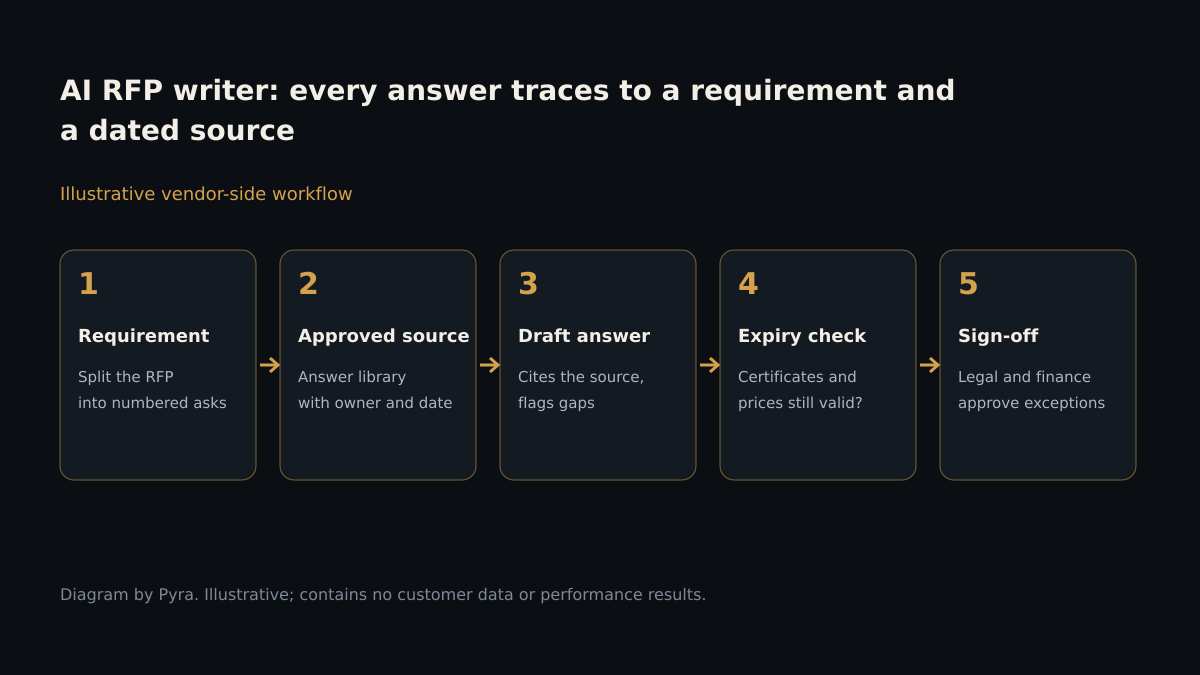
This guide is for the vendor side of the table: the team that receives an RFP and must answer it accurately, on time, and without promising something the company cannot deliver. If you are the buyer sending out requests for quotation, see our separate RFQ management software guide.
What an AI RFP writer should and should not do
An RFP response mixes three kinds of content: facts that never change (company details), facts that change on a schedule (certifications, prices, insurance), and judgement calls (how you would approach this customer's problem). An AI RFP writer is strongest on the first kind, useful with supervision on the second, and weakest on the third. Design for that.
- It should draft from an answer library you control, show which entry each sentence came from, and mark any requirement with no match.
- It should not invent a capability, a certification, a customer reference or a date. If it cannot cite an approved entry, it should say so.
- It should not decide pricing, legal terms or exceptions. Those need a named person.
Build the answer library before you use an AI RFP writer
A drafting tool is only as reliable as the library under it. Each entry should carry five fields: the approved text, an owner who can confirm it, the date it was last confirmed, an expiry rule, and the document it came from (policy, certificate, contract template). Entries without an owner or date should not be eligible for automatic drafting. This rule keeps a lapsed certificate or an unconfirmed policy from being described as current.
Requirements-to-evidence matrix
Use a matrix like this for every response. Each row is one requirement from the RFP. The AI RFP writer fills the draft and source columns; people complete the status and approver columns.
Requirements-to-evidence matrix (template with synthetic example rows)
| Req # | Requirement (RFP text) | Draft answer source | Source owner and date | Expiry | Status | Approver |
|---|---|---|---|---|---|---|
| 4.2 | Describe your information security program | Security policy summary, entry SEC-01 | Security lead, confirmed 2026-09-30 | 12 months | Ready for review | Security |
| 5.1 | Provide certificate of insurance | Certificate PDF, entry INS-03 | Finance, issued 2026-06-01 | Policy end date | Check expiry | Finance |
| 6.3 | State pricing for 500 seats | No approved entry | None | Not applicable | Gap: human answer | Finance and sales |
| 7.4 | Confirm data residency options | Product documentation excerpt, entry PRD-12 | Product, confirmed 2026-08-15 | 6 months | Needs legal review | Legal |
Rows are invented to show the format. They are not from a real response.
Source expiry and approvals
Set an expiry rule per source type rather than trusting a general date. Certificates and insurance end on a printed date. Policies change on an owner's schedule. Product facts change when the product does. When a draft cites an expired or unconfirmed source, the tool should flag it in the matrix instead of quietly using it. Route legal and finance items to those teams every time, and keep a record of who approved what before the response is sent.
Where Pyra's RFP agent fits
Pyra's RFP / RFQ response agent is described on its product page as reading the requirements, pulling your pricing and proof, and writing the response in your format, with experts approving every draft. The page also states SOC 2 Type II audit status. Treat the draft quality and any speed claim on that page as the vendor's statements until you test the agent on your own past RFPs. The sensible test is to run it on three completed responses and compare each answer to what your team actually sent.
A small pilot plan
- Pick three past RFPs of different sizes, including one you lost.
- Build or clean the answer library entries those responses used, with owner and date.
- Run the drafting tool and score each answer: accurate, needs edit, wrong, or gap.
- Count the gaps the tool flagged honestly versus the errors it did not flag. Unflagged errors matter most.
- Time the review compared with your normal assembly time, and decide only after that.
Questions readers ask
What is an AI RFP writer?
It is software that drafts answers to a request for proposal from content a company has already approved, ideally citing the source of each answer and flagging requirements it cannot answer.
Can an AI RFP writer replace the proposal team?
No. It reduces assembly work, but people still own pricing, legal terms, exceptions and final approval.
How do I stop an AI RFP writer from using outdated claims?
Give every library entry an owner, a confirmation date and an expiry rule, and require the tool to flag any entry past expiry or without an owner.
Is this guide for buyers or vendors?
It is for vendors responding to RFPs. Buyers collecting quotes should see our RFQ management software guide.
Sources
- Pyra RFP / RFQ response agent product description, human approval and SOC 2 Type II statement. Read Nov 23, 2026.
About the author
Bob Generale is COO and co-founder of Pyra, with 20+ years of Fortune 500 operations experience. This guide explains how to tie each proposal answer to a requirement and a dated source. The matrix is a template, not a real response, and no AI RFP product was tested for this article.
Test drafting on your own past RFPs
Bring three completed responses and your answer library to a conversation about the RFP agent, and compare its drafts with what your team sent.
Talk with Pyra