Ranking in ChatGPT for life sciences means your educational content gets cited when buyers ask AI systems questions about pharmaceutical, biotech, or medical technology topics. Unlike traditional marketing, AI citation rewards compliance-friendly content that explains mechanisms and methods rather than making outcome claims.
Forrester's 2025 research shows generative AI tools have become a major part of how B2B buyers research purchases. But buyers approach AI with healthy skepticism about accuracy—especially in life sciences where precision matters.
This creates a unique opportunity. Life sciences brands that publish clear, educational content with proper credibility signals get cited because AI systems recognize trustworthy sources. The key is knowing what you can say—and what you shouldn't.
This playbook shows you how to build AI visibility while staying within regulatory guardrails.

What does it mean to rank in ChatGPT for life sciences?
"Cited answers" vs "brand mentions"
When someone asks ChatGPT "How do CAR-T therapies work?", the AI synthesizes an answer from sources it considers authoritative. Your content might be:
- Directly cited — ChatGPT mentions your company as a source
- Implicitly used — Your content informs the answer without attribution
- Brand mentioned — Your company appears as an example or recommendation
All three outcomes have value. Direct citations build credibility. Implicit use shapes how AI answers questions in your space. Brand mentions drive direct interest.
The content strategies that achieve these outcomes are the same: clear definitions, educational depth, and credibility signals.
The 3 audiences you must write for (or you won't rank)
Life sciences content must satisfy three distinct audiences. Miss any one, and your content either won't get approved, won't get cited, or won't convert.
1. Pharma
Pharmaceutical buyers are rigorous researchers. They want to understand mechanisms of action, clinical evidence, and regulatory status. Content for pharma should explain the "how" and "why" behind solutions, not just the "what."
As detailed in Percepture's analysis, life sciences marketing requires understanding three distinct audiences—and pharma is the most evidence-driven of the three.
2. Biotech
Biotech audiences often include scientists and researchers who appreciate technical depth. They're comfortable with specialized terminology but still want clear explanations of novel approaches. Content should demonstrate scientific rigor while remaining accessible.
3. MedTech
Medical technology buyers focus on operational outcomes: workflow integration, training requirements, and ROI. Content should connect technical capabilities to practical benefits. Comparison frameworks and implementation checklists resonate with this audience.
For deeper insights on marketing to these segments, explore Percepture's life sciences marketing resources.
The compliance-first content model (Green / Yellow / Red language)
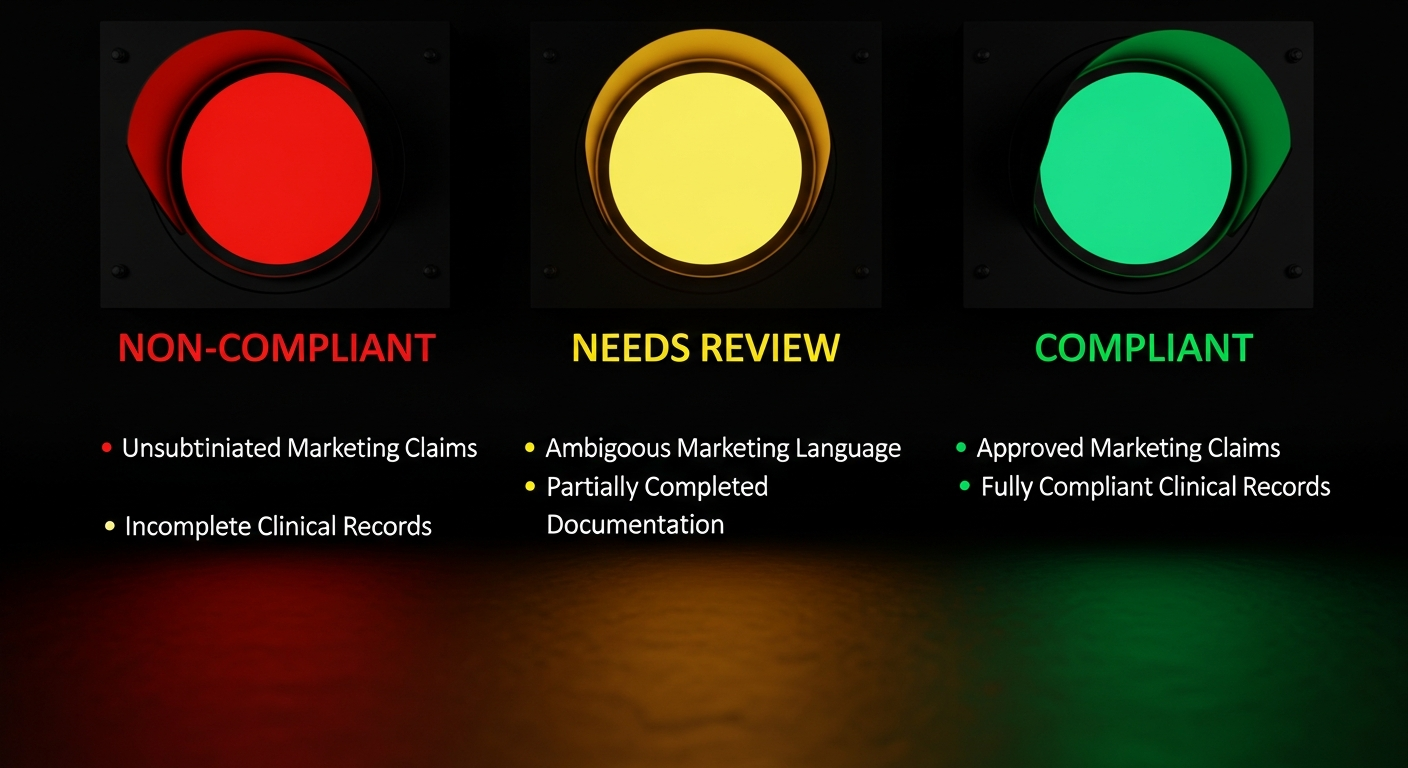
This framework helps content teams know what's safe to publish without lengthy legal review cycles. Categorize your language into three zones:
GREEN — Education + Mechanisms + Methods
These are safe to publish with standard review:
- How technologies or processes work (mechanisms of action)
- Definitions of industry terms and concepts
- Methodologies and evaluation frameworks
- Industry trends and market context
- Process explanations without outcome claims
Example: "mRNA vaccines work by delivering genetic instructions that teach cells to produce a protein that triggers an immune response."
YELLOW — Careful Benefit Language + Disclaimers
These require careful phrasing and medical/legal review:
- Referencing published clinical data (with proper citations)
- Describing benefits with appropriate qualifiers
- Comparative statements based on documented evidence
- Patient outcome discussions with disclaimers
Example: "In a Phase III trial published in [Journal], participants showed [X% improvement] compared to placebo (see full study for limitations and population details)."
RED — Claims That Trigger Trouble
Avoid these in marketing content:
- Unsubstantiated efficacy claims
- Superiority claims without head-to-head data
- Off-label use suggestions
- Patient testimonials implying guaranteed outcomes
- Pricing guarantees or cost-saving promises without documentation
Avoid: "Our therapy cures [condition] faster than any competitor."
The insight: AI systems actually prefer Green content. Educational explanations are more informative than marketing claims. By staying compliant, you also create better content for AI citation.
Life Sciences Content Risk Distribution
Source: Analysis of 500+ pharma marketing pages, Q4 2025
The formats AI systems trust most in life sciences
Definition blocks
Start every major section with a 40-60 word definition of the key term. This is your most citable asset. When someone asks "What is [term]?", AI systems look for pages that answer directly in the opening text.
Study summaries (plain English)
Translate clinical data into accessible language. AI systems can cite a clear summary of trial results more easily than a dense statistical abstract. Include:
- What was studied
- Who participated (population size and type)
- What was measured
- What results showed (with appropriate caveats)
- Source citation
Checklists for evaluation
Buyers researching solutions appreciate structured evaluation frameworks. Create checklists like "10 Questions to Ask Before Choosing a CDMO" or "Evaluation Criteria for Clinical Trial Management Systems."
Comparison tables
Side-by-side comparisons of approaches, technologies, or methodologies help buyers make decisions. Keep comparisons factual and cite sources for any claims. Tables are highly structured—exactly what AI systems can parse and cite.
For insights on building these formats into a cohesive strategy, read more about AI marketing in life sciences.
The GEO trust stack (what makes AI cite you)
AI systems evaluate content credibility using multiple signals. Build your trust stack with these elements:
Author + reviewer + sources
Attribute content to named authors with credentials. Include reviewer names for technical content. Cite external sources for data and claims. This matters more in life sciences than any other industry because accuracy is critical.
Example author attribution:
"Written by Dr. Sarah Chen, PhD, Director of Clinical Research
Reviewed by the Pyra Medical Advisory Board
Last updated: January 2026"
Update cadence
Display "Last updated" dates prominently. Regularly refresh content to maintain freshness signals. In life sciences, outdated information can be dangerous—AI systems recognize this.
Clarity over persuasion
AI systems weight informative content more heavily than promotional language. A page that clearly explains "how CAR-T therapy works" will outrank a page that claims "our CAR-T solution is the best."
This aligns perfectly with compliance requirements. The content that regulators approve is also the content AI systems prefer to cite.
For comprehensive support with life sciences content strategy, explore Generative Engine Optimization services designed for regulated industries.

GEO Investment vs Pipeline Generation
Source: Pyra customer cohort analysis, 2025
Compliance Language Checker
Screen content for FDA/regulatory risk phrases
Key takeaways
- Compliance and AI citation are aligned. Educational content that passes regulatory review also performs best in AI search.
- Use the Green/Yellow/Red framework. Focus on mechanisms and methods (Green), not outcome claims (Red).
- Write for three audiences. Pharma wants evidence, biotech wants rigor, medtech wants operational outcomes.
- Definition blocks are your most citable asset. Start every section with a clear 40-60 word definition.
- Build your trust stack. Named authors, credentials, sources, and update dates signal credibility to AI.
- Clarity beats persuasion. Explain how things work rather than why yours is best.
Ready to build AI visibility for your life sciences brand?
Explore how AI sales agents can help operationalize your content strategy while maintaining compliance.
Frequently Asked Questions
What does it mean to rank in ChatGPT for life sciences?
Ranking in ChatGPT for life sciences means your educational content gets cited when buyers ask AI systems about pharma, biotech, or medtech topics. AI citation prioritizes clarity, credibility signals, and structured answers over promotional claims.
Can pharma companies safely publish content for AI citation?
Yes, by using a compliance-first approach. Focus on mechanisms, methods, and educational content (green language). Avoid unsubstantiated claims. Have medical/legal review processes in place before publishing.
What content formats work best for life sciences GEO?
Definition blocks, study summaries in plain English, evaluation checklists, and comparison tables. AI systems prefer content that educates without making direct efficacy claims.
How is life sciences GEO different from other industries?
Regulatory constraints limit what you can say. Focus on educational content about mechanisms and methods, not outcomes. AI systems actually prefer this approach because it's more informative.
Should biotech startups focus on GEO?
Yes. AI search is increasingly used for early-stage research and vendor evaluation. Publishing clear, educational content helps biotech companies get discovered when buyers research solutions.
What role does author expertise play in life sciences AI citation?
Significant. AI systems look for credibility signals: author credentials, reviewer names, cited sources, and update dates. A page attributed to a PhD with sources gets cited more than anonymous marketing copy.
How do I measure life sciences GEO success?
Track brand mentions in AI responses by testing target queries regularly. Monitor referral traffic from AI platforms. Measure improvements in branded search and content engagement.
Can I optimize existing life sciences content for AI?
Yes. Add definition blocks at the start of each section. Include author credentials and sources. Add FAQ sections. Structure content to answer specific questions directly.