Best Prompts for AI to Write SEO-Optimized Product Descriptions 2026
The best prompts for AI to write SEO-optimized product descriptions in 2026: seven templates built on a verified fact sheet, search intent, structure, voice, batch uniqueness and a fact-check pass. Google sources read Nov 16, 2026.
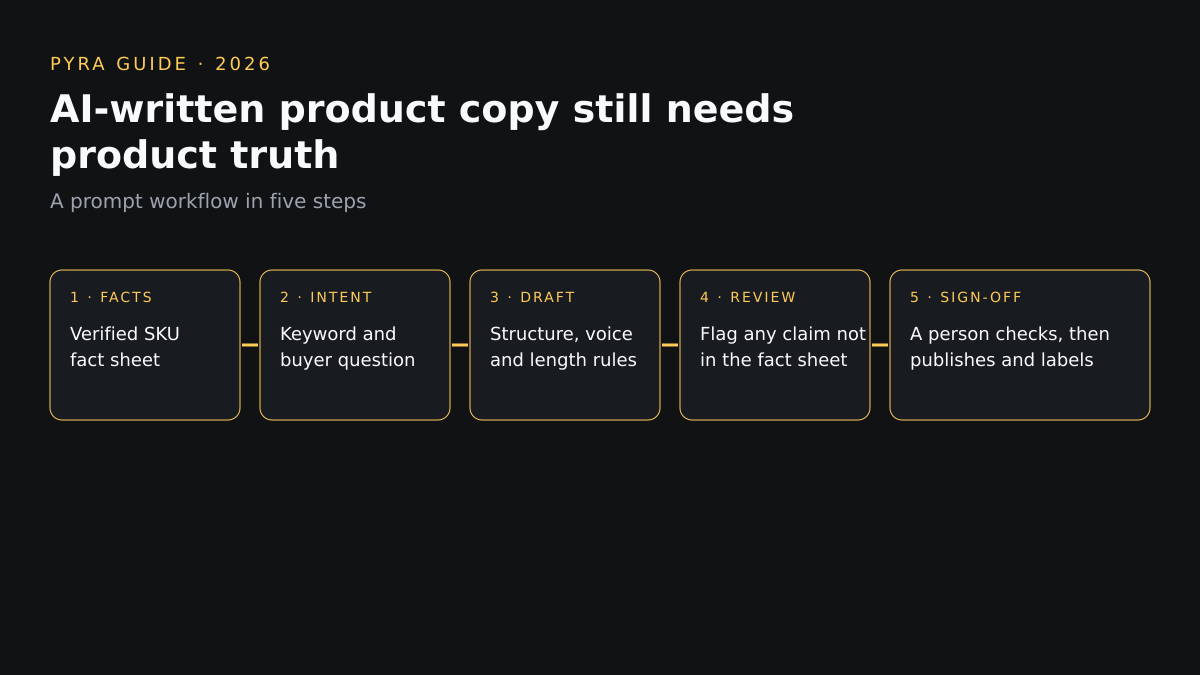
Short answer: the best prompts for AI to write SEO-optimized product descriptions restrict the model to a verified fact sheet, ask it to list missing information instead of guessing, add one primary keyword and the buyer's question, fix the layout, and then run a separate fact-check prompt. This guide gives seven templates in that order for 2026.
AI-written product copy still needs product truth. This guide is for ecommerce owners, merchandisers and SEO writers who produce product pages in ChatGPT, Claude, Gemini or any similar assistant. The prompts are Pyra's own wording and are tool-agnostic; they have not been tested for ranking or conversion, and no results are claimed. The Google statements below come from its guidance on generative AI content, read on November 16, 2026.
What most prompt lists miss
Search results for this query are mostly lists of 15 to 20 copy-paste prompts from prompt libraries and AI-tool vendors. Many stop at the draft. The part buyers need is what happens before and after: where the facts come from, and who checks the output. Google's guidance says generative models do not retrieve facts but predict likely sequences of words, so outputs may contain inaccuracies, and that AI-generated content should be fact-checked and reviewed before publishing, including titles, meta descriptions and structured data. The templates below build those steps in.
How the prompts were compared
Six criteria, applied to every template as written. These are design properties, not test results.
| Criterion | The question it answers |
|---|---|
| Product-truth grounding | Does the prompt restrict the model to a fact sheet and surface missing facts? |
| Search intent | Does it connect the copy to a keyword and the buyer's question? |
| Structure and length control | Does it fix a layout and limits? |
| Brand voice | Does it anchor tone in approved examples? |
| Catalog uniqueness | Does it guard against duplicate text across SKUs? |
| Review step | Does it make errors visible for a human to check? |
Criteria built for AI-answer rank trackers, such as engine coverage, exact cited-source visibility and history depth, do not apply to prompts, so they are not used here; the section on measuring discovery below covers that job separately. No prompt was run for this guide, and none is scored.
Seven prompts compared
Scroll sideways on small screens.
| Prompt | Product-truth grounding | Search intent | Structure and length control | Brand voice | Catalog uniqueness | Review step |
|---|---|---|---|---|---|---|
| 1. Fact-grounded base prompt | Yes | Partly | Partly | No | No | Partly |
| 2. Search-intent prompt | Partly | Yes | Partly | No | No | No |
| 3. Benefit-hierarchy and structure prompt | Yes | Partly | Yes | No | No | No |
| 4. Brand-voice prompt | Partly | No | No | Yes | No | No |
| 5. Title and meta description prompt | Yes | Yes | Yes | Partly | No | No |
| 6. Catalog batch prompt | Yes | Partly | Yes | Partly | Yes | Partly |
| 7. Fact-check reviewer prompt | Yes | No | No | No | Partly | Yes |
The prompts
Replace the bracketed fields. Use the prompts in order: 1 to 3 together as one draft prompt, 4 and 5 as needed, 6 for batches, and 7 always.
1. Fact-grounded base prompt
Best for: Any catalog where wrong specs, materials or claims cost you returns or trust.
You are an ecommerce copywriter for [category]. Write a product description for the product below using ONLY the facts in the fact sheet. If a detail a shopper would expect (size, material, care, warranty) is missing from the fact sheet, list it under 'Missing information' instead of guessing. Do not add superlatives, awards, certifications or comparisons that are not in the fact sheet.

FACT SHEET:
[paste SKU record: name, materials, dimensions, colors, care, warranty, price, what is in the box]
Inputs: A verified fact sheet per product.
Strength: Turns hallucination risk into a visible 'Missing information' list you can fill in.
Limitation: The output is only as accurate as the fact sheet, and the model can still misread it.
Verify before publishing: Every number, material and claim in the draft against the fact sheet.
2. Search-intent prompt
Best for: Pages that should answer the question a buyer typed, not just contain a keyword.
Primary keyword: [keyword]. Secondary terms: [2 to 3 terms]. The shopper's likely question is: [question, such as 'Will this fit a 15-inch laptop?']. Write the description so the first two sentences answer that question using the fact sheet. Use the primary keyword once, where it reads naturally, and use the secondary terms only if they describe a real feature. Do not repeat any term for its own sake.
Inputs: One primary keyword, up to three secondary terms, one buyer question.
Strength: Puts the answer a buyer wants first and limits keyword repetition by instruction.
Limitation: The prompt does not know search volume or what already ranks; choose terms from your own keyword research.
Verify before publishing: That the opening answers the stated question and reads like a person wrote it.
3. Benefit-hierarchy and structure prompt
Best for: Product pages that need a scannable layout shoppers can read in seconds.
Format the description as: (1) a one-sentence lead that states who the product is for and the main benefit, (2) three bullets, each starting with a feature and ending with what it means for the buyer, (3) a short specifications list taken exactly from the fact sheet, (4) one sentence on care, returns or warranty if the fact sheet includes them. Keep the whole description under [word limit] words. Order benefits by importance to [buyer type].
Inputs: Fact sheet, a word limit and a buyer type.
Strength: Gives every product the same predictable layout, which makes review faster.
Limitation: A fixed template can make unlike products read alike.
Verify before publishing: That the specification list matches the fact sheet character for character.
4. Brand-voice prompt
Best for: Brands with an established tone that generic output flattens.
Match the voice of the three approved examples below: sentence length, level of formality, use of humor and words to avoid. Do not copy their phrases. Examples:
[paste 3 approved product descriptions]
Words to avoid: [list]. Then rewrite the draft above in that voice without changing any fact.
Inputs: Three approved descriptions and a list of banned words.
Strength: Anchors tone in your own approved copy instead of an adjective like 'friendly'.
Limitation: Voice rewrites can quietly change meaning, so run a fact check afterward.
Verify before publishing: That no fact, number or claim changed between the draft and the rewrite.
5. Title and meta description prompt
Best for: Pages where the search snippet text also needs writing.
Write a page title of at most [your character limit] characters and a meta description of at most [your character limit] characters for this product. Include the primary keyword once in the title. The meta description must state one concrete benefit from the fact sheet and must not promise anything the fact sheet does not state, such as free shipping or discounts.
Inputs: Fact sheet, primary keyword and your own length limits.
Strength: Keeps snippet text tied to the same facts as the page.
Limitation: Length limits are your choice; search engines may rewrite titles and descriptions.
Verify before publishing: Title and description against the live page, because Google says this review also applies to title elements, meta descriptions and structured data.
6. Catalog batch prompt
Best for: Many similar SKUs, such as size or color variants, where duplicate text is the risk.
Below are [number] product records. Write one description per record, in the same layout, using only that record's facts. Give each product a different opening angle based on what is actually different about it. Do not reuse any sentence across products. If two records are too similar to describe differently, say so instead of padding. Return the output as a table: SKU, description, missing information.
Inputs: A table of SKU records.
Strength: Asks for a per-SKU output with traceable fields and permission to say two products are too alike.
Limitation: Large batches are harder to review, and Google's spam policy covers generating many pages without adding value for users.
Verify before publishing: Pages that add something for shoppers, such as real specs, fit notes or photos, not only reworded text.
7. Fact-check reviewer prompt
Best for: A second pass before a person signs off.
Act as a strict editor. Compare the description to the fact sheet. List every claim, number, material or benefit in the description that is NOT stated in the fact sheet, quoting the sentence. Then list any repeated phrasing or keyword stuffing. Do not rewrite anything; only report problems.
Inputs: The fact sheet and the draft.
Strength: Separates writing from checking, so the second pass hunts for errors instead of polishing.
Limitation: A model reviewing a model can miss the same error; it supports a human check and does not replace it.
Verify before publishing: Every item the reviewer flags and, separately, a sample of items it did not flag.
Before you publish AI-written descriptions
Google's guidance says that using generative AI to produce many pages without adding value for users may violate its scaled content abuse policy, so a catalog full of lightly reworded text is a risk the batch prompt cannot remove. It also says Google Merchant Center has policies for AI-generated content: AI-generated title and description attributes must be specified separately and labeled as AI-generated. Confirm the current policy in your Merchant Center account before uploading a feed. Our ChatGPT SEO analysis tools guide covers tools that analyze pages after they are written.
After publishing: measuring discovery and acting on signals
Content and creative distribution influence discovery, but a prompt does not tell you whether answer engines name your products. Prime AI Visibility measures whether ChatGPT, Perplexity and other answer engines mention and cite your brand and pages for your buyers' questions; it does not monitor Google organic rankings, and a copywriting prompt does not provide that measurement. Prime's guide to AI visibility strategy lays out a loop: start from business context, baseline what engines say, fix the gaps, remeasure, and count mentions and citations as separate signals. For Perplexity specifically, our Perplexity rank trackers guide is the place to compare tools.
If you sell wholesale or to businesses, Lead Seeker handles B2B prospecting: you describe the buyer in plain English and it returns prospects with a verified email and a source-backed dossier. It does not write product copy or track AI answers. When intent signals need to become qualified account selection, campaign execution or sales activation, Percepture's B2B intent data services help design that signal-to-sales workflow. For the wider marketing work around content, see our marketing agents page.
AI product description prompts: questions buyers ask
What are the best prompts for AI to write SEO-optimized product descriptions?
The strongest pattern in this guide is a fact-grounded prompt: paste a verified fact sheet, tell the model to list missing information instead of guessing, add one primary keyword and the buyer's question, fix the layout, then run a separate review prompt. Seven templates are given above. They are Pyra's own wording and have not been tested for ranking or conversion results.
Does Google allow AI-written product descriptions?
Google's guidance on generative AI content says the tools can add structure to original content, but generating many pages without adding value for users may violate its scaled content abuse policy. It says to fact-check and review AI-generated content before publishing, including titles, meta descriptions and structured data. Check the current page before you publish at volume.
Do I have to label AI-generated product descriptions in Merchant Center?
Google's page on generative AI content states that AI-generated product data such as title and description attributes must be specified separately and labeled as AI-generated in Google Merchant Center, and that AI-generated images need IPTC DigitalSourceType metadata. Merchant Center policies can change, so confirm the current requirement in your account.
How many times should the keyword appear in the description?
No search engine publishes a fixed number. The template in this guide asks for the primary keyword once, where it reads naturally, and tells the model not to repeat any term for its own sake. Choose terms from your own keyword research and read the output aloud before publishing.
Why not ask the model for facts it does not have?
Google's guidance notes that generative models do not retrieve facts but predict likely sequences of words, so outputs can contain inaccuracies. That is why every template restricts the model to a pasted fact sheet and why a person checks specs, claims and numbers before publishing.
Sources
Google Search Central, Google Search's guidance on using generative AI content on your website (read November 16, 2026). Prompt templates are Pyra's own wording. Written by Bob Generale, COO and co-founder of Pyra.
Connect product content to AI-answer measurement
If you want Pyra to design how product content, AI-answer measurement and account follow-up fit one workflow, talk with the team.