Best B2B Marketing Analytics Tools 2026: Six Compared
The best B2B marketing analytics tools in 2026: Google Analytics, Data Studio, Funnel, HubSpot, Dreamdata and HockeyStack compared on nine criteria, from workflow and AI to governance and price.
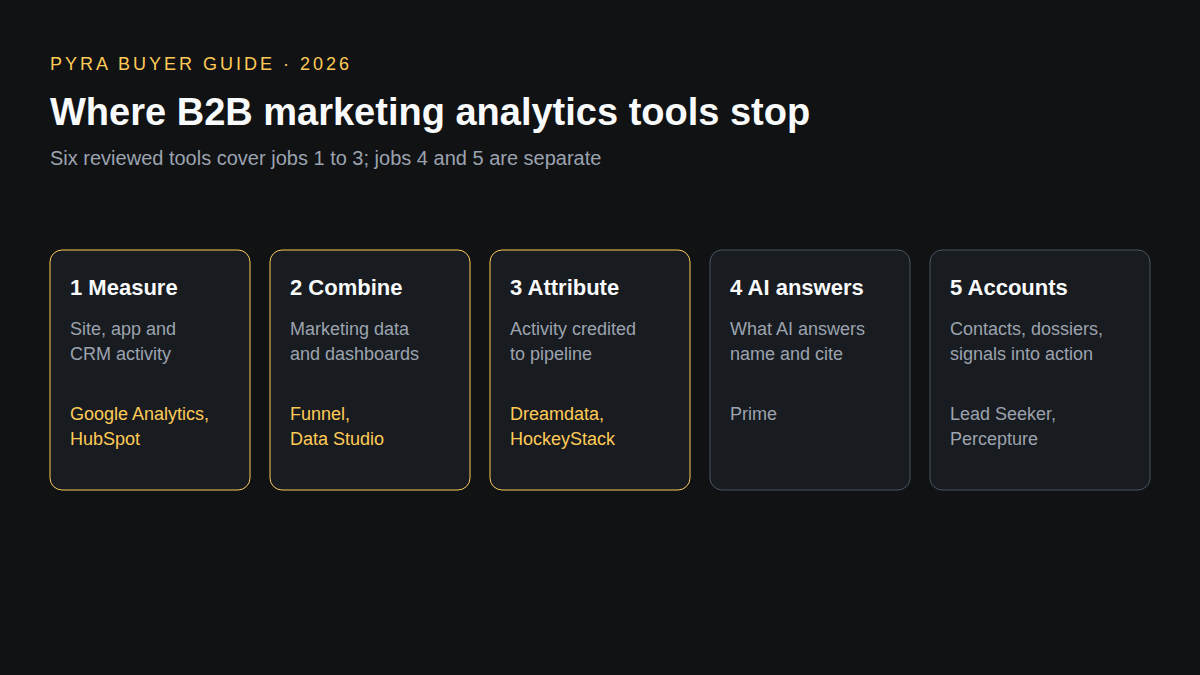
Short answer: the best B2B marketing analytics tools depend on the question you need answered. Google Analytics measures site and app behavior at no cost, Data Studio builds dashboards, Funnel combines marketing data, and Dreamdata and HockeyStack attribute activity to pipeline. HubSpot reports inside its CRM. Of six tools reviewed on November 8, 2026, HockeyStack lists no price.
This guide is for B2B marketing and revenue operations leads choosing how to measure campaigns against pipeline. A dashboard cannot fix an undefined metric, so decide the question first and then the tool. Prices and plan limits reflect vendor pages reviewed on November 8, 2026. Pyra makes Prime and Lead Seeker, covered later and not part of the comparison. Bob Generale, who wrote this guide, is also President of Percepture. "Not described" means the pages reviewed did not say, not that the feature is absent.
How the best B2B marketing analytics tools were compared
The same nine criteria were applied to every option, using only its public product, pricing and documentation pages. No hands-on test was run, and nothing here measures attribution accuracy or marketing results. The tools do different jobs (collect, combine, report, attribute), so the tables compare what each page describes rather than ranking them against each other; the profile order runs from free general tools to B2B attribution platforms. The set is not exhaustive. Prices are the figures displayed on the review date and differ by billing term.
| Criterion | The question it answers |
|---|---|
| Use-case fit | Is it built for B2B account and pipeline questions, or for general marketing? |
| Workflow depth | Does it collect, combine, model or only report? |
| Collaboration | Does it describe seats, workspaces or roles? |
| Analytics and measurement | Which attribution or reporting methods does it list? |
| AI assistance | What does the AI do? |
| Integrations | Does it name the systems it connects to? |
| Brand governance | Are access, SSO or audit controls described? |
| Pricing | Is a price published, and for which plan? |
| Time to value | Is there a free plan, trial or demo-led onboarding? |
Best B2B marketing analytics tools compared
Two tables, the same six tools in profile order. The first covers fit, workflow, collaboration, analytics and AI; the second covers integrations, governance, price and time to value. Scroll sideways on small screens.
| Tool | Kind | Use-case fit | Workflow depth | Collaboration | Analytics | AI assistance |
|---|---|---|---|---|---|---|
| Google Analytics | Free web and app analytics | Customer-journey measurement across sites and apps; the page does not describe account-level or B2B pipeline reporting | Built-in automation, flexible reporting and cross-platform attribution | Shareable reports and an interface described as easy to collaborate in; roles are not described on the page reviewed | Cross-platform attribution and reporting on how customers interact across sites and apps through their lifecycle | Google machine learning to uncover insights and anticipate customer actions |
| Data Studio (formerly Looker Studio) | Free dashboard and reporting layer | Dashboards and reports on data from other sources; it does not collect marketing data itself | A drag-and-drop report editor, interactive viewer filters and calculated fields | Reports can be shared with your team or with the world | Charts and customizable reports; attribution modeling is not described | Not described on the documentation page reviewed |
| Funnel | Marketing data hub with measurement add-ons | Collecting and organizing marketing data; Funnel Measure adds media measurement for brands by ad spend | A Data Hub with semantics for your business logic, budgets and targets context, dashboards and data storage; Funnel Measure adds always-on MMM and MTA | Unlimited users and workspaces on Business and Enterprise; advanced roles, permissions and an audit log on Enterprise | Dashboards in the Data Hub; MMM, MTA and incrementality testing in Funnel Measure, an add-on for Business and Enterprise | Unlimited use of Funnel AI and an MCP connection to Claude, ChatGPT and other AI tools |
| HubSpot Marketing Hub | Marketing platform with CRM-based reporting | Marketing automation and reporting for any business; the pricing page does not describe B2B account-based attribution beyond Enterprise | Email, simple automation and ad management on Starter; omni-channel campaigns and social on Professional | Free for up to 2 users; Professional includes 3 core seats and Enterprise 5, with extra seats priced per month | Multi-touch revenue attribution, customer journey analytics and behavioral event reporting on Enterprise | Agent Hub and Agent Builder on Starter; HubSpot AEO is a $50 a month add-on that tracks 25 prompts across ChatGPT, Gemini and Perplexity |
| Dreamdata | B2B attribution and activation platform | B2B analytics and attribution for go-to-market teams | B2B web analytics, an audience builder, notifications and an ad spend report on Free; custom attribution models, revenue and content analytics and an Activation add-on on the paid plan | 5 seats on Free; multiple business units and a dedicated CSM on the paid plan | Engagement scoring and company identification on Free; custom reporting on ROI and ROAS and AI-powered report summaries on the paid plan | An Analytics Agent for plain-English questions and an MCP server for your own LLM; AI-based attribution on the paid plan |
| HockeyStack | B2B attribution and revenue analytics platform | Attribution for marketing, GTM operations and sales leaders, from first touch to closed-won | Multi-touch attribution with side-by-side models, lift and incrementality reports, and custom reports without SQL | Pages are organized for marketing leaders, GTM operations and sales leaders; seats are not described | Buyer-journey views including anonymous touches, model comparison and lift reports | AI agents that surface forward-looking recommendations and a next best action per segment |
| Tool | Integrations | Brand governance | Pricing | Time to value |
|---|---|---|---|---|
| Google Analytics | Google Ads, Search Ads 360, Display & Video 360, Google Cloud and Google Search Console | A feature brief on controlling how data is used is linked; specific controls are not listed on the page reviewed | Described as free of charge | A get-started link with no purchase step |
| Data Studio (formerly Looker Studio) | A data source tutorial is listed; the connector list is not on the page reviewed | Not described on the page reviewed | Described as a no-cost tool | A start-free link with a quick start guide and report tutorial |
| Funnel | 117 connectors and 13 destinations on Starter, 579 and 46 on Business, 600+ and 47 on Enterprise, with Power BI, Tableau, BigQuery, Amazon S3 and, on Enterprise, Snowflake | Enterprise SSO and provisioning (SAML, OIDC, SCIM), advanced roles and permissions, an audit log and an enterprise SLA | Starter, Business and Enterprise Data Hub plans with capacity sold as flexpoints; Digital Measurement shows an estimated $2,250 a month billed annually at $500K to $1M monthly ad spend; Advanced Measurement is custom | A 14-day Data Hub trial with no card required |
| HubSpot Marketing Hub | Not detailed on the pricing page reviewed | Email approvals and limits on access to content and data on Enterprise | Free $0; Starter from $7 a month per seat (shown beside $20 under another billing term); Professional from $800 a month plus one-time onboarding of $3,000; Enterprise from $3,600 a month plus one-time onboarding of $7,000 | A free plan with no credit card; a 28-day trial of HubSpot AEO |
| Dreamdata | Slack and Teams notifications and one sync on Free; custom data sources, an event builder and custom UTM mapping on the paid plan | SSO and SAML on the paid plan (SCIM as an add-on); a trust center for security documentation | Free $0 a month with 2 months of user history, 3 stage models and 1 sync; the paid Attribution & Activation plan is custom priced by monthly tracked users | A free plan with self-serve onboarding and no credit card, and a guided free trial of the paid plan |
| HockeyStack | Two-way sync with your CRM, ad platforms and warehouse; every plan includes integrations with GTM tools and CRM | Not described on the pages reviewed | No price on the pricing page, which asks for a demo request | Demo-led, with hands-on support from a success team |
Profiles
1. Free web and app analytics
Google Analytics
Best fit: Teams that need to see how visitors reach and use a site or app before paying for B2B attribution.
Use-case fit: Customer-journey measurement across sites and apps; the page does not describe account-level or B2B pipeline reporting. Workflow: Built-in automation, flexible reporting and cross-platform attribution.
Collaboration: Shareable reports and an interface described as easy to collaborate in; roles are not described on the page reviewed. Analytics: Cross-platform attribution and reporting on how customers interact across sites and apps through their lifecycle.
AI: Google machine learning to uncover insights and anticipate customer actions. Integrations: Google Ads, Search Ads 360, Display & Video 360, Google Cloud and Google Search Console. Governance: A feature brief on controlling how data is used is linked; specific controls are not listed on the page reviewed.
Pricing: Described as free of charge. Time to value: A get-started link with no purchase step.
Strength: A no-cost measurement foundation with first-party links to Google's advertising tools.
Limitation: The page describes no CRM or account-level pipeline attribution, and its integrations list centers on Google products.
What to verify: Whether your B2B questions need account or opportunity data that your CRM holds and this tool does not report.
Source: marketingplatform.google.com Analytics page (reviewed November 8, 2026).
2. Free dashboard and reporting layer
Data Studio (formerly Looker Studio)
Best fit: Teams that already hold data elsewhere and need shareable dashboards on top of it.
Use-case fit: Dashboards and reports on data from other sources; it does not collect marketing data itself. Workflow: A drag-and-drop report editor, interactive viewer filters and calculated fields.
Collaboration: Reports can be shared with your team or with the world. Analytics: Charts and customizable reports; attribution modeling is not described.
AI: Not described on the documentation page reviewed. Integrations: A data source tutorial is listed; the connector list is not on the page reviewed. Governance: Not described on the page reviewed.
Pricing: Described as a no-cost tool. Time to value: A start-free link with a quick start guide and report tutorial.
Strength: Free, shareable dashboards that can sit on top of the tools below.
Limitation: It reports on other tools' data and the documentation page reviewed lists no connectors, AI features or governance controls.
What to verify: Which connectors your sources need and who owns the metric definitions behind each chart.
Source: cloud.google.com Data Studio documentation (reviewed November 8, 2026).
3. Marketing data hub with measurement add-ons
Funnel
Best fit: Teams that need ad and marketing data from many platforms combined and sent to a BI tool or warehouse.
Use-case fit: Collecting and organizing marketing data; Funnel Measure adds media measurement for brands by ad spend. Workflow: A Data Hub with semantics for your business logic, budgets and targets context, dashboards and data storage; Funnel Measure adds always-on MMM and MTA.
Collaboration: Unlimited users and workspaces on Business and Enterprise; advanced roles, permissions and an audit log on Enterprise. Analytics: Dashboards in the Data Hub; MMM, MTA and incrementality testing in Funnel Measure, an add-on for Business and Enterprise.
AI: Unlimited use of Funnel AI and an MCP connection to Claude, ChatGPT and other AI tools. Integrations: 117 connectors and 13 destinations on Starter, 579 and 46 on Business, 600+ and 47 on Enterprise, with Power BI, Tableau, BigQuery, Amazon S3 and, on Enterprise, Snowflake. Governance: Enterprise SSO and provisioning (SAML, OIDC, SCIM), advanced roles and permissions, an audit log and an enterprise SLA.
Pricing: Starter, Business and Enterprise Data Hub plans with capacity sold as flexpoints; Digital Measurement shows an estimated $2,250 a month billed annually at $500K to $1M monthly ad spend; Advanced Measurement is custom. Time to value: A 14-day Data Hub trial with no card required.
Strength: The longest connector and destination lists reviewed, with governance controls on its top plan.
Limitation: Its measurement add-ons are priced by ad spend, and the pages reviewed describe no B2B account or opportunity attribution.
What to verify: How many flexpoints your sources use, and whether Funnel Measure's ad-spend pricing fits a B2B budget.
Source: funnel.io pricing page (reviewed November 8, 2026).
4. Marketing platform with CRM-based reporting
HubSpot Marketing Hub
Best fit: Teams whose contacts, campaigns and deals already live in HubSpot and who need reporting beside them.
Use-case fit: Marketing automation and reporting for any business; the pricing page does not describe B2B account-based attribution beyond Enterprise. Workflow: Email, simple automation and ad management on Starter; omni-channel campaigns and social on Professional.
Collaboration: Free for up to 2 users; Professional includes 3 core seats and Enterprise 5, with extra seats priced per month. Analytics: Multi-touch revenue attribution, customer journey analytics and behavioral event reporting on Enterprise.
AI: Agent Hub and Agent Builder on Starter; HubSpot AEO is a $50 a month add-on that tracks 25 prompts across ChatGPT, Gemini and Perplexity. Integrations: Not detailed on the pricing page reviewed. Governance: Email approvals and limits on access to content and data on Enterprise.
Pricing: Free $0; Starter from $7 a month per seat (shown beside $20 under another billing term); Professional from $800 a month plus one-time onboarding of $3,000; Enterprise from $3,600 a month plus one-time onboarding of $7,000. Time to value: A free plan with no credit card; a 28-day trial of HubSpot AEO.
Strength: Attribution, journey analytics and approvals sit in the same product as the CRM data on its Enterprise plan.
Limitation: Attribution and journey analytics start at Enterprise, which costs from $3,600 a month plus onboarding.
What to verify: Which plan unlocks the attribution model you need and what the required onboarding fee covers.
Source: hubspot.com pricing page (reviewed November 8, 2026).
5. B2B attribution and activation platform
Dreamdata
Best fit: B2B teams that want a free starting plan, then account-level attribution with custom models.
Use-case fit: B2B analytics and attribution for go-to-market teams. Workflow: B2B web analytics, an audience builder, notifications and an ad spend report on Free; custom attribution models, revenue and content analytics and an Activation add-on on the paid plan.
Collaboration: 5 seats on Free; multiple business units and a dedicated CSM on the paid plan. Analytics: Engagement scoring and company identification on Free; custom reporting on ROI and ROAS and AI-powered report summaries on the paid plan.
AI: An Analytics Agent for plain-English questions and an MCP server for your own LLM; AI-based attribution on the paid plan. Integrations: Slack and Teams notifications and one sync on Free; custom data sources, an event builder and custom UTM mapping on the paid plan. Governance: SSO and SAML on the paid plan (SCIM as an add-on); a trust center for security documentation.
Pricing: Free $0 a month with 2 months of user history, 3 stage models and 1 sync; the paid Attribution & Activation plan is custom priced by monthly tracked users. Time to value: A free plan with self-serve onboarding and no credit card, and a guided free trial of the paid plan.
Strength: A published free plan with its limits, and a paid plan that lists AI and warehouse options.
Limitation: The Free plan keeps 2 months of history and 1 sync, and the paid plan has no public price.
What to verify: How your monthly tracked users compare with the free limit, and which attribution models the paid plan supports.
Source: dreamdata.io pricing page (reviewed November 8, 2026).
6. B2B attribution and revenue analytics platform
HockeyStack
Best fit: B2B teams that want to compare attribution models and run lift tests, and will work through a demo.
Use-case fit: Attribution for marketing, GTM operations and sales leaders, from first touch to closed-won. Workflow: Multi-touch attribution with side-by-side models, lift and incrementality reports, and custom reports without SQL.
Collaboration: Pages are organized for marketing leaders, GTM operations and sales leaders; seats are not described. Analytics: Buyer-journey views including anonymous touches, model comparison and lift reports.
AI: AI agents that surface forward-looking recommendations and a next best action per segment. Integrations: Two-way sync with your CRM, ad platforms and warehouse; every plan includes integrations with GTM tools and CRM. Governance: Not described on the pages reviewed.
Pricing: No price on the pricing page, which asks for a demo request. Time to value: Demo-led, with hands-on support from a success team.
Strength: Lift and incrementality reports and side-by-side attribution models are described on its product page.
Limitation: The pricing page lists no plans or prices, and governance controls are not described.
What to verify: Pricing for your data volume, and which sources and models are included at that price.
Source: hockeystack.com pricing and product pages (reviewed November 8, 2026).
Enterprise marketing analytics in Australia: where the data sits
Global dashboards still need local buyer questions, and for an Australian enterprise one of the first is where the data is stored. Hosting regions from vendor pages read November 14, 2026, not a measure of product quality:
- HubSpot Marketing Hub: Its cloud infrastructure FAQ lists data centers in the United States, Canada, Australia (Sydney) and the European Union (Germany); an account is hosted in one of them, and customer data is processed and stored there.
- Funnel: Its privacy page says customers can choose a US or EU data region on select subscriptions; Australia is not listed.
- Dreamdata: Its documentation says data is stored in the European Union on Google Cloud, and that data sent to your own warehouse can sit in EU or US regions depending on your agreement.
- HockeyStack: Its security page for Revenue Agents says all data is stored in the EU; the pages reviewed for its analytics product did not state a region.
None of these pages describes Australian support hours or local pricing, so ask each vendor for both.
Beyond the dashboard: visibility, accounts and intent
Analytics tools measure activity you can track. Buyers also ask ChatGPT, Perplexity and Gemini who to consider, and only one tool here describes tracking that. Prime AI Visibility, a Pyra product, saves the answers those engines give to your buyers' questions and records whether your company was named and which pages were cited; it does not monitor Google organic rankings. Prime's guide to choosing an AI visibility tool says to compare tools on six axes (engines covered, how often prompts re-run, whether you own the prompt set, metric definitions, raw-data export and pricing) and to trial one with ten real buyer prompts.
Next comes deciding which accounts deserve follow-up. Lead Seeker handles B2B prospecting, verified contacts and buyer dossiers; it does not track AI answers. When those signals need to become qualified account selection, campaign execution or sales activation, Percepture's B2B intent data services connect them. These are separate tools and services, not one product, and none of them replaces your analytics stack.
For which AI agents can run parts of the marketing workflow with human approval, see our guide to AI agents for marketing teams. For tools that measure AI-answer presence specifically, see our comparison of AI visibility tools for B2B companies.
Best B2B marketing analytics tools: questions buyers ask
Which AI insights platforms for enterprise marketing analytics can host data in Australia?
Of the six tools in this guide, only HubSpot's published list of data centers includes Australia (Sydney). Funnel lists US and EU regions, Dreamdata documents EU storage, and HockeyStack's Revenue Agents page says EU. The Google Analytics and Data Studio pages reviewed did not state an Australian option. Confirm the hosting region, the contract terms and your own privacy obligations with each vendor before shortlisting.
What is the difference between web analytics and B2B attribution tools?
Web analytics such as Google Analytics describes how visitors reach and use a site or app. B2B attribution tools such as Dreamdata and HockeyStack describe marketing influence across a longer buyer journey, with models you can compare. The pages reviewed for Google Analytics do not describe account-level pipeline reporting, so teams that need it usually add a tool that connects CRM data.
Do I need a data hub and a dashboard tool as well as an attribution tool?
Not always. Funnel combines marketing data from many sources and sends it to destinations such as Power BI, Tableau and BigQuery, and Data Studio builds shareable dashboards. Dreamdata and HockeyStack describe their own reports. A combine-and-report stack suits teams that already own their data model; an attribution platform suits teams that want the model supplied.
Which of these tools publish prices?
On the pages reviewed on November 8, 2026, Google Analytics and Data Studio are described as free, Dreamdata lists a Free plan at $0 with a custom-priced paid plan, HubSpot lists Starter, Professional and Enterprise starting prices with one-time onboarding fees on the top two, and Funnel shows an estimated Digital Measurement price by ad spend. HockeyStack lists no price.
Can B2B marketing analytics tools show what ChatGPT or Google's AI answers say about a company?
Only HubSpot describes it, as a $50 a month AEO add-on that tracks 25 prompts across ChatGPT, Gemini and Perplexity. Dreamdata, Funnel and others describe MCP connections that let you query their data from an AI tool, which is a different thing. The pages reviewed for the rest do not describe tracking AI answers.
Sources
Vendor pages are linked from each profile and were reviewed November 8, 2026. Written by Bob Generale, COO and co-founder of Pyra and President of Percepture; reviewed by Alex Mannine.
Plan what comes after the dashboard
Talk with Pyra about visibility in AI answers, buyer-fit accounts and the signals that should drive your campaigns.