Best Tools for Omnichannel Marketing in 2026
Six omnichannel marketing platforms compared on nine criteria: HubSpot, Salesforce Marketing Cloud Next, Braze, Klaviyo, Mailchimp and Brevo, with published pricing. Reviewed Nov 5, 2026.
Short answer: the best tools for omnichannel marketing keep one customer profile across channels. For B2B teams on a CRM, HubSpot Marketing Hub and Salesforce Marketing Cloud Next fit; Braze fits real-time journeys; Klaviyo fits ecommerce; Mailchimp and Brevo fit small teams. Of six options reviewed on November 5, 2026, Braze is quote-only and Klaviyo's paid plans are built in a configurator.
One message, several channels, different measurements. This guide is for marketing leads comparing platforms; searches for the best tools for omnichannel marketing 2025 still find last year's lists, so prices here come from vendor pages on November 5, 2026. The tools below send and orchestrate messages; they do not find new buyers. Pyra makes Prime and Lead Seeker, which are covered later and are not omnichannel platforms. Bob Generale, who wrote this guide, is also President of Percepture, which sells omnichannel marketing services. "Not described" means the pages reviewed did not say, not that the feature is absent.
How we compared the best tools for omnichannel marketing
The same nine criteria were applied to every option, using only its public product and pricing pages. Search results for this query are mostly vendor-written lists, so each claim below is tied to the vendor's own page. The order of the profiles is editorial judgement of fit for B2B teams moving from CRM data to campaigns, not a score, and no hands-on test was run.
| Criterion | The question it answers |
|---|---|
| Use-case fit | Which buyer or customer type does the page say it serves? |
| Workflow depth | Can it run multi-step, multi-channel journeys? |
| Collaboration | Does it describe seats, roles or team features? |
| Analytics and measurement | Does it show attribution or reporting by channel? |
| AI assistance | What does the AI do and who approves it? |
| Integrations | Does it name the systems it connects to? |
| Brand governance | Are consent, permissions or brand controls described? |
| Pricing | Is a price published? |
| Time to value | Is there a free plan, trial or template path? |
Best tools for omnichannel marketing compared
Two tables, the same six platforms in profile order. The first covers fit, workflow, collaboration, analytics and AI; the second covers integrations, governance, price and time to value. Scroll sideways on small screens.
| Platform | Kind | Use-case fit | Workflow depth | Collaboration | Analytics | AI assistance |
|---|---|---|---|---|---|---|
| HubSpot Marketing Hub | CRM-based marketing suite | B2B demand generation; the page frames it as building awareness, converting leads and running campaigns from one place | Audience segments, social publishing and an inbox, form shortening that uses CRM data; customer journey mapping is listed in the Enterprise tier | Priced by seat, with 3 seats included in Professional and 5 in Enterprise | Revenue tracking and A/B tests are listed in the Enterprise tier | A Content Agent that drafts posts and landing pages from brand voice and audience data, and an AEO feature showing how your brand appears in answer engines |
| Salesforce Marketing Cloud Next | Enterprise CRM-connected marketing | Larger organizations running campaigns on the Salesforce CRM; Salesforce Starter is a small-team CRM suite with email marketing | Multi-channel journeys, forms and landing pages, and a Campaign Agent; conversational email, RCS, SMS and WhatsApp appear in the Advanced edition | Org-based pricing for Marketing Cloud Next; Starter is priced per user | Campaign attribution reporting in Growth; AI-powered engagement scoring in Advanced; a separate Marketing Intelligence product | Agentic content and a Campaign Agent in Growth; agentic campaigns in Advanced |
| Braze | Cross-channel orchestration | Customer engagement at scale across outbound channels, in-product messages and paid media | Drag-and-drop journeys with branching and delays, real-time triggers, and A/B/n tests on copy, timing, channel mix and promotions | Expanded dashboard user group administration appears in Pro; day-to-day team workflow is not detailed | Insights and segmentation with 100+ filters or a SQL composer; predictive intelligence in higher editions | BrazeAI: predictive propensity, personalized recommendations and autonomous AI decisioning agents |
| Klaviyo | Ecommerce customer platform | Retention and revenue marketing for B2C brands; its home page calls it an autonomous B2C CRM | Campaigns and flows, forms, templates and mobile app marketing; a helpdesk with omnichannel support shares a profile with marketing | Not described on the pages reviewed | Built-in reporting, revenue attribution for campaigns and engagement metrics; basic segmentation on the free plan | Composer, an AI marketing agent that plans campaigns for your approval, plus an AI subject-line generator and a Customer Agent |
| Mailchimp | Small-business email and SMS | Email and SMS campaigns for small businesses | Enhanced automations, custom-coded email templates and popup forms in Standard | Premium is described as built for teams | Actionable insights into audience growth and conversion funnels in Standard | Generative AI features in Standard |
| Brevo | Multichannel small-business platform | Multichannel marketing and sales for growing businesses | Marketing automation with unlimited multi-step workflows and A/B testing from the Standard plan; advanced segmentation from Starter | Starter is described as for single users; team features are not detailed on the pages reviewed | Basic reporting and analytics in Starter | An AI content generator, send-time optimization and product recommendations, and MCP access from ChatGPT and Claude |
| Platform | Integrations | Brand governance | Pricing | Time to value |
|---|---|---|---|---|
| HubSpot Marketing Hub | Built on the HubSpot CRM; third-party integration depth is not described on the page reviewed | Brand-voice grounding for generated content; approval workflows are not described | Free at $0; Starter from $10 per seat a month (shown against a $20 list price); Professional from $890 a month; Enterprise from $3,600 a month | A 14-day free trial and a free tier |
| Salesforce Marketing Cloud Next | Connected to the Salesforce CRM; other integrations are not detailed on the pricing page | Consent management is included in Growth | Growth edition $1,500 per org a month and Advanced $3,250 (both billed annually); Personalization is a separate $8,000 and Marketing Intelligence $10,000 per org a month; Salesforce Starter from $25 per user a month | Starter offers a free trial; implementation time for Marketing Cloud Next is not described |
| Braze | 170+ turnkey partner integrations, lightweight SDKs, modern APIs and cloud data ingestion | Enhanced security and user provisioning in Select; message prioritization in Pro | Quote only: editions Go, Select, Pro and Enterprise with no prices on the page | A free trial is offered; time to launch is not stated |
| Klaviyo | Ecommerce platforms are named on the home page; the list is not on the pricing page | You approve each step Composer plans; brand rules are not described | A free plan (250 active profiles, 500 email sends a month, $5 of mobile messages and $5 of Composer usage); paid plans are built in a plan configurator | A free plan with templates and built-in reporting |
| Mailchimp | Not detailed on the pages reviewed | Not described | Free plan limited to 250 contacts; at the lowest contact tier Essentials $13, Standard $20 and Premium $350 a month; 15% off the first 12 months above 10,000 contacts | A 14-day free trial of Standard and a free plan |
| Brevo | Not detailed on the pages reviewed | Not described | A free-forever plan; Starter and Standard tiers are listed with monthly and yearly billing; SMS credit is sold separately | A free plan and ready-made templates |
Profiles
1. CRM-based marketing suite
HubSpot Marketing Hub
Best fit: B2B teams that want campaigns, content, social and segments in the same system as their CRM.
Workflow: Audience segments, social publishing and an inbox, form shortening that uses CRM data; customer journey mapping is listed in the Enterprise tier. Collaboration: Priced by seat, with 3 seats included in Professional and 5 in Enterprise.
Analytics: Revenue tracking and A/B tests are listed in the Enterprise tier. AI: A Content Agent that drafts posts and landing pages from brand voice and audience data, and an AEO feature showing how your brand appears in answer engines.
Integrations: Built on the HubSpot CRM; third-party integration depth is not described on the page reviewed. Governance: Brand-voice grounding for generated content; approval workflows are not described.
Pricing: Free at $0; Starter from $10 per seat a month (shown against a $20 list price); Professional from $890 a month; Enterprise from $3,600 a month. Time to value: A 14-day free trial and a free tier.
Strength: One CRM and marketing record for B2B teams, with published prices for every tier.
Limitation: Journey mapping and revenue reporting are in the top tier, and the jump from Starter to Professional is large.
What to verify: Which tier includes the channels and reporting you need and how many seats you will use.
Source: hubspot.com Marketing Hub page (reviewed November 5, 2026).
2. Enterprise CRM-connected marketing
Salesforce Marketing Cloud Next
Best fit: Salesforce CRM customers that need multi-channel journeys with consent management and attribution reporting.
Workflow: Multi-channel journeys, forms and landing pages, and a Campaign Agent; conversational email, RCS, SMS and WhatsApp appear in the Advanced edition. Collaboration: Org-based pricing for Marketing Cloud Next; Starter is priced per user.
Analytics: Campaign attribution reporting in Growth; AI-powered engagement scoring in Advanced; a separate Marketing Intelligence product. AI: Agentic content and a Campaign Agent in Growth; agentic campaigns in Advanced.
Integrations: Connected to the Salesforce CRM; other integrations are not detailed on the pricing page. Governance: Consent management is included in Growth.
Pricing: Growth edition $1,500 per org a month and Advanced $3,250 (both billed annually); Personalization is a separate $8,000 and Marketing Intelligence $10,000 per org a month; Salesforce Starter from $25 per user a month. Time to value: Starter offers a free trial; implementation time for Marketing Cloud Next is not described.
Strength: Consent management and attribution reporting in the lowest Marketing Cloud tier, and a published price ladder.
Limitation: Starts at $1,500 a month billed annually, and WhatsApp and SMS journeys are in the more expensive Advanced edition.
What to verify: Which channels are in the edition you are quoted, and what implementation work sits outside the subscription.
Source: salesforce.com Marketing Cloud pricing page (reviewed November 5, 2026).
3. Cross-channel orchestration
Braze
Best fit: Consumer and app-led brands that need real-time cross-channel journeys across email, SMS, push and WhatsApp.
Workflow: Drag-and-drop journeys with branching and delays, real-time triggers, and A/B/n tests on copy, timing, channel mix and promotions. Collaboration: Expanded dashboard user group administration appears in Pro; day-to-day team workflow is not detailed.
Analytics: Insights and segmentation with 100+ filters or a SQL composer; predictive intelligence in higher editions. AI: BrazeAI: predictive propensity, personalized recommendations and autonomous AI decisioning agents.
Integrations: 170+ turnkey partner integrations, lightweight SDKs, modern APIs and cloud data ingestion. Governance: Enhanced security and user provisioning in Select; message prioritization in Pro.
Pricing: Quote only: editions Go, Select, Pro and Enterprise with no prices on the page. Time to value: A free trial is offered; time to launch is not stated.
Strength: Real-time triggers, a large set of named connectors and governance features that scale by edition.
Limitation: No published prices, and the product page is aimed at teams with an engineering or data function.
What to verify: The edition and message volume you are quoted, and which governance features are in it.
Source: braze.com product and pricing pages (reviewed November 5, 2026).
4. Ecommerce customer platform
Klaviyo
Best fit: Ecommerce and B2C brands that want email, SMS, WhatsApp and service tied to one customer profile.
Workflow: Campaigns and flows, forms, templates and mobile app marketing; a helpdesk with omnichannel support shares a profile with marketing. Collaboration: Not described on the pages reviewed.
Analytics: Built-in reporting, revenue attribution for campaigns and engagement metrics; basic segmentation on the free plan. AI: Composer, an AI marketing agent that plans campaigns for your approval, plus an AI subject-line generator and a Customer Agent.
Integrations: Ecommerce platforms are named on the home page; the list is not on the pricing page. Governance: You approve each step Composer plans; brand rules are not described.
Pricing: A free plan (250 active profiles, 500 email sends a month, $5 of mobile messages and $5 of Composer usage); paid plans are built in a plan configurator. Time to value: A free plan with templates and built-in reporting.
Strength: A free plan that includes email, mobile messages and reporting, and revenue attribution at campaign level.
Limitation: Positioned for B2C and ecommerce rather than B2B account journeys, and paid prices depend on a configurator.
What to verify: The paid price at your profile count and whether your commerce platform integration is supported.
Source: klaviyo.com home and pricing pages (reviewed November 5, 2026).
5. Small-business email and SMS
Mailchimp
Best fit: Small teams starting with email and SMS who want published prices and a trial.
Workflow: Enhanced automations, custom-coded email templates and popup forms in Standard. Collaboration: Premium is described as built for teams.
Analytics: Actionable insights into audience growth and conversion funnels in Standard. AI: Generative AI features in Standard.
Integrations: Not detailed on the pages reviewed. Governance: Not described.
Pricing: Free plan limited to 250 contacts; at the lowest contact tier Essentials $13, Standard $20 and Premium $350 a month; 15% off the first 12 months above 10,000 contacts. Time to value: A 14-day free trial of Standard and a free plan.
Strength: Published plan prices (per month by contact tier, not per seat) and a free trial of its middle plan.
Limitation: Prices rise with the contact count, and the pages reviewed describe email and SMS but not other channels.
What to verify: The price at your contact count and whether the channels you need are included.
Source: mailchimp.com home and pricing pages (reviewed November 5, 2026).
6. Multichannel small-business platform
Brevo
Best fit: Small and mid-sized teams that want email, SMS, WhatsApp, chat and a CRM on one platform.
Workflow: Marketing automation with unlimited multi-step workflows and A/B testing from the Standard plan; advanced segmentation from Starter. Collaboration: Starter is described as for single users; team features are not detailed on the pages reviewed.
Analytics: Basic reporting and analytics in Starter. AI: An AI content generator, send-time optimization and product recommendations, and MCP access from ChatGPT and Claude.
Integrations: Not detailed on the pages reviewed. Governance: Not described.
Pricing: A free-forever plan; Starter and Standard tiers are listed with monthly and yearly billing; SMS credit is sold separately. Time to value: A free plan and ready-made templates.
Strength: A wide channel list (email, SMS, WhatsApp, push, chat, phone) and a free plan with automation tiers.
Limitation: Team collaboration and governance are not described, and SMS credit is an extra cost.
What to verify: Current monthly prices at your send volume, and what each tier includes for WhatsApp and SMS.
Source: brevo.com home and pricing pages (reviewed November 5, 2026).
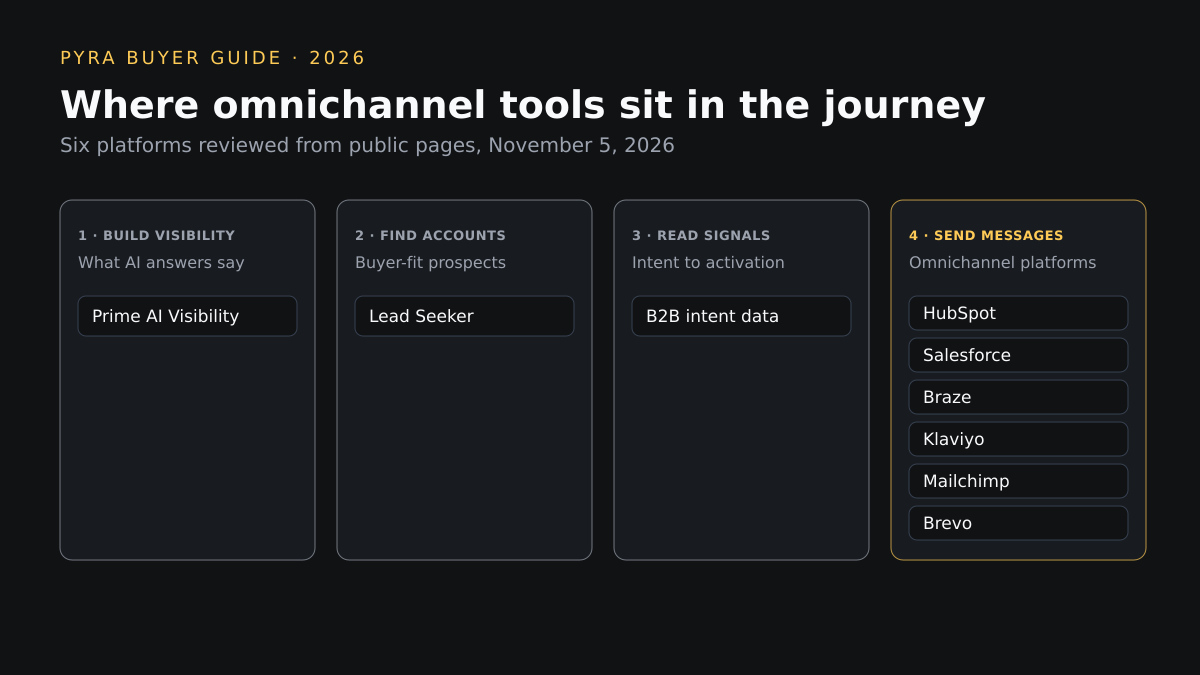
What happens before the message goes out
An omnichannel tool works on people already in your data, so the demand journey starts earlier. Buyers now ask ChatGPT, Perplexity, Gemini and Google's AI answers who to consider, and Prime AI Visibility, a Pyra product, shows what those engines name and cite for your buyers' questions; it does not monitor Google organic rankings. Its guide to choosing an AI visibility tool scores six axes (engines covered, refresh cadence, prompt ownership, metric definitions, raw-data export and pricing) and recommends a trial with your own ten buyer prompts.
Next comes deciding which accounts to message. Pyra's product page describes Lead Seeker, and Lead Seeker handles B2B prospecting, verified contacts and buyer dossiers; it does not track AI answers. Its explainer, purchase intent data explained, covers the signals that show an account is researching. When those intent signals need to become qualified account selection, campaign execution or sales activation, Percepture's B2B intent data services connect them, and its explainer on what B2B intent data means is the place to start. For teams that want the channel work run for them, Percepture also offers an omnichannel marketing service. These are separate tools and services, not one product.
If your question is which AI agents can run parts of the marketing workflow with human approval, see our guide to AI agents for marketing teams.
Best tools for omnichannel marketing: questions buyers ask
What is the difference between omnichannel and multichannel marketing tools?
Multichannel tools send messages on several channels, often from separate screens. Omnichannel tools keep one customer profile and one journey across those channels, so a reply on one channel changes what is sent on the next. Check whether a tool's journeys can branch on activity from another channel, not just whether it lists the channels.
How much do omnichannel marketing tools cost?
Published figures vary widely. Mailchimp lists Essentials at $13, Standard at $20 and Premium at $350 a month at its lowest contact tier, HubSpot lists Professional from $890 and Enterprise from $3,600 a month, and Salesforce Marketing Cloud Next lists Growth at $1,500 and Advanced at $3,250 per org a month billed annually. Braze quotes by edition, Klaviyo builds paid plans in a configurator, and Brevo lists tiers with a free plan.
Which tool suits a B2B team and which suits ecommerce?
HubSpot and Salesforce are built on CRMs, which suits account-based B2B work. Klaviyo describes itself as a B2C CRM and Braze is aimed at app-led consumer engagement. Mailchimp and Brevo suit small teams that need email and SMS first. Match the tool to the record your team already works from.
How do I measure omnichannel marketing?
One message across several channels is measured differently on each: email by opens and clicks, SMS by replies, ads by clicks and cost. Pick one outcome, such as a booked meeting or a purchase, and check that the tool can attribute it back to the channel mix. Of the tools reviewed, Klaviyo, HubSpot and Salesforce describe revenue or attribution reporting.
Do omnichannel tools find new buyers?
No. They reach people you already have in your data. Finding AI-answer visibility, buyer-fit accounts and buying signals happens before a message is sent and uses different tools.
Sources
Vendor pages are linked from each profile and were reviewed November 5, 2026. Written by Bob Generale, COO and co-founder of Pyra and President of Percepture; reviewed by Alex Mannine.
Plan your demand journey with Pyra
Talk with Pyra about visibility, buyer-fit accounts and the signals that should drive your campaigns.