Enterprise AI Governance Platforms for MCP Deployments
Enterprise AI governance platforms for MCP deployments: a framework to compare identity, authorization, approval, audit and incident response, with MCP and NIST sources.
Enterprise AI governance platforms for MCP deployments are products that sit around Model Context Protocol connections, the standard way AI applications reach tools and data, and control who may do what through them. The protocol defines how clients and servers talk, and its current release adds stronger authorization and gateway-friendly headers. MCP governance platforms have to supply the rest: identity, per-action permissions, human approval, audit records and incident response. This guide gives a framework for comparing MCP governance platforms against those six needs.
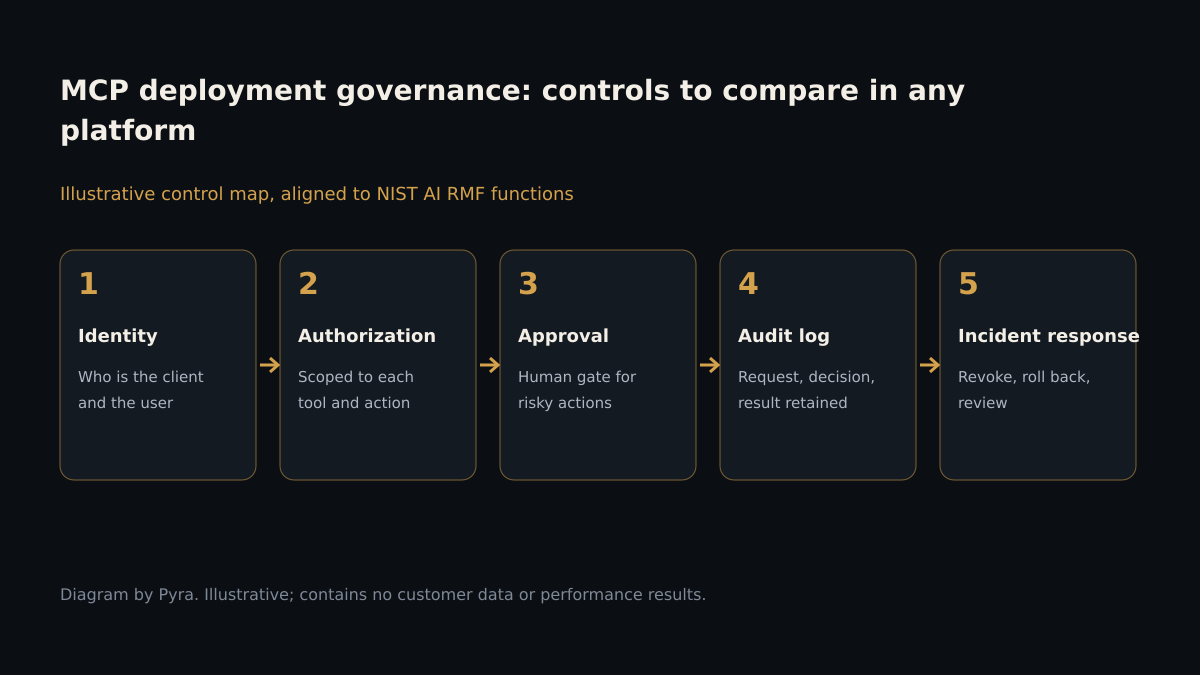
This page is a framework for comparing MCP governance platforms, not a ranking of products. It assumes you will ask each vendor to show the controls below working on your own tools. It is separate from our earlier posts on authorizing agent actions before execution and governing agents as identities, which cover those ideas in general terms.
What MCP defines, and what enterprise AI governance platforms for MCP deployments must add
The Model Context Protocol site describes MCP as an open-source standard for connecting AI applications to external systems such as data sources, tools and workflows. The specification version 2026-07-28, announced on the MCP blog, makes the protocol stateless: each request carries its protocol version and client information, and the earlier initialize handshake and session header are retired. Streamable HTTP requests must include Mcp-Method and Mcp-Name headers, which the announcement says let a gateway, rate limiter or firewall route and meter without parsing request bodies.
The same announcement lists authorization changes: authorization servers should return the iss parameter defined in RFC 9207 and clients must validate it, client credentials are bound to the issuer that created them, and Dynamic Client Registration is formally deprecated in favor of client ID metadata documents. It also names Enterprise Managed Authorization as one of the protocol's extensions. The sources I read do not define audit-log retention, approval workflows or incident procedures, so those are decisions for your governance layer.
Use NIST AI RMF to question enterprise AI governance platforms for MCP deployments
NIST's AI Risk Management Framework is voluntary and organizes risk work into four functions: Govern, Map, Measure and Manage. NIST notes that a revised version is in progress. The mapping below is this guide's interpretation, intended to turn the functions into questions you can put to a vendor. It is not NIST guidance.
Six controls to ask enterprise AI governance platforms for MCP deployments about, mapped to NIST AI RMF functions (interpretation by this guide)
| Control | Question for the platform | Evidence to ask for | NIST function (interpretive) |
|---|---|---|---|
| Identity | Can you tell which client, user and agent made each request? | A demonstration where two users call one tool and the log separates them | Govern, Map |
| Authorization | Can access be limited per server, tool and action, not just per connection? | A policy example denying one action on a tool that allows another | Govern, Manage |
| Approval | Can risky actions require a named human before they run? | A recorded approval, with who approved and when | Manage |
| Auditability | Is each request, decision and result logged and exportable? | A sample export and the stated retention setting | Measure, Manage |
| Gateway fit | Can the platform route and enforce policy using the MCP headers and your auth server? | Documentation naming the supported spec versions and auth flows | Map, Manage |
| Incident response | Can you revoke a client, disable a tool and review what happened? | A revoke-and-replay walk-through on a test tool | Manage |
Tests to run on enterprise AI governance platforms for MCP deployments in a trial
- Wrong-scope request: have a client call a tool action it should not have. Confirm denial and a log entry that says why.
- Approval gate: trigger an action that needs approval and confirm it waits. Approve it and check the record.
- Issuer check: ask how the platform validates the issuer on authorization responses, per the current MCP release.
- Version change: ask what happens when a client or server uses a different spec version, and how deprecations (the release announcement states a twelve-month minimum window) are handled.
- Revoke and review: disable a client mid-session and confirm the platform can show everything it did.
Scorecard for enterprise AI governance platforms for MCP deployments
Score each platform from 0 (not shown) to 3 (shown on your tools). Weights are assumptions to adjust for your risk.
Scorecard template with assumed weights
| Criterion | Assumed weight | Platform A | Platform B |
|---|---|---|---|
| Identity and attribution | 20% | ||
| Per-action authorization | 25% | ||
| Human approval | 15% | ||
| Audit export and retention | 20% | ||
| Spec and auth currency | 10% | ||
| Incident response | 10% |
Servers, gateways and enterprise AI governance platforms for MCP deployments are different things
Some products are MCP servers that expose a tool. Some are gateways that route traffic. Some add policy and approval on top. A vendor may offer one, two or all three, so ask which role it plays in your design and which controls it enforces itself. Where a vendor relies on another component for a control, such as your identity provider for sign-in, write down who owns it.
Pyra deploys governed agents with approval gates and audit trails (platform page). We have not tested any MCP governance platforms for this guide.
Questions readers ask
What are enterprise AI governance platforms for MCP deployments?
They are products that control access through Model Context Protocol connections, adding identity, permissions, approvals, audit records and incident response around the tools an AI application can call.
Does MCP itself replace enterprise AI governance platforms for MCP deployments?
The protocol defines how clients and servers communicate and, in its current release, improves authorization and gateway routing. The sources reviewed do not define approval workflows, audit retention or incident procedures, so those come from your governance layer.
Is the NIST AI RMF required?
No. NIST describes it as voluntary. Its Govern, Map, Measure and Manage functions give a useful structure for vendor questions.
Which spec version does this guide reflect?
It reflects the 2026-07-28 MCP specification as described on the MCP blog, read on November 23, 2026. Confirm the version your vendors support.
Sources
- Model Context Protocol describes MCP as an open-source standard for connecting AI applications to external systems. Read Nov 23, 2026.
- MCP blog: specification 2026-07-28 stateless core, Mcp-Method and Mcp-Name headers, authorization changes, extensions and deprecation window. Read Nov 23, 2026.
- NIST AI Risk Management Framework voluntary framework; Govern, Map, Measure, Manage; revision in progress. Read Nov 23, 2026.
About the author
Bob Generale is COO and co-founder of Pyra, with 20+ years of Fortune 500 operations experience. This guide explains the governance controls to ask about for MCP deployments, using the public MCP and NIST sources cited below. It was not technically or security reviewed, and the NIST mapping is interpretive.
Run the six tests on your shortlist
Use the scorecard in a trial and ask each vendor to demonstrate denial, approval, audit export and revocation on your own tools.
Talk with Pyra