Enterprise AI Agent Development Services: How to Scope and Buy
Enterprise AI agent development services: how to scope discovery, integration ownership, permissions, acceptance tests and handoff, with an assumptions-based scorecard.
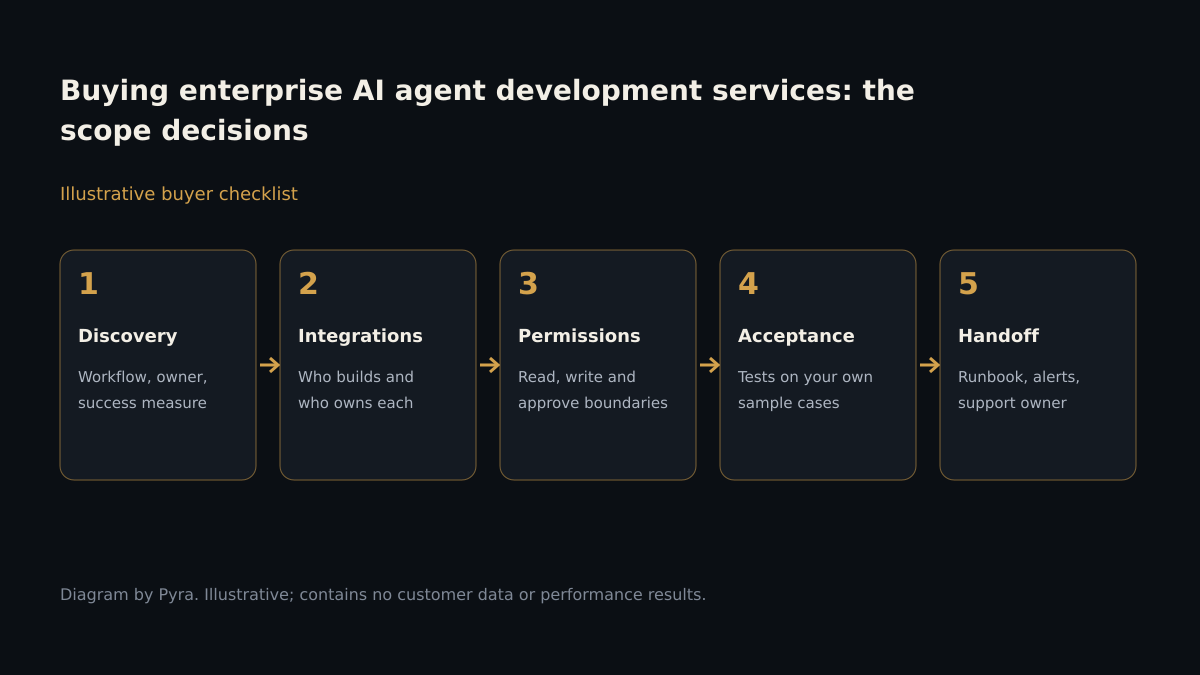
Enterprise AI agent development services are paid engagements in which a provider designs, builds and hands over AI agents that do defined work inside your company's systems. The contract that matters is the scope: what workflow is covered, who builds and owns each integration, what the agent may read and change, how acceptance is tested, and who runs it afterward. This guide gives a buyer's checklist and an assumptions-based scorecard, and it is not a ranking of providers.
Several of our existing guides compare named agencies and platforms, including the best AI agent development agencies and enterprise AI agent platforms. This guide answers a different question: given any provider, how do you scope and judge the engagement so you get a working agent and not a demonstration?
Enterprise AI agent development services start with discovery: one workflow, one owner, one measure
A good discovery phase ends with a written description of a single workflow: its inputs, the systems it touches, the steps a person takes today, the exceptions that occur, and who in your company owns the outcome. Insist on one measure of success agreed in advance, such as minutes of human review per case or the share of cases handled without correction. Broad goals like "transform operations" are not scopes.
Integration ownership in enterprise AI agent development services
Most delays in enterprise agent work come from access to your systems, not from the model. For every system the agent touches, write down who builds the connection, who supplies credentials, who maintains it when the system changes, and who pays for related licenses or API usage. If the answer is "to be decided", the project plan is incomplete.
Permission boundaries
Decide per action whether the agent may read, draft, or write, and which actions always need human approval. The NIST AI Risk Management Framework organizes risk work into four functions, Govern, Map, Measure and Manage, which gives a useful vocabulary for these conversations: who is accountable, what the system is used for, how you test it, and how you respond when it fails. NIST describes the framework as voluntary. Ask the provider to show how its design addresses each of those four questions for your workflow.
Acceptance criteria and exception handling
Acceptance should be tested on your own sample cases, chosen before the build, including difficult ones. Write the pass condition for each: for example, the agent must stop and hand over when a required field is missing, and every handover must include the evidence it used. Agree what happens to a case the agent cannot finish: who receives it, within what time, and how it is recorded.
Operational handoff after enterprise AI agent development services
An agent in production needs an owner. Require a runbook, an alert path, a rollback or switch-off procedure, a record of model and prompt versions, and a named support contact with a response time. Ask who retrains or adjusts the agent when your process changes and what that costs.
Assumptions-based evaluation scorecard
Score each provider from 0 (no evidence) to 3 (shown on your sample or documented in writing). The weights below are assumptions to adjust, and the scorecard is a thinking tool rather than a benchmark.
Scorecard for enterprise AI agent development services, with assumed weights (adjust to your priorities)
| Criterion | Assumed weight | What a 3 looks like | Provider A | Provider B |
|---|---|---|---|---|
| Discovery scope | 15% | One workflow, owner and measure written and signed | ||
| Integration ownership | 20% | Named owner per system, credentials and maintenance plan | ||
| Permission boundaries | 20% | Read, draft and write limits per action; approval gates listed | ||
| Acceptance tests | 20% | Your sample cases, pass conditions and exception rules agreed first | ||
| Handoff and support | 15% | Runbook, alerts, rollback and named support contact | ||
| Evidence and references | 10% | Relevant case you can verify, not a logo slide |
Weighted score = sum of (score x weight). Compare the reasons behind scores, not only the totals.
Red flags during selection
- A fixed price with no discovery, or discovery with no written scope at the end.
- Claims of integration with your systems without named documentation.
- No acceptance tests on your data, or tests the provider writes alone.
- No answer to who operates the agent after launch.
- Customer results quoted without a way for you to verify them.
Pyra's platform page describes how Pyra approaches governed agent deployment; ask any provider, including us, to tie its claims to your scope in writing.
Questions readers ask
What are enterprise AI agent development services?
They are services in which a provider designs, builds and hands over AI agents that perform defined work in your company's systems, usually including integration, testing and operational handoff.
What should be in the scope of enterprise AI agent development services?
A single described workflow, integration ownership for each system, permission boundaries, acceptance tests on your sample cases, exception handling, and operational handoff with a named support contact.
Is the NIST AI RMF mandatory?
No. NIST describes the AI Risk Management Framework as voluntary, but its Govern, Map, Measure and Manage functions are a useful structure for buyer questions.
How is this different from a ranked list of agencies?
A ranked list compares named providers. This guide helps you scope and evaluate any provider against your own workflow and acceptance tests.
Sources
- NIST AI Risk Management Framework voluntary framework with four functions: Govern, Map, Measure, Manage. Read Nov 23, 2026; NIST notes a revision is in progress.
About the author
Bob Generale is COO and co-founder of Pyra, with 20+ years of Fortune 500 operations experience. This guide explains the scope, ownership and handoff questions a buyer should settle before engaging an agent development provider. It is not a technical review of any provider, and Pyra is among the providers a buyer could consider.
Scope your first agent workflow
Describe one workflow, its systems and its exceptions, and use the scorecard to compare how any provider would handle it.
Talk with Pyra