Best Practices for Increasing Visibility in Google Gemini's AI Overviews (2026)
Best practices for increasing visibility in Google Gemini's AI Overviews in 2026: seven practices compared on evidence, effort and limits, plus how Gemini differs from AI Overviews and how to measure the result. Reviewed Nov 7, 2026.
Short answer: the best practices for increasing visibility in Google Gemini's AI Overviews in 2026 are the ones Google names for Search: keep pages indexed and eligible for a snippet, put the answer in plain text, match structured data to visible text, and keep business details current. Google lists no extra technical requirement and promises no inclusion. Brand mentions elsewhere and separate measurement are the two additions worth planning.
This guide is for marketing leads and site owners who want their pages shown as supporting links in Google's AI answers. "Gemini's AI Overviews" blends two products, covered below. Seven practices are compared on the evidence behind each, not on how many sites repeat them. Bob Generale, who wrote it, is co-founder of Pyra, which makes the Prime AI Visibility product described in the measurement section. Facts come from the pages cited and were reviewed November 7, 2026.
Gemini and AI Overviews are not the same lever
AI Overviews are a feature of Google Search. Gemini Apps are a separate product. The levers differ. For Search, Google says a page needs to be indexed and eligible to show with a snippet, and that its preview controls govern what appears. For Gemini, Google documents Google-Extended, a robots.txt token that manages whether crawled content may be used to train future Gemini models and for grounding in Gemini Apps and Vertex AI, and which does not affect inclusion in Google Search or act as a ranking signal. Blocking it is therefore not a way to leave AI Overviews, and allowing it is not a way to enter them.
Google also describes AI Mode as a separate feature for queries that need more exploration. Both features may use query fan-out, and Google says they may use different models and techniques, so the links they show will vary. That variation is why the practices below are written as eligibility and evidence work, not as a ranking formula.
How the practices were compared
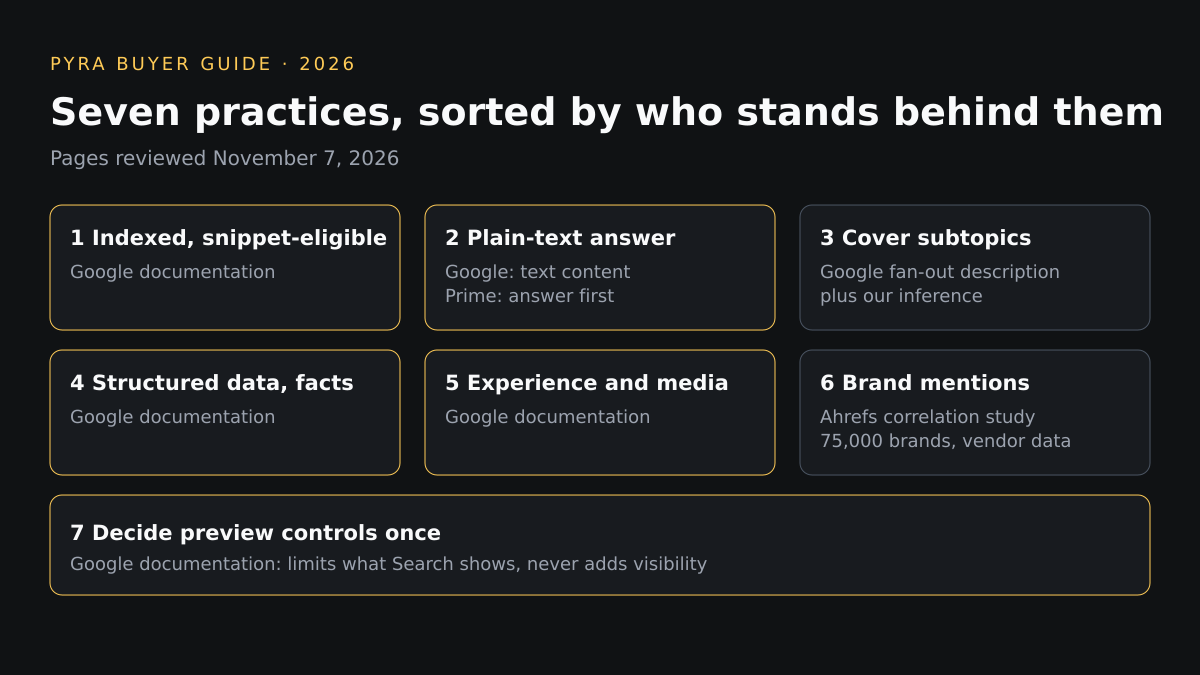
Each practice was read against Google's AI features and your website guide (page last updated December 10, 2025, reviewed November 7, 2026) and checked for a second source. Practices are tagged by who stands behind them: Google documentation, a vendor study, or our own inference. The order is an editorial judgement that puts practices Google documents first; it is not a score, and no hands-on test was run.
Eight criteria were written for products. They are kept in the same order here, with a practice-specific meaning: "Pricing" becomes cost beyond staff time, and "Integration depth" becomes what must already be in place. Each practice is described under every criterion in its profile.
| Criterion | The question it answers |
|---|---|
| Use-case fit | Which buyer situation does this practice address? |
| Capabilities | What does it change on the page or site? |
| Evidence | Who says it works, and is that Google, a vendor study or an inference? |
| Integration depth | What else must already be in place for it to matter? |
| Governance | Who owns the setting and what can go wrong if it is changed? |
| Pricing | What does it cost beyond staff time? |
| Implementation effort | How much work is it for a typical site? |
| Limitations | What does it not do? |
Best practices for increasing visibility in Google Gemini's AI Overviews, compared
Seven practices in profile order. Scroll sideways on small screens.
| # | Practice | Use-case fit | Evidence tier | Effort | Cost | Main limitation |
|---|---|---|---|---|---|---|
| 1 | Keep the page indexed and eligible for a snippet | Every page you want shown as a supporting link | Google documentation | Low for a clean site; higher if a CDN or WAF blocks crawlers | No product cost | Eligibility is not inclusion. Google says AI Overviews are shown only when its systems judge them additive and often do not trigger |
| 2 | State the answer in plain text near the top | Informational and comparison questions where a short answer is quotable | Google documentation for text; Prime guide for answer-first | Low to medium: rewrite the opening of existing pages | No product cost | A clear answer makes a page easy to quote; no source reviewed shows it makes an AI Overview appear |
| 3 | Cover the subtopics behind the question | Complex questions where one query becomes several searches | Google description plus inference | Medium to high: new or expanded pages | No product cost | Fan-out describes how Google builds the response; it does not say which pages it will choose |
| 4 | Match structured data to visible text and keep business facts current | Brands, products, local businesses and stores | Google documentation; Prime guide for consistency | Medium: audit once, then maintain | No product cost; Merchant Center and Business Profile are Google's own tools | Google does not say markup raises the chance of an AI Overview; it says markup must be accurate |
| 5 | Support the text with page experience, images and video | Pages where a diagram, product image or video clarifies the answer | Google documentation | Medium | Production time for original media | Listed by Google as a worthwhile fundamental, not as a trigger for AI Overviews |
| 6 | Earn brand mentions on other sites | Brands that are absent from AI Overviews although their pages rank | Vendor research, correlation only | High and slow | Depends on the route: PR, partnerships or content | A correlation does not show that more mentions cause more appearances, and the data is about brands, not a specific query |
| 7 | Decide preview controls once | Publishers who must limit what Search shows from a page | Google documentation | Low | No product cost | A control limits visibility; it never adds it, and changes can take days to months to be recrawled |
The seven practices
1. Google documentation
Keep the page indexed and eligible for a snippet
Best fit: Every page you want shown as a supporting link.
Capabilities: Lets Google crawl, index and show the page with a snippet, which is the entry condition.
Evidence: Google says a page must be indexed and eligible to be shown in Search with a snippet to be a supporting link in AI Overviews or AI Mode, and that there are no additional technical requirements. It also lists allowing crawling in robots.txt and by any CDN or hosting infrastructure.
Integration depth: Search Console verification to diagnose indexing; robots.txt, CDN and WAF rules.
Governance: Robots.txt and CDN bot rules are often owned by different teams; a blanket bot block can remove a page from Search.
Pricing: No product cost. Implementation effort: Low for a clean site; higher if a CDN or WAF blocks crawlers.
Limitation: Eligibility is not inclusion. Google says AI Overviews are shown only when its systems judge them additive and often do not trigger.
What to verify: That Googlebot can fetch the page (URL Inspection) and that no nosnippet or noindex setting applies.
Source: Google Search Central, AI features and your website (reviewed November 7, 2026).
2. Google documentation for text; Prime guide for answer-first
State the answer in plain text near the top
Best fit: Informational and comparison questions where a short answer is quotable.
Capabilities: Puts the direct answer in text a crawler and a reader can both read, before background.
Evidence: Google lists making sure important content is available in textual form. The advice to lead with the answer comes from Prime's hybrid strategy guide, which gives each priority question one canonical page answering it in the first paragraph; Google does not state that rule.
Integration depth: A canonical page per question rather than several near-duplicate URLs.
Governance: Editors need one owner per page so the direct answer stays accurate when facts change.
Pricing: No product cost. Implementation effort: Low to medium: rewrite the opening of existing pages.
Limitation: A clear answer makes a page easy to quote; no source reviewed shows it makes an AI Overview appear.
What to verify: That the answer appears in the server-rendered HTML, not only after scripts run.
Source: Google Search Central, AI features and your website (reviewed November 7, 2026).
3. Google description plus inference
Cover the subtopics behind the question
Best fit: Complex questions where one query becomes several searches.
Capabilities: Makes sure the page or cluster answers the related questions an answer could draw on.
Evidence: Google says AI Overviews and AI Mode may use query fan-out, issuing multiple related searches across subtopics and data sources, and show a wider and more diverse set of links than classic search. Covering subtopics in response is our inference from that description, not a Google instruction.
Integration depth: Internal links so the related pages are findable; Google lists internal links among fundamentals.
Governance: Content ownership across pages, so the cluster does not contradict itself.
Pricing: No product cost. Implementation effort: Medium to high: new or expanded pages.
Limitation: Fan-out describes how Google builds the response; it does not say which pages it will choose.
What to verify: That each related question has a page and that those pages link to each other.
Source: Google Search Central, AI features and your website (reviewed November 7, 2026).
4. Google documentation; Prime guide for consistency
Match structured data to visible text and keep business facts current
Best fit: Brands, products, local businesses and stores.
Capabilities: Gives Google consistent facts from page markup, Merchant Center and Business Profile.
Evidence: Google lists making sure structured data matches the visible text and checking that Merchant Center and Business Profile information is up to date. Prime's hybrid guide adds that the company name, offer and location should read the same on the site, in markup and in listings the team controls.
Integration depth: A single source of truth for business facts.
Governance: Markup that claims more than the page shows breaches Google's structured data policies.
Pricing: No product cost; Merchant Center and Business Profile are Google's own tools. Implementation effort: Medium: audit once, then maintain.
Limitation: Google does not say markup raises the chance of an AI Overview; it says markup must be accurate.
What to verify: That every marked-up fact appears in visible text and matches listings.
Source: Google Search Central, AI features and your website (reviewed November 7, 2026).
5. Google documentation
Support the text with page experience, images and video
Best fit: Pages where a diagram, product image or video clarifies the answer.
Capabilities: Improves how the page works for visitors and adds media Google can index.
Evidence: Google lists providing a great page experience and supporting textual content with high-quality images and videos when applicable.
Integration depth: Text content already in place; media needs descriptive alt text and captions.
Governance: Image and video rights belong to the publisher.
Pricing: Production time for original media. Implementation effort: Medium.
Limitation: Listed by Google as a worthwhile fundamental, not as a trigger for AI Overviews.
What to verify: That media is crawlable and the page still stands on its text alone.
Source: Google Search Central, AI features and your website (reviewed November 7, 2026).
6. Vendor research, correlation only
Earn brand mentions on other sites
Best fit: Brands that are absent from AI Overviews although their pages rank.
Capabilities: Builds the off-site recognition that a vendor study found most associated with brand appearance.
Evidence: Ahrefs analysed 75,000 brands and reported branded web mentions had the strongest correlation with brand mentions in AI Overviews (0.664), above backlinks (0.218). It states these are correlations; it is a vendor study dated May 2025.
Integration depth: A clear category description, so mentions describe the brand correctly.
Governance: Paid or manipulated mentions can breach Google's spam policies; earn them through coverage and real use.
Pricing: Depends on the route: PR, partnerships or content. Implementation effort: High and slow.
Limitation: A correlation does not show that more mentions cause more appearances, and the data is about brands, not a specific query.
What to verify: That the mentions are on pages Google can index and describe the brand accurately.
Source: Ahrefs, AI Overview brand visibility factors (reviewed November 7, 2026).
7. Google documentation
Decide preview controls once
Best fit: Publishers who must limit what Search shows from a page.
Capabilities: Uses nosnippet, data-nosnippet, max-snippet and noindex to limit how content appears in Search, including AI features.
Evidence: Google states these controls limit information shown from your pages in Search and that robots.txt directives for Googlebot are the site-owner control for Search crawling.
Integration depth: Search Console URL Inspection to confirm what Googlebot receives.
Governance: An old restriction added for legal reasons can suppress visibility on every surface; review it before a campaign.
Pricing: No product cost. Implementation effort: Low.
Limitation: A control limits visibility; it never adds it, and changes can take days to months to be recrawled.
What to verify: That no snippet restriction sits on pages meant to be shown.
Source: Google Search Central, AI features and your website (reviewed November 7, 2026).
A hybrid SEO and AI strategy guide from Prime puts these practices in one frame: content, entity facts, structured data and crawl access are shared inputs for classic results and AI answers, while rankings and AI mentions are reported as two separate scorecards and never averaged.
How to measure whether the practices worked
AI Overviews are dynamic answers, not a fixed billboard. Google says they often do not trigger and that the links shown vary, so one screenshot is a single observation, not a ranking. Three ways to record the result, compared on the same criteria:
| Criterion | Search Console | Manual check of live results | Prime AI Visibility |
|---|---|---|---|
| Use-case fit | Search traffic to your pages | A handful of key questions, once | Recurring checks on buyer questions across answer engines |
| Capabilities | Impressions and clicks in the Performance report; AI feature traffic is counted within the Web search type | You read the answer and its links yourself | Saves each answer and the cited websites; separates named from cited; records competitors in the same answer |
| Evidence | Google's AI features guide | Your own screenshots; results vary by session | primeaivisibility.com/pricing and Pyra's product pages, November 7, 2026 |
| Integration depth | Verify the site in Search Console | None | Gemini and an AI Overview-style preview start on the Starter plan; it is a preview, not Google's live results |
| Governance | Site-owner access | Record the date, query and location | Claims needing proof are flagged before export |
| Pricing | Free | Staff time | Flash free; Starter $69/mo, Growth $179/mo, Agency $369/mo (Nov 7, 2026) |
| Implementation effort | Low | Low per check, high to repeat | Enter buyer questions and run checks |
| Limitations | Cannot show whether an overview named your brand or which brands it named | Not a trend; no history | Pyra makes it; it does not crawl your site and does not monitor Google organic rankings |
To keep that record, Prime AI Visibility saves the exact answer and cited websites for each buyer question, which Search Console does not show. Pair it with Search Console rather than replacing it. Our GEO playbook and ChatGPT SEO analysis tools guide cover the evidence standard in more depth.
From AI visibility to the accounts worth contacting
What answer engines name, cite and recommend is one question; which accounts and verified contacts deserve outreach is another. B2B sales intelligence such as Lead Seeker handles B2B prospecting, verified contacts and buyer dossiers, and does not track AI answers.
When intent signals must become qualified account selection, campaign execution or sales activation, Percepture's B2B intent data services connect signal interpretation to ICP targeting and campaign activation. These are separate offerings from AI Overview work and from each other.
Gemini and AI Overviews: questions site owners ask
Are Google Gemini and AI Overviews the same thing?
No. AI Overviews are a Google Search feature. Gemini Apps are a separate product. Google says Google-Extended is a robots.txt token for whether crawled content may be used to train future Gemini models and for grounding in Gemini Apps and Vertex AI, and that it does not affect inclusion in Google Search or act as a ranking signal. For AI Overviews, the Googlebot and preview controls apply.
Do I need special markup or a new file to appear in AI Overviews?
Google says there are no additional technical requirements: the page must be indexed and eligible to show in Search with a snippet. Specific optimization isn't required for AI Overviews and AI Mode, and the usual SEO fundamentals continue to apply.
Can I see AI Overview traffic in Search Console?
Only as part of the Web search type. Google says sites appearing in AI features are included in the overall Search Console Performance report, within the Web search type; it does not describe a separate AI Overview report, so Search Console cannot show which brands an overview named.
Can I stop my content appearing in AI Overviews?
Use the Search controls Google names: nosnippet, data-nosnippet, max-snippet or noindex. Google-Extended does not control Search. Google notes crawling changes can take several days to several months to be processed.
Sources
Google Search Central pages are linked from the practices above and were reviewed November 7, 2026. The Ahrefs figures are the vendor's own correlation data. Written by Bob Generale, COO and co-founder of Pyra and President of Percepture; reviewed by Alex Mannine.
Get a baseline for your buyer questions
Talk with Pyra about which questions to record, which of the seven practices your pages are missing and how to separate search traffic from AI answers.