Best Historical Data Providers for AI Search Optimization in 2026: 7 Compared
The best historical data providers for AI search optimization compared on nine criteria: Similarweb, DataForSEO, Profound, Trakkr, Semrush, Peec AI and Prime, with pricing. Reviewed Nov 6, 2026.
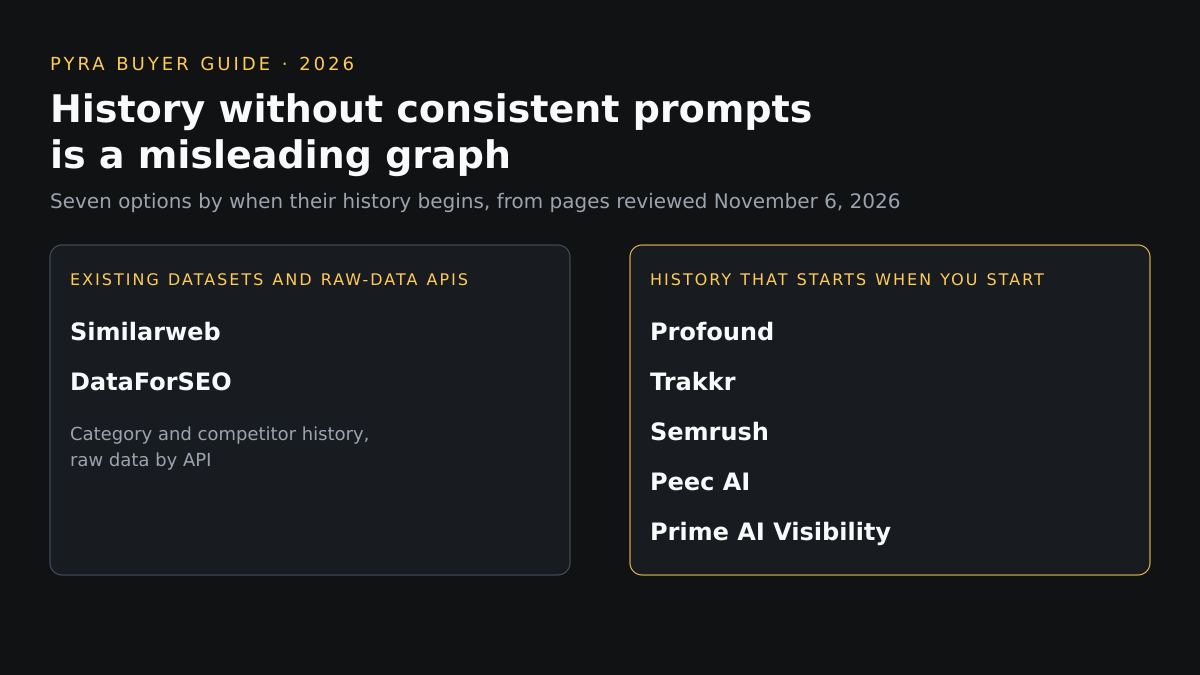
Short answer: the best historical data providers for AI search optimization fall into two groups. Similarweb describes AI search data gathered before you signed up, and DataForSEO sells raw mention and citation data by API. Profound, Trakkr, Semrush, Peec AI and Prime AI Visibility start recording when you do, so their history depends on your start date and a fixed prompt set.
History without consistent prompts is a misleading graph. This guide is for SEO and marketing leads who need to show whether AI answers about their brand are changing, and who must decide between buying data that already exists and starting a record today. Pyra makes Prime AI Visibility and Lead Seeker, and the author, Bob Generale, is Pyra's COO and co-founder and President of Percepture; Prime is held to the same nine criteria and listed last. Prices and features are what each vendor displayed on November 6, 2026, and "not described" means those pages did not say.
What counts as historical data for AI search
Similarweb's guide to historical data providers makes a rule explicit: data can be recovered later only if someone was sampling it at the time. An AI answer is generated when requested, and asking an engine again today returns a new answer, not the old one. That leaves two ways to get history.
- Buy data that already exists: a provider that was sampling answers before you asked can show category and competitor movement from earlier months.
- Start your own record: a tracker or API holds the answers to your fixed questions from the day you begin, which is the only way to see your own prompts over time.
The two answer different questions, and a trend line from either is only comparable if the questions, engines and schedule stay the same. Prime's guide to an AI visibility strategy describes a repeatable loop: pick the buyer questions, measure whether AI platforms mention, recommend and cite you, correct the content and source gaps, and recheck the same questions, so the result is a dated baseline rather than anecdotes. Our GEO playbook and guide to ChatGPT SEO analysis tools cover the evidence standard in more depth.
How we compared these historical data options
Nine criteria were applied to every option using only its public pricing, product and documentation pages. No hands-on scores were produced. The order is editorial: options with data that exists before signup first, then trackers, then the evidence-and-content layer. The set is not exhaustive; Similarweb's guide also names Comscore, Datos, Cloudflare, Kantar and NIQ, which are not scored here.
| Criterion | The question it answers |
|---|---|
| Engine coverage | Which answer engines are queried, and on which plan? |
| Mention vs citation | Does it separate 'named in the answer' from 'linked as a source'? |
| Exact cited source | Can you see which URL was cited, yours or a competitor's? |
| History and trend | Are answers kept per run so a change can be dated? |
| Competitor comparison | Does it show who was named or cited instead of you? |
| Question tracking | Can you track your own buyer questions, not only the vendor's sample? |
| Reporting, export, API | Can the evidence leave the tool for your reports and BI? |
| Pricing transparency | Is the price on the public page, and what does it include? |
| Diagnosis to action | Does it help you fix a miss, or only report it? |
Best historical data providers for AI search optimization compared
Two tables, the same seven tools in profile order. The first covers type, engines, evidence and price; the second covers history, competitors, questions, reporting and what happens after a change is found. Scroll sideways on small screens.
| # | Tool | Type | AI engines | Mention vs citation | Exact cited source | Pricing shown |
|---|---|---|---|---|---|---|
| 1 | Similarweb AI Search Intelligence | Retroactive data provider | Referral traffic from ChatGPT, Perplexity, Gemini and AI Mode on the product page; Similarweb's own guide lists ChatGPT, AI Mode, AI Overviews, Gemini and Perplexity for its answer data | AI Brand Visibility (mentions) and AI Citation Analysis (sources) are separate features | AI Citation Analysis lists the sources AI answers cite, with the exact links | Sold through sales on the Web Intelligence pricing page; Similarweb's guide lists paid plans from $99 a month |
| 2 | DataForSEO AI Optimization API | Raw data API | ChatGPT, Gemini, Google AI Overview, Claude and Perplexity | Brand and domain mentions and citations are both described in the LLM Mentions API | The LLM Scraper API returns scraped chatbot answers with sources and citations | Pay as you go with a free trial: LLM Mentions from $0.1 a task plus $0.001 a row, LLM Scraper from $0.0012 a result page |
| 3 | Profound | Tracker that starts at signup | Trial: ChatGPT, Gemini and Google AI Overviews. Enterprise: up to 9 answer engines | It says it tracks citations, sentiment, ranking and competitive presence in responses | Citation tracking is described; per-answer URL display is not detailed on the pricing page | Enterprise is custom; the trial is free for 7 days; an agency plan uses 400 credits a month per client workspace |
| 4 | Trakkr | Tracker that starts at signup | Eight models, checked daily, on every plan: ChatGPT, Claude, Gemini, Perplexity, Grok, DeepSeek, Meta AI and Google AI Overviews | Visibility and perception are separate views; a Citations view lists the sources AI trusts | A Citations view shows the sources AI trusts | Growth $100 a month for one brand; Scale $500 a month with 10 brands; 14-day free trial |
| 5 | Semrush AI Visibility Toolkit | Tracker that starts at signup | ChatGPT, Google AI, Gemini and Perplexity | Mentions are listed; the pricing page does not describe a separate citation metric | Not described on the pricing page | Base $99 a month per domain billed annually; extra users from $45 a month; Enterprise is custom |
| 6 | Peec AI | Tracker that starts at signup | Six models listed (ChatGPT, AI Mode, AI Overviews, Microsoft Copilot, Gemini, Naver AI); Starter, Pro and Advanced include 3 active models you choose, and the page offers paid Additional Models add-ons to track more without switching plans (prices and model lists not itemized here); Enterprise lists up to 13 models, including Claude, Grok and DeepSeek | Citation share is listed alongside visibility | Yes: each source is classified, for example competitor or editorial, and retrievals and fanout are shown | Starter $95, Pro $245, Advanced $495 a month; Enterprise custom |
| 7 | Prime AI Visibility | Evidence and fix layer | ChatGPT, Claude and Perplexity on the free Flash plan; Gemini and an AI Overview-style preview on paid plans. No Grok, DeepSeek or Copilot | Yes: brand mention and owned citation are tracked separately | Yes: exact answers and cited websites are saved per question | Flash free (30 credits, one check a month); Starter $69, Growth $179, Agency $369, Enterprise $1,499 a month |
| Tool | History | Competitors | Question tracking | Reporting, export, API | Diagnosis to action |
|---|---|---|---|---|---|
| Similarweb AI Search Intelligence | The Gen AI suite lists up to 37 months of added data with daily-level insights; Similarweb's guide says its AI search data reaches back to January 2024 | Brand and competitor visibility and competitor landing pages that receive AI traffic | AI Prompt Analysis shows the prompts people ask about any topic and the latest responses; it works by topic, not from a prompt set you own | APIs, data feeds and MCP are listed on the pricing page; Similarweb's guide adds scheduled Datahub reports | Prompts, citations and sentiment point to content and partnership targets; drafting a fix is not described |
| DataForSEO AI Optimization API | How far back the mentions data reaches is not stated on the page reviewed; history you keep depends on when you start storing results | Multi-target analysis compares several domains, brands or keywords in one request | LLM Responses and LLM Scraper take the prompts you send; an AI Keyword Search Volume API is listed | API only; no dashboard or report is described | Raw data for your own tools; diagnosis and content fixes are yours to build |
| Profound | None on the trial; all-time history on Enterprise | Competitive presence is part of its measurement description | Trial: 50 unique prompts run daily for 7 days. Enterprise: a tailored prompt tracking plan | CSV and JSON export and an API on Enterprise only; none on the trial | AI Marketer agents, shared projects, Profound Sheets, and Agent Analytics for AI-sourced traffic with GA, Cloudflare, Vercel and other integrations |
| Trakkr | Daily checks; full history is listed on Scale | A Competitors view shows who AI picks instead of you | 50 prompts per brand on Growth, more in blocks of 50 up to 500 | Reports, password-protected dashboards, CSV and Google Sheets export, API and MCP; REST API and Looker Studio on Scale | Agent and Fixes features ship changes to your site |
| Semrush AI Visibility Toolkit | Daily, weekly and monthly data updates | AI competitor analysis and prompt research | 25 custom prompts with daily AI rankings on the Base plan, for one domain | Report add-ons: Base at $10 and Pro at $20 a month (white-label, AI summaries); API and custom integrations are Enterprise | A site audit for AI readiness; Enterprise adds AI automations, content workflows and forecasting with ROI attribution |
| Peec AI | Daily tracking; trend depth is not described | Unlimited competitors on every plan | 50 prompts on Starter, 150 on Pro, 350 on Advanced; custom prompt setup on Enterprise | Custom CSV exports and MCP on every plan; Looker Studio from Advanced; API not included on Starter and included on Pro, Advanced and Enterprise | Ranked recommended actions grouped by earned and owned, plus agent actions from your data |
| Prime AI Visibility | Exact answer history on Agency and above; each check keeps its saved answers | Cited website and competitor evidence per question on Agency and above | Your own buyer questions: 5 on Flash, up to 25 on Starter, 50 on Growth, 120 on Agency, 500 on Enterprise per check | PDF and CSV reports; reading and exporting saved data costs no credits | Content gap recommendations and source-enriched Word drafts from the saved answers |
Profiles
1. Retroactive data provider
Similarweb AI Search Intelligence
Best fit: Teams that need category and competitor history from before they started tracking, and can work with a sales-led data contract.
Evidence: engines: Referral traffic from ChatGPT, Perplexity, Gemini and AI Mode on the product page; Similarweb's own guide lists ChatGPT, AI Mode, AI Overviews, Gemini and Perplexity for its answer data. Mention vs citation: AI Brand Visibility (mentions) and AI Citation Analysis (sources) are separate features. Exact cited source: AI Citation Analysis lists the sources AI answers cite, with the exact links. Competitors: Brand and competitor visibility and competitor landing pages that receive AI traffic. Questions: AI Prompt Analysis shows the prompts people ask about any topic and the latest responses; it works by topic, not from a prompt set you own.
Pricing: Sold through sales on the Web Intelligence pricing page; Similarweb's guide lists paid plans from $99 a month.
Strength: It is the one option here whose AI search record is described as starting before your account, with competitor and category views.
Limitation: Prompt analysis is topic-level rather than your fixed prompt set, and the price depends on a sales quote.
What to verify: Which months of history your plan includes, which countries and engines are covered, and whether the data is sampled or tied to your own questions.
Source: aisearch.similarweb.com (reviewed November 6, 2026).
2. Raw data API
DataForSEO AI Optimization API
Best fit: Developers and data teams who want to build their own AI visibility dataset and store it in their own warehouse.
Evidence: engines: ChatGPT, Gemini, Google AI Overview, Claude and Perplexity. Mention vs citation: Brand and domain mentions and citations are both described in the LLM Mentions API. Exact cited source: The LLM Scraper API returns scraped chatbot answers with sources and citations. Competitors: Multi-target analysis compares several domains, brands or keywords in one request. Questions: LLM Responses and LLM Scraper take the prompts you send; an AI Keyword Search Volume API is listed.
Pricing: Pay as you go with a free trial: LLM Mentions from $0.1 a task plus $0.001 a row, LLM Scraper from $0.0012 a result page.
Strength: Usage-based prices are published per endpoint, and the data is yours to keep and chart.
Limitation: It is an API, not a reporting product, and the page does not state how far back mentions data goes.
What to verify: The earliest date available for your prompts and brands, and how much engineering time a warehouse and charts need.
Source: dataforseo.com AI Optimization API (reviewed November 6, 2026).
3. Tracker that starts at signup
Profound
Best fit: Enterprise teams that need all-time history from a tracker and can buy through a demo.
Evidence: engines: Trial: ChatGPT, Gemini and Google AI Overviews. Enterprise: up to 9 answer engines. Mention vs citation: It says it tracks citations, sentiment, ranking and competitive presence in responses. Exact cited source: Citation tracking is described; per-answer URL display is not detailed on the pricing page. Competitors: Competitive presence is part of its measurement description. Questions: Trial: 50 unique prompts run daily for 7 days. Enterprise: a tailored prompt tracking plan.
Pricing: Enterprise is custom; the trial is free for 7 days; an agency plan uses 400 credits a month per client workspace.
Strength: The only option here that pairs answer tracking with agent analytics for AI-sourced traffic attribution on the pricing page.
Limitation: Everything beyond a three-engine, 7-day trial is sold through a demo, and no price is published.
What to verify: Which nine engines and what prompt volume your contract covers, and whether exact cited URLs are stored per answer.
Source: tryprofound.com/pricing (reviewed November 6, 2026).
4. Tracker that starts at signup
Trakkr
Best fit: Teams that want daily checks with full history on its Scale plan and exports to Google Sheets or an API.
Evidence: engines: Eight models, checked daily, on every plan: ChatGPT, Claude, Gemini, Perplexity, Grok, DeepSeek, Meta AI and Google AI Overviews. Mention vs citation: Visibility and perception are separate views; a Citations view lists the sources AI trusts. Exact cited source: A Citations view shows the sources AI trusts. Competitors: A Competitors view shows who AI picks instead of you. Questions: 50 prompts per brand on Growth, more in blocks of 50 up to 500.
Pricing: Growth $100 a month for one brand; Scale $500 a month with 10 brands; 14-day free trial.
Strength: Eight engines, daily checks and CSV and Sheets export are all in the entry plan.
Limitation: Entry price is above Otterly Lite or Ahrefs Prompt Tracking, and the pages reviewed do not say whether the exact cited URL is saved per answer.
What to verify: Whether the Citations view stores the exact URL per answer, and what fixes shipped to the site require.
Source: trakkr.ai/pricing (reviewed November 6, 2026).
5. Tracker that starts at signup
Semrush AI Visibility Toolkit
Best fit: Teams on Semrush that want daily, weekly or monthly updates for a fixed set of tracked prompts.
Evidence: engines: ChatGPT, Google AI, Gemini and Perplexity. Mention vs citation: Mentions are listed; the pricing page does not describe a separate citation metric. Exact cited source: Not described on the pricing page. Competitors: AI competitor analysis and prompt research. Questions: 25 custom prompts with daily AI rankings on the Base plan, for one domain.
Pricing: Base $99 a month per domain billed annually; extra users from $45 a month; Enterprise is custom.
Strength: Per-domain price and report add-ons are published, and the Enterprise tier names ROI attribution.
Limitation: Base tracks 25 prompts on one domain and does not describe cited sources.
What to verify: Whether cited URLs are visible per answer and how prompt limits change on Enterprise.
Source: semrush.com/pricing/ai (reviewed November 6, 2026).
6. Tracker that starts at signup
Peec AI
Best fit: Teams that want daily tracking with CSV export and, on Pro and above, an API to keep their own history.
Evidence: engines: Six models listed (ChatGPT, AI Mode, AI Overviews, Microsoft Copilot, Gemini, Naver AI); Starter, Pro and Advanced include 3 active models you choose, and the page offers paid Additional Models add-ons to track more without switching plans (prices and model lists not itemized here); Enterprise lists up to 13 models, including Claude, Grok and DeepSeek. Mention vs citation: Citation share is listed alongside visibility. Exact cited source: Yes: each source is classified, for example competitor or editorial, and retrievals and fanout are shown. Competitors: Unlimited competitors on every plan. Questions: 50 prompts on Starter, 150 on Pro, 350 on Advanced; custom prompt setup on Enterprise.
Pricing: Starter $95, Pro $245, Advanced $495 a month; Enterprise custom.
Strength: Source classification, unlimited users and competitors, and CSV export are on every published plan.
Limitation: The three published plans include 3 active models; tracking more means paid Additional Models add-ons, whose prices and model lists are not itemized here, and Enterprise lists up to 13 models. The API is not on Starter.
What to verify: Which 3 models fit your buyers, what the add-ons for more models cost, whether you need the API (Pro and above), and whether the exact answer and cited URL are saved per run.
Source: peec.ai/pricing (reviewed November 6, 2026).
7. Evidence and fix layer
Prime AI Visibility
Best fit: Teams that want each check's exact answer and cited websites saved, so a fixed question set can be compared over time.
Evidence: engines: ChatGPT, Claude and Perplexity on the free Flash plan; Gemini and an AI Overview-style preview on paid plans. No Grok, DeepSeek or Copilot. Mention vs citation: Yes: brand mention and owned citation are tracked separately. Exact cited source: Yes: exact answers and cited websites are saved per question. Competitors: Cited website and competitor evidence per question on Agency and above. Questions: Your own buyer questions: 5 on Flash, up to 25 on Starter, 50 on Growth, 120 on Agency, 500 on Enterprise per check.
Pricing: Flash free (30 credits, one check a month); Starter $69, Growth $179, Agency $369, Enterprise $1,499 a month.
Strength: Keeps the exact answer, the named-or-cited result and cited URLs for every buyer question, then drafts the page that closes the gap.
Limitation: Flash covers three engines (ChatGPT, Claude, Perplexity) and Starter and above cover all five supported tools; no Grok, DeepSeek or Copilot, no Google organic rankings and no traffic attribution or CRM integration described.
What to verify: Whether five engines cover where your buyers ask, and how credits map to your question count.
Source: primeaivisibility.com/pricing (reviewed November 6, 2026).
How to choose a historical data provider
Decide first whether you need history from before today. If you need category or competitor movement from earlier months, a retroactive provider is the only route, and you should ask for the exact start date for your countries and engines. If you need your own prompts over time, start recording now and keep the question set fixed; check the plan's retention, because Trakkr lists full history only on Scale and Profound lists all-time history only on Enterprise.
For a record of your own questions, an AI Search Visibility Platform such as Prime, which Pyra makes, saves each check's exact answers and cited websites for the engines it covers. Its exact answer history is listed on Agency and above, it does not provide history from before you started, and it does not monitor Google organic rankings.
From AI search history to the accounts worth contacting
History shows what engines named and cited; which accounts and verified contacts deserve outreach is a different question. B2B sales intelligence such as Lead Seeker handles B2B prospecting, verified contacts and buyer dossiers, and does not track AI answers.
When intent signals must become qualified account selection, campaign execution or sales activation, Percepture's B2B intent data services connect signal interpretation, ICP targeting and campaign activation. These are separate jobs from AI search history and from each other.
Best historical data providers for AI search optimization: questions buyers ask
What are the best historical data providers for AI search optimization?
On the pages reviewed on November 6, 2026, Similarweb is the one that describes AI search data from before you signed up, and DataForSEO sells raw mention and citation data by API. Profound, Trakkr, Semrush, Peec AI and Prime AI Visibility record from the day you start, so choose by how far back each plan keeps data and whether it lets you export it.
Can I get historical AI search data for prompts I never tracked?
Only from a provider that was already sampling those prompts. Similarweb's guide states that data can be recovered later only if someone was sampling it at the time, and re-asking an engine today produces a new answer, not a recovered one. A tracker you configure today starts its history today.
How long should AI visibility history be?
Long enough to see a change after you edit a page or publish a source. Answers change between runs, so compare the same fixed questions on the same schedule, and keep a dated baseline before making changes. Plan limits differ: Trakkr lists full history on Scale and Profound lists all-time history on Enterprise.
Do AI visibility tools let me export my history?
Some do. Peec AI lists custom CSV exports on every plan and an API from Pro, Trakkr lists CSV and Google Sheets export and an API, Prime saves each check's answers and exports PDF and CSV reports, and Profound lists CSV, JSON and API on Enterprise only. Confirm the export format and plan before you rely on a tool as your record.
Does AI search history tell sales which accounts to contact?
No. History shows what answer engines named and cited over time; it does not identify accounts or verified contacts. That is a sales intelligence job, and turning intent signals into campaigns is a separate service.
Sources
Vendor pricing and product pages are linked from each profile and were reviewed November 6, 2026. Vendor-stated features are attributed to the vendor, and prices change often. Written by Bob Generale; reviewed by Alex Mannine.
Start a baseline you can compare
Talk with Pyra about the buyer questions to fix, the schedule to recheck them and the content work that follows.