Best AI Search Optimization Agencies in the US (2026): 6 Compared for ChatGPT Visibility
The best AI search optimization agencies in the US in 2026: six (Onely, Percepture, Thrive, Single Grain, Omniscient Digital, iPullRank) compared on nine criteria for ChatGPT visibility, plus how LLM optimization services differ from cost and inference tuning. Agencies reviewed Nov 5, 2026.
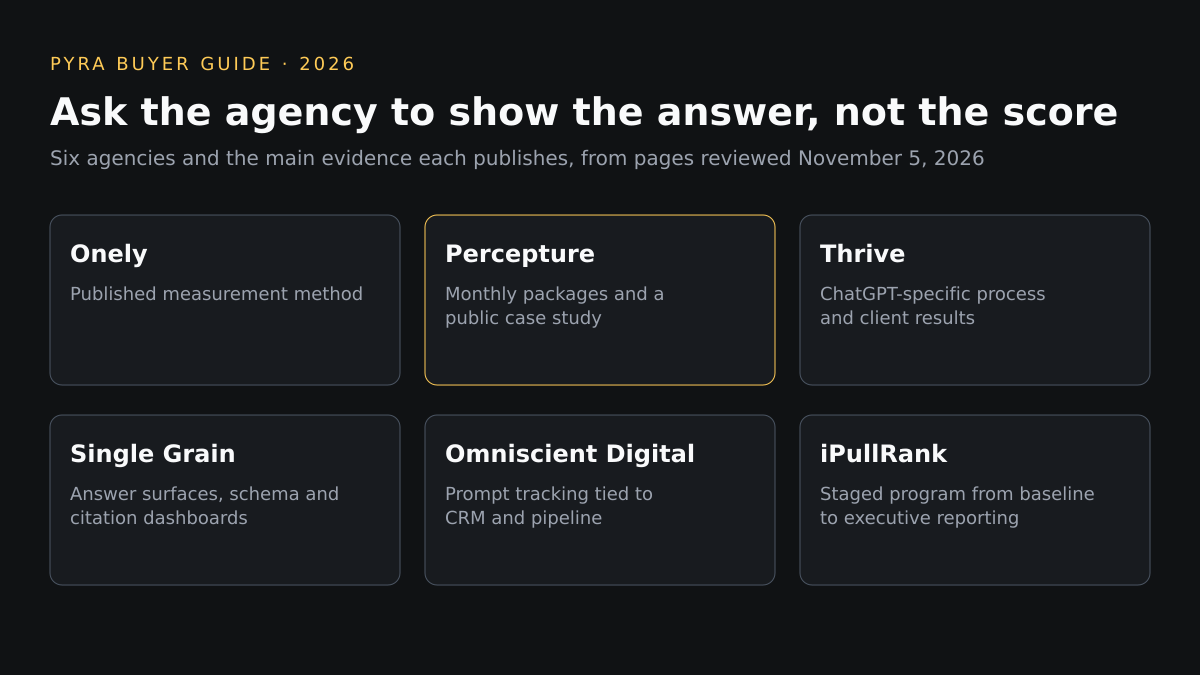
Short answer: the best AI search optimization agencies in the US show how they measure answers, not a promise of rank. Of six agencies reviewed on November 5, 2026 for ChatGPT visibility, Onely publishes its measurement method, Percepture publishes monthly GEO packages from $3,500 and a public case study, and Thrive publishes a ChatGPT process with client results. None describes a per-answer cited-URL record.
The right agency explains where measurement ends. A buyer selects the agency after judging the proof, and ChatGPT visibility cannot be promised by an agency. This guide is for founders and marketing leads, mainly at AI product companies, comparing agencies that say they can make their company easier for ChatGPT and other AI engines to find, understand and cite. Bob Generale, who wrote it, is President of Percepture, which is listed second, and co-founder of Pyra, which makes the Prime and Lead Seeker products mentioned later. Facts come from each agency's public pages on November 5, 2026; results quoted from an agency are its own figures, and "not described" means the pages did not say.
What the best AI search marketing agencies should do
Lists for "best AI search marketing agencies 2025" and 2026 that were returned in search on November 8, 2026 run from five to seventeen agencies (ZeroClick Labs five, Stridec seven, GenOptima ten, Derivatex seventeen, by their titles), so list length says little about fit.
The agencies below sell one label for different jobs: structuring pages and schema so engines can read them, earning mentions on other sites, testing the questions buyers ask, and measuring what changed. Onely's research on agency ranking lists reports that ChatGPT named none of the nine agencies that rank themselves first across 13 lists it checked, which is a reason to judge an agency by its method and evidence rather than a list position, including this one.
For buyers who want a US agency, the pages reviewed say little. Thrive's locations page lists its headquarters in Arlington, Texas, and Omniscient Digital's team page lists offices in Austin and New York. Percepture describes itself on its homepage as a global agency. Onely, Single Grain and iPullRank locations were not confirmed on the pages reviewed, so ask each where the team doing the work sits and who answers the call.
Verticalized work is a useful reference point. A site such as AI search for real estate describes combining real estate SEO, local search, GEO and digital authority for agents, brokerages and investors, which shows how a program changes when it is built around one buyer's questions rather than a generic checklist. Ask any agency which of your buyers' questions it would test first.
Which LLM optimization service do you mean?
"LLM optimization services" names two different jobs. The first is visibility: getting an AI product named and cited when buyers ask ChatGPT and other engines for recommendations, which is what the agencies below sell. The second is performance: lowering the cost, latency or error rate of the model calls inside the product. Search results for this query mix both. Growthner (updated August 19, 2026) lists 12 agencies for SaaS and Cintra ranks seven, and each places itself first; separate service pages describe the second job.
| Service type | What it optimizes | How it is described on public pages | Buy it when |
|---|---|---|---|
| AI search visibility (this guide) | Whether buyers' questions to ChatGPT and other engines name or cite your product | Measurement method, content and authority work, reporting; compared below on nine criteria | Buyers shortlist AI products by asking an assistant |
| Cost and inference performance | Spend, latency and throughput of the product's own model calls | Olypsis traces an agent's model calls and tests changes on real tasks; IntelliSensei profiles latency, throughput and cost per token; Systima describes cost audits, model routing, evaluation and caching | The model bill or response time is the constraint, not discovery |
The nine criteria in this guide measure answer visibility, so they do not apply to the performance services, which are not compared here. Read the two as separate purchases: a faster model does not make an engine cite you, and a citation does not lower your inference bill.
How we compared these AI search marketing agencies
Nine criteria were applied to every agency using only its public pages. The order of the profiles is an editorial judgement weighted toward a stated measurement approach, published pricing and public evidence of results on the same criteria; it is not a score, Percepture's second place is not a claim to be first, and no hands-on test was run. Agencies were chosen because they recur in published ChatGPT agency lists and have their own service pages describing ChatGPT or AI search work; the set is not exhaustive.
| Criterion | The question it answers |
|---|---|
| Engine coverage | Which AI engines does the agency say it works on? |
| Mention vs citation | Does reporting separate being named from being linked as a source? |
| Exact cited source | Can you see which URL an engine cited, yours or a competitor's? |
| History and trend | Are results kept per run so a change can be dated? |
| Competitor comparison | Does it show who was named or cited instead of you? |
| Question tracking | Does it track your buyer questions, not only a generic set? |
| Reporting, export, API | Can you take the evidence out of the agency's reports? |
| Pricing transparency | Is the price or a range on the public page? |
| Diagnosis to action | Does a finding turn into a named fix? |
Best AI search marketing agencies for ChatGPT compared
Two tables, the same six agencies in profile order. The first covers base, engines, evidence and price; the second covers history, competitors, questions, reporting and what happens after a finding. Scroll sideways on small screens.
| # | Agency | Focus | Engines named | Mention vs citation | Exact cited source | Pricing shown |
|---|---|---|---|---|---|---|
| 1 | Onely | GEO for enterprises selling in several countries | ChatGPT, Perplexity, Gemini and Google's AI Overviews | Its monthly report lists the brand's share of each answer, recommendations and citations | Says it shows which sources the engines use; a per-answer cited-URL record is not described | No price published; it says the price depends on audience research, how new the problem is and the number of countries |
| 2 | Percepture | GEO with digital PR, schema and published packages | ChatGPT, Grok, Perplexity, Gemini and Google AI Overviews, with Claude named in the ChatGPT and LLM work | Tracks mentions, sentiment and referral traffic from AI platforms; its packages include citation and mention opportunity mapping | Not described as a per-answer cited-URL record | AI Search (GEO) packages: Launch from $3,500 a month, Growth from $6,000, Authority from $8,500, Enterprise from $10,000; optional AI link and mention building from $1,000 a month and digital PR from $4,500 a month |
| 3 | Thrive Internet Marketing Agency | ChatGPT SEO inside a full-service agency | ChatGPT is the focus of the page; Google AI Overviews, Claude and general AI SEO have separate Thrive pages | Reports both ChatGPT mentions and AI citations in its case results; how reports separate them is not described | Not described | No price published; its enquiry form offers monthly budget bands |
| 4 | Single Grain | Answer engine optimization for content-led growth | Google's AI Overviews, ChatGPT, Perplexity, Copilot, Alexa and Siri | Tracks AI citations, AI Overview appearances and zero-click impressions; mentions are not separately described | Not described | No price published |
| 5 | Omniscient Digital | AEO for B2B brands, measured against pipeline | ChatGPT, Claude and Gemini are named as where buyers ask | Measures visibility and recommendation patterns across prompt clusters; citations are measured and described as not an outcome by themselves | Says it identifies the publishers and sources shaping answers; a per-answer record is not described | No price published |
| 6 | iPullRank | Relevance engineering for enterprise and growth brands | Its page refers to ChatGPT, Google AI Overviews and AI Mode | Describes mentions and citations as part of visibility measurement; the split in reports is not described | Not described | No price published |
| Agency | History | Competitors | Question tracking | Reporting, export, API | Diagnosis to action |
|---|---|---|---|---|---|
| Onely | A baseline, then the same questions monthly | Not described | Each tracked question is tied to a buying decision, with separate question research per country | Monthly report per market and per step of the customer journey; export and API are not described | Audience research, baseline, entity and schema work, mentions on other sites, then monthly measurement tied to leads |
| Percepture | Monthly measurement is the fifth step of its five-step workflow | Not described on the GEO page; comparison and best-of content strategy is included from the Growth package | Topic and question research is included in every package | Transparent reporting using Semrush and Google Search Console; export and API are not described | Intake and audit, topic and entity map, page optimization with schema, digital PR and citations, then monthly measurement |
| Thrive Internet Marketing Agency | Prompt tests are re-run on a regular cadence; trend reporting is not described | Not described | Tests the prompts your customers ask at the audit step | Thrive Stats, its reporting dashboard for marketing metrics; export and API are not described | Audit AI visibility, structure content, build brand mentions and third-party authority, then monitor, test and adapt |
| Single Grain | Not described | Not described | Not described | Custom dashboards; export and API are not described | Structured answers and schema, original research and content, promotion, then answer-visibility measurement and testing |
| Omniscient Digital | Not described | Competitive intelligence feeds the demand model; a comparison report is not described | Prompt clusters built from buyer research, sales conversations and search behavior | Visibility connected to analytics and CRM; export and API are not described | Demand model, consideration-set content, source and PR strategy, technical foundations and structured experiments |
| iPullRank | Baseline and measurement framework are listed; trend reporting is not described | Competitive analysis is listed for the growth stage | Foundational prompt and topic strategy is listed for the emerging stage | Executive reporting tied to revenue is listed for the elite stage; export and API are not described | Baseline and strategy, then content engineering, digital PR and cross-functional coordination as the program matures |
Profiles
1. GEO for enterprises selling in several countries
Onely
Best fit: Enterprises that need ChatGPT and other engines to connect them to buyers in more than one country and want leads, not mentions, as the measure.
Evidence: Its GEO page publishes a method: research from real customer conversations such as forums and the follow-up questions engines suggest, a baseline, then the same questions checked every month. It says it believes it is the best GEO agency for enterprises seeking international AI search and is not focused on small businesses, local search or paid media. Its research on ranking lists says ChatGPT named none of the nine agencies that rank themselves first across 13 lists it checked.
Engines: ChatGPT, Perplexity, Gemini and Google's AI Overviews. Mention vs citation: Its monthly report lists the brand's share of each answer, recommendations and citations. Exact cited source: Says it shows which sources the engines use; a per-answer cited-URL record is not described.
Pricing: No price published; it says the price depends on audience research, how new the problem is and the number of countries.
Strength: The clearest published method for measuring answers that change run to run, and it says it judges its reports by leads, not mentions.
Limitation: No price is published, it says it is not built for small businesses or local search, and competitor comparison is not described.
What to verify: Which questions would be tracked first, whether the report saves each answer and cited URL, and the cost for your number of markets.
Source: onely.com GEO services page (reviewed November 5, 2026).
2. GEO with digital PR, schema and published packages
Percepture
Best fit: B2B and enterprise teams that want ChatGPT-focused GEO work with published packages, digital PR citations and a public case study.
Evidence: Founded in 2004; its pricing page says the team works from 8 countries and 52 cities with an average of 15 years of experience. Its GEO page names a ChatGPT and LLM visibility service covering entity mapping, conversational content structure and citation-worthy assets. Its public Broadstaff Global case study, a digital infrastructure staffing firm, reports 90% of tracked keywords on page one and 3x qualified leads within 12 months from a program that included AI search visibility support. Its GEO page also quotes an unnamed tech client with a 3000% increase in AI mentions in 3 months, which is the agency's own figure and cannot be verified from the page.
Engines: ChatGPT, Grok, Perplexity, Gemini and Google AI Overviews, with Claude named in the ChatGPT and LLM work. Mention vs citation: Tracks mentions, sentiment and referral traffic from AI platforms; its packages include citation and mention opportunity mapping. Exact cited source: Not described as a per-answer cited-URL record.
Pricing: AI Search (GEO) packages: Launch from $3,500 a month, Growth from $6,000, Authority from $8,500, Enterprise from $10,000; optional AI link and mention building from $1,000 a month and digital PR from $4,500 a month.
Strength: Combines published GEO packages, schema and entity work, digital PR citations and a public case study that states a result and its period.
Limitation: Its case-study categories are telecom, travel and life sciences, the Broadstaff result covers a broader program than ChatGPT alone, and the pages do not describe cited-URL records.
What to verify: Which questions would be tracked, what the monthly report shows about named versus cited, and which package fits your scope.
Source: Percepture GEO services and AI search pricing pages (reviewed November 5, 2026).
3. ChatGPT SEO inside a full-service agency
Thrive Internet Marketing Agency
Best fit: Companies that want ChatGPT optimization from a full-service agency that also runs SEO, web design and paid media.
Evidence: Its ChatGPT SEO page describes a six-step process, from auditing the prompts your customers ask to re-running prompt tests on a regular cadence, and lists its own client results: an industrial equipment manufacturer with 68% more ChatGPT traffic and 71% more ChatGPT mentions, and a medical group with 1,000+ AI citations and 2,658% more Google AI Overview citations. These are the agency's figures, and the page does not give the periods.
Engines: ChatGPT is the focus of the page; Google AI Overviews, Claude and general AI SEO have separate Thrive pages. Mention vs citation: Reports both ChatGPT mentions and AI citations in its case results; how reports separate them is not described. Exact cited source: Not described.
Pricing: No price published; its enquiry form offers monthly budget bands.
Strength: A ChatGPT-specific page with a stated process, a named reporting platform and client results that separate mentions from citations.
Limitation: No price or result periods are published, and per-answer source records are not described.
What to verify: The period behind each result, how mentions are counted, and whether the reporting platform shows the answers behind the numbers.
Source: thriveagency.com ChatGPT SEO page (reviewed November 5, 2026).
4. Answer engine optimization for content-led growth
Single Grain
Best fit: Brands that want structured answer content and schema aimed at many answer surfaces, not ChatGPT alone.
Evidence: Its AEO services page says it builds answer blocks and schema (FAQ, HowTo, Speakable, Organization), creates original research and tracks AI citations with custom dashboards. It lists client results in its own words, including 400+ AI citations for a building products company and 10 monthly SQLs from LLMs for another client.
Engines: Google's AI Overviews, ChatGPT, Perplexity, Copilot, Alexa and Siri. Mention vs citation: Tracks AI citations, AI Overview appearances and zero-click impressions; mentions are not separately described. Exact cited source: Not described.
Pricing: No price published.
Strength: Names a broad set of answer surfaces and ties client results to citations and sales-qualified leads.
Limitation: ChatGPT is one of six surfaces named, and prompts, history and price are not described.
What to verify: Which engines and questions your dashboard would cover and what each client result's period was.
Source: singlegrain.com AEO services page (reviewed November 5, 2026).
5. AEO for B2B brands, measured against pipeline
Omniscient Digital
Best fit: B2B teams that want prompt tracking built from voice-of-customer research and tied to CRM and pipeline.
Evidence: Its page describes four steps: model real buyer demand, win the consideration set, shape the sources that shape the answer, and measure influence against pipeline using web analytics, self-reported attribution and CRM data. It links case studies that state Convert grew LLM visibility 81% and AI citations 140%, and OnBoard reached the top AI share of voice; both are the agency's own claims.
Engines: ChatGPT, Claude and Gemini are named as where buyers ask. Mention vs citation: Measures visibility and recommendation patterns across prompt clusters; citations are measured and described as not an outcome by themselves. Exact cited source: Says it identifies the publishers and sources shaping answers; a per-answer record is not described.
Pricing: No price published.
Strength: Ties prompt tracking to commercial-intent prompts and connects visibility to pipeline data.
Limitation: No price, history or per-answer source record is described, and the stated results are linked case studies not summarized on the page.
What to verify: Which prompt clusters would be tracked and which CRM and attribution data it would use.
Source: beomniscient.com AEO page (reviewed November 5, 2026).
6. Relevance engineering for enterprise and growth brands
iPullRank
Best fit: Mid-market and enterprise brands that want a technical, stage-based GEO program from an SEO-led agency.
Evidence: Its GEO page sorts needs into emerging, growth and elite stages: from an AI search visibility baseline and prompt strategy, to competitive analysis and a measurement framework, to cross-platform measurement and executive reporting tied to revenue. It says ranking well and being cited well are different skills.
Engines: Its page refers to ChatGPT, Google AI Overviews and AI Mode. Mention vs citation: Describes mentions and citations as part of visibility measurement; the split in reports is not described. Exact cited source: Not described.
Pricing: No price published.
Strength: A staged scope that shows what a team needs at each maturity level, with competitive analysis and revenue reporting named.
Limitation: No price is published and the page does not describe per-answer source records or case results for GEO.
What to verify: Which stage you would start at, what the baseline records, and which reports you would receive.
Source: ipullrank.com GEO services page (reviewed November 5, 2026).
How to check an agency's ChatGPT work
An AI service needs a measure of what changed. None of the six agencies described a per-answer record of named versus cited results on the pages reviewed, so ask for one. Prime's AI visibility strategy guide frames the work as a loop: start from business context, choose commercially important buyer questions, take a dated baseline, diagnose why a competitor wins, fix the gap and re-measure, with mentions and citations measured separately and a 30/60/90-day plan. It says a strategy cannot guarantee traffic or revenue. That is the standard to hold an agency to.
To keep your own record, the AI Visibility Platform Prime, which Pyra makes, saves the exact answer and cited websites for each buyer question on the engines it covers. It does not crawl or index your site and does not monitor Google organic rankings. Prime on the same nine criteria, from primeaivisibility.com/pricing on November 7, 2026:
| Criterion | What the Prime pages state |
|---|---|
| Engine coverage | ChatGPT, Claude, Perplexity on Flash; Gemini and an AI Overview-style preview start on Starter |
| Named vs cited | Separates named (brand in answer text) from cited (source link) for every answer |
| Exact cited source | Yes: saved answers show the exact source URLs each engine returned |
| History and trend | One check per month on Flash; paid plans can run weekly and keep every run |
| Competitor comparison | Competitors named or cited in the same answer are recorded |
| Question tracking | Buyer questions are the unit: 5 on Flash, 25 on Starter, 50 on Growth |
| Reporting, export, API | Exports from saved data; Word, HTML and Markdown drafts from Content Fix |
| Pricing transparency | Flash free; Starter $69/mo, Growth $179/mo, Agency $369/mo, Enterprise from $1,499/mo (primeaivisibility.com, Nov 7, 2026) |
| Diagnosis to action | Identify the missed question, research, draft, review, export, recheck; claims needing proof are flagged before export |
Prime is a measurement product, not an agency, so it is shown beside the agencies rather than ranked among them. Our guides to ChatGPT SEO analysis tools and the GEO playbook cover the evidence standard in more depth.
From AI visibility to the accounts worth contacting
What answer engines name, cite and recommend is one question; which accounts and verified contacts deserve outreach is another. B2B sales intelligence such as Lead Seeker handles B2B prospecting, verified contacts and buyer dossiers, and does not track AI answers.
When intent signals must become qualified account selection, campaign execution or sales activation, Percepture's B2B intent data services connect signal interpretation to ICP targeting and campaign activation. These are separate offerings from AI search optimization and from each other.
Best AI search marketing agencies: questions buyers ask
How do I choose among AI search optimization agencies in the US?
Do not choose by the label "US agency" alone. Among the six reviewed on November 5, 2026, only Thrive (headquarters in Arlington, Texas) and Omniscient Digital (offices in Austin and New York) stated a US location on the pages checked, and Percepture describes itself as a global agency. Ask where the team doing the work sits, how it measures answers, and whether it will show named versus cited results per buyer question. An agency that cannot say where measurement ends is promising more than it can verify.
Are "best AI search marketing agencies" lists reliable?
Treat them as starting points. Lists returned in search on November 8, 2026 range from five to seventeen agencies, and Onely's research says ChatGPT named none of the nine agencies that rank themselves first across 13 lists. Judge an agency by its published measurement method, pricing and evidence on the same criteria, and ask for a saved before-and-after record of your own buyer questions.
Do LLM optimization services mean AI search visibility or model cost and speed?
Both uses exist. For the best LLM optimization services for AI products, visibility services work on whether ChatGPT and other engines name or cite your product, while performance services such as Olypsis, IntelliSensei and Systima describe lowering the cost, latency or error rate of the product's own model calls. This guide compares visibility agencies; choose by which problem you have.
What are the best AI search optimization agencies for ChatGPT?
On the pages reviewed on November 5, 2026, Onely publishes the clearest measurement method, Percepture publishes monthly GEO packages from $3,500 and a public case study, and Thrive publishes a ChatGPT-specific process with client results. Single Grain, Omniscient Digital and iPullRank cover ChatGPT among other engines. None describes a per-answer cited-URL record, so ask for one.
Can an agency guarantee that ChatGPT will recommend my company?
No. Onely's own research on agency ranking lists says ChatGPT named none of the nine agencies that rank themselves first, and Percepture's guide to hiring a GEO agency says no agency can control AI outputs directly. Work can make pages clearer and better sourced, but any guarantee of placement should be treated as a warning.
How much do ChatGPT optimization agencies cost?
Few publish prices. Percepture lists GEO packages from $3,500 to $10,000 or more a month, with optional digital PR from $4,500 a month. Onely, Thrive, Single Grain, Omniscient Digital and iPullRank did not publish prices on the pages reviewed, and Onely says its price depends on research needs, how new the problem is and the number of countries.
How can I check an agency's ChatGPT work?
Ask for the same buyer questions to be run before and after the work, with each answer saved. For each question record whether your company was named, whether one of your pages was cited and the exact cited URL. An agency that reports only a visibility score cannot show you the answer behind it.
Sources
Agency pages are linked from each profile. Results and positioning quoted from an agency are its own statements, and all pages were reviewed November 5, 2026. Written by Bob Generale, COO and co-founder of Pyra and President of Percepture; reviewed by Alex Mannine.
Get a baseline before you hire
Talk with Pyra about the buyer questions to test in ChatGPT, the baseline to record and the content and account work that follows.