Best AI Agents For PR Teams: Workflows, Guardrails & Human Approval (2026)
We evaluated AI agents for PR teams by the work they can support, the evidence behind each claim, and where a human must approve. This 2026 guide separates PR software, governed orchestration, and AI-search measurement.
Methodology first: what earns a “best for” label?
For this comparison, an AI agent for PR completes a bounded job using context and tools. An assistant suggests or drafts; a platform may contain both. Calling every AI feature an agent hides the buying decision: are you buying intelligence, content preparation, or permission to act?
Evidence reviewed September 10, 2026. We used public product descriptions and the company evidence supplied for this guide. Each recommendation below names a job, its supporting source, a limitation, and the demonstration a buyer should request.
The same criteria apply to every option: source quality, relevance, allowed actions, approval control, auditability, and measurable output.
The 2026 shortlist: choose the job before the vendor
Short answer: shortlist Muck Rack for media-list recommendations, Agility for monitoring-to-briefing work, and Pyra for governed PR workflow orchestration. Consider CisionOne, Meltwater Mira, or PR.co when the need is decision support, intelligence summaries, or content preparation rather than autonomous execution.
| Candidate | Best for | What you are buying |
|---|---|---|
| Muck Rack Media List Agent | Media-list discovery and maintenance | Bounded recommendation agent |
| Agility Agent | Turning a monitoring goal into a stakeholder briefing | Monitoring-to-report agent |
| Pyra | Governed PR workflow orchestration | Governed workflow orchestration |
| CisionOne AI | Coverage analysis and PR decision support | AI-assisted PR platform |
| Meltwater Mira | Source-linked media intelligence for executive reporting | Conversational intelligence assistant |
| PR.co | Pitch preparation and campaign localization | AI content assistant; vendor label: AI Agent |
Bounded recommendation agent
Muck Rack Media List Agent — best for media-list discovery and maintenance
Documented workflow: Muck Rack describes an agent that takes a journalist or creator brief, recommends a list, refines results, and suggests additions or removals with explanations. Muck Rack's agent explainer (reviewed September 10, 2026).
Limitation: The reviewed evidence supports recommendations, not permission to send pitches autonomously. A relevant-looking contact can still be wrong for the story.
Before choosing: Give it one brief and a stale list. Ask it to explain every addition and removal using current reporting. A PR owner must approve the final list.
Monitoring-to-report agent
Agility Agent — best for turning a monitoring goal into a stakeholder briefing
Documented workflow: Agility says its agent interprets a plain-language goal, curates and analyzes coverage, charts metrics, and sends the finished briefing to intended stakeholders. Agility's media-monitoring product page (reviewed September 10, 2026).
Limitation: The public evidence reviewed does not establish configurable approval gates, complete audit exports, or safe failure behavior. Delivery is an external action, not just a formatting feature.
Before choosing: Ask for a preview-only briefing with cited sources. Show how recipients are restricted and how delivery is stopped when a source conflicts with the summary.
Governed workflow orchestration
Pyra — best for governed PR workflow orchestration
Documented workflow: Pyra's marketing-agent page describes controlled inputs, approved language, evidence preparation, and approval before external use. The supplied company operating model adds the full trigger-to-outcome loop shown below. Pyra's marketing workflow description (reviewed September 10, 2026).
Limitation: Source licenses, connectors, permission enforcement, audit export, and maintenance must be demonstrated for the proposed scope.
Before choosing: Map one workflow across your systems. Require a blocked-send demonstration, a named approver, and an exported record connecting sources, edits, approval, and outcome.
AI-assisted PR platform
CisionOne AI — best for coverage analysis and PR decision support
Documented workflow: Cision describes coverage summaries, key narratives and themes, next-step recommendations, harmful-content React Score, and suggested pitch timing. CisionOne AI product description (reviewed September 10, 2026).
Limitation: Those features do not prove autonomous execution, crisis prevention, or approval and audit controls. Treat a risk score as a review signal rather than a verdict.
Before choosing: Use ambiguous coverage, sarcasm, and a regional source. Have your analyst inspect the underlying evidence and explain which recommendation they would reject.
Conversational intelligence assistant
Meltwater Mira — best for source-linked media intelligence for executive reporting
Documented workflow: Meltwater describes answers over media, social, and AI-search signals, with coverage, sentiment, and narrative analysis and source-linked summaries. Meltwater's AI and Mira overview (reviewed September 10, 2026).
Limitation: An assistant that answers questions is not evidence of an agent executing a PR campaign. Coverage quality, access to integrations, and summary accuracy need buyer validation.
Before choosing: Request a board-ready summary, then trace each statement to its source. Include a correction and confirm it appears in the revised briefing.
AI content assistant; vendor label: AI Agent
PR.co — best for pitch preparation and campaign localization
Documented workflow: PR.co describes draft pitch emails for users to review, refine, and send; campaign translation; headline, summary, and social-post suggestions; and coverage sentiment analysis with brand context. PR.co's AI Agent feature page (reviewed September 10, 2026).
Limitation: The documented workflow covers generation and recommendations. A fluent translation still needs local editorial review.
Before choosing: Provide approved brand language, an embargo, and a market-specific term. Verify that drafts preserve all three and cannot bypass the accountable editor.
AI Agents PR Teams Operating Loop
Use the loop to decide whether a tool is ready for your workflow. Start with one approved brief and ask the vendor to show each stage. If it cannot show a permission or approval control, keep the pilot read-only or draft-only. Do not infer a safety control from the presence of a chat window.
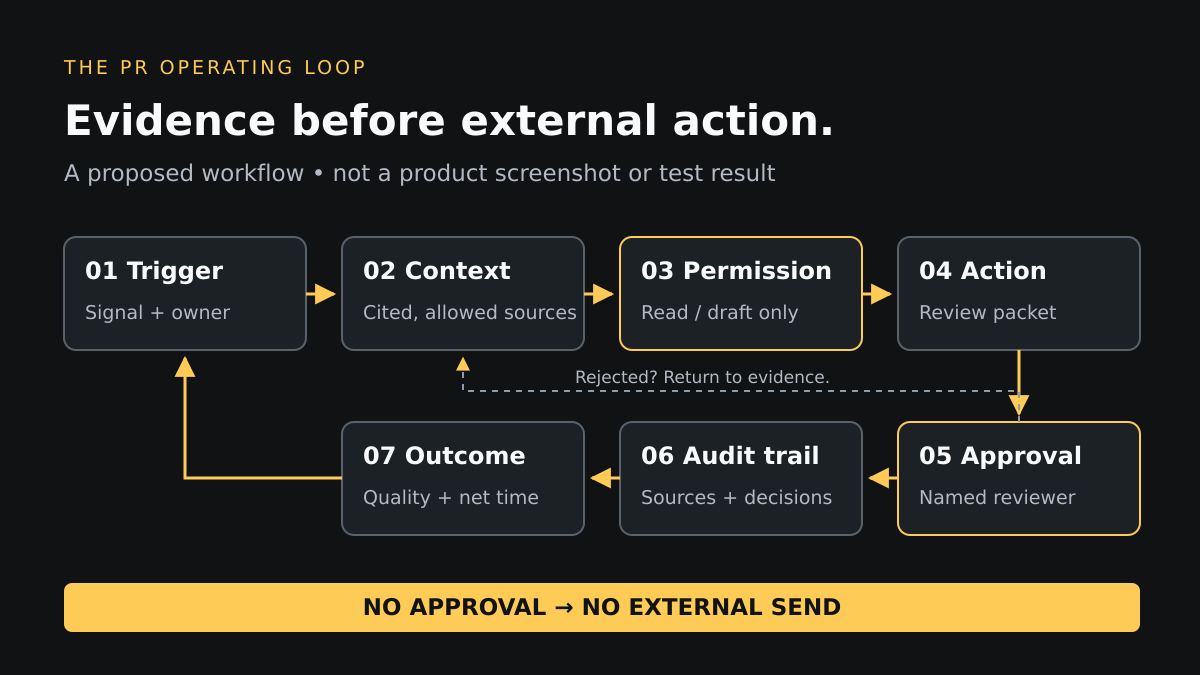
- Trigger. A named signal or approved request starts the job. Buyer check: Who owns the signal, and which events should not start it?
- Context. Use licensed reporting, approved claims, and current brand guidance. Buyer check: Can a reviewer open every source and distinguish fact from inference?
- Permission boundary. Separate read, draft, edit, and send rights. Buyer check: Can the agent read an embargoed document without being allowed to distribute it?
- Action. Prepare a cited briefing, list review, or draft. Buyer check: Is the output a bounded artifact rather than an unrestricted campaign?
- Human approval. A named owner accepts or rejects the exact external action. Buyer check: Does an edit after approval require fresh approval?
- Audit trail. Retain sources, changes, approver, recipient, and timestamps. Buyer check: Can you reconstruct the result without relying on the vendor's demo?
- Measurable outcome. Measure relevance, corrections, review time, and useful coverage. Buyer check: Did work improve after counting rework and oversight?
Worked workflow: a source conflict, not a polished demo
Illustrative scenario, not a client case: an agent flags coverage that contradicts an approved product claim. It may collect the article, compare it with the approved fact sheet, and prepare a discrepancy brief. It must not contact the journalist or publish a correction.
The PR owner checks the source; legal reviews any sensitive claim; the spokesperson approves the response. A changed draft invalidates the earlier approval. The record retains the source, decision, final wording, recipient, and time. That is the operating boundary to demonstrate before giving a PR agent send access.
A buyer test that can reject an unsafe system
Our proposed test protocol uses 25 approved historical examples: five ordinary briefs, five stale or conflicting sources, five irrelevant or duplicate mentions, five sensitive or embargoed cases, and five missing-source or failed-tool cases. These are suggested test inputs, not tests we have already run.
PR judges relevance; legal and security judge allowed data and claims; IT checks identity and export; operations checks failure recovery; the budget owner checks total cost. For every case, retain the input, expected boundary, actual output, source evidence, reviewer decision, and correction time.
| Test | Evidence required | Decision |
|---|---|---|
| Claim grounding | A valid source for each factual assertion; conflicting sources flagged | Unsupported claims return to review |
| Denied action | An attempted unapproved send is blocked | Any bypass stops the action-enabled pilot |
| Relevance | Human-labeled lists and alert samples | Compare with the team's baseline, not the demo |
| Reconstruction | Sources, edits, approvals, and actions in an export | No reconstructable record: stay draft-only |
| Net work saved | Preparation time minus review, corrections, and upkeep | Expand only if quality holds and net value is positive |
Calculate savings after review, not before it
Hypothetical calculation: if a weekly briefing takes 120 minutes manually, and the assisted workflow takes 20 minutes to prepare, 35 to review, and 15 to correct, net time saved is 120 − 20 − 35 − 15 = 50 minutes per briefing. At four briefings, that is 200 minutes per month before setup and maintenance. Substitute your own observed figures. This is arithmetic, not a vendor performance claim.
Ask procurement for current licensing, source coverage, model-training and retention terms, implementation, exports, and exit costs. Budget-constrained teams should first test a feature in their existing stack. More subscriptions do not resolve a missing approval owner.
Keep PR execution, strategy, and measurement separate
Prime AI Visibility — best companion for measuring AI mentions, citations, and recommendations. Pyra's Prime AI Visibility helps inspect AI-answer evidence and track mentions and citations alongside your PR workflows.
Keep the buyer-question set, captured answer, cited source, and check date together. A change in mentions is a measurement signal, not proof that one press placement caused revenue. Use our citation-tracking methodology to separate mentions from actual source citations.
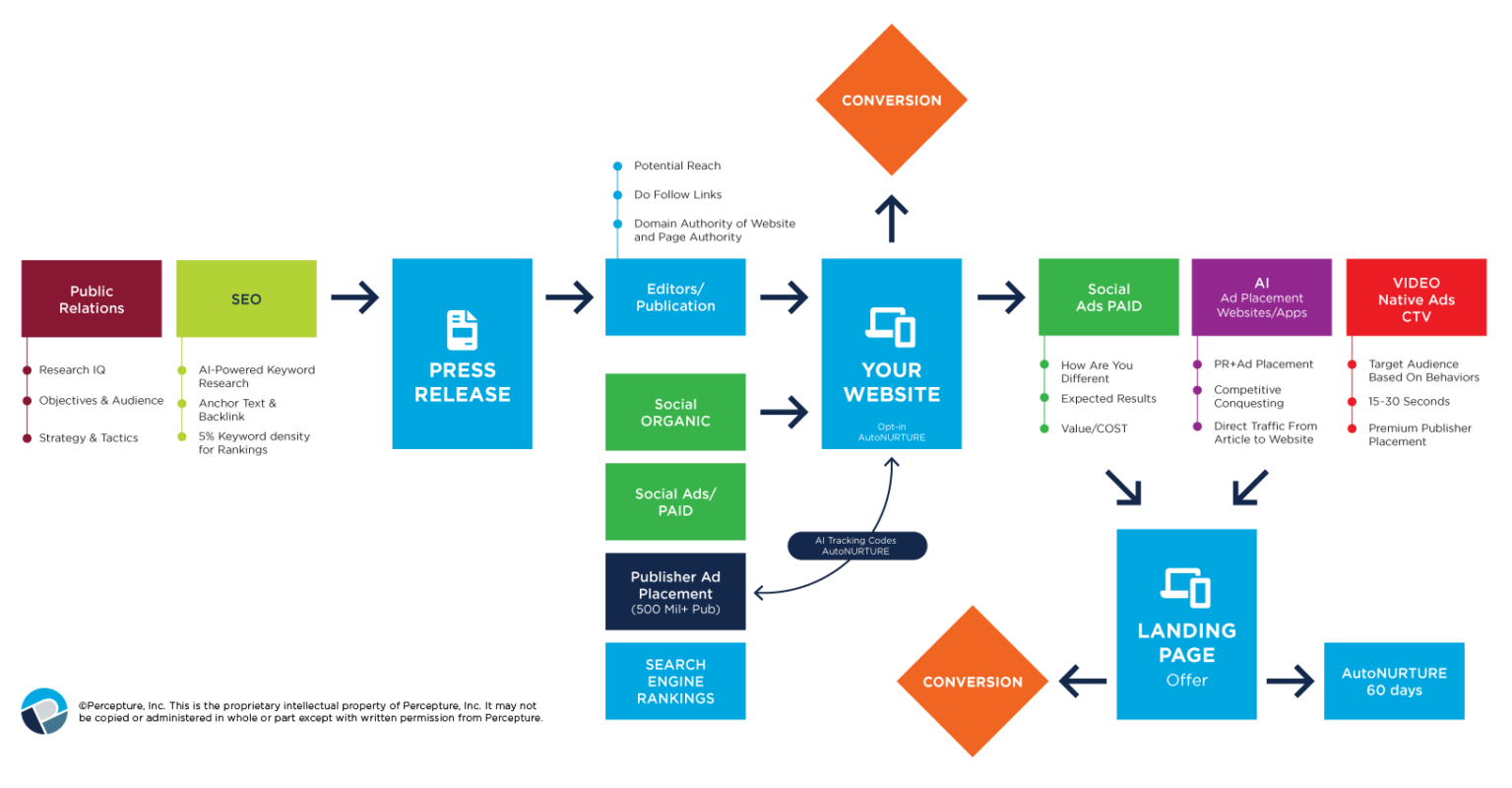
For agency execution, explore integrated PR and search strategy through Percepture's Digital PR process visual and Digital PR explainer video.
For cross-department requirements, compare enterprise agent platform controls. Do not replace a specialist PR source license with a general-purpose model and assume the evidence is equivalent.
Questions PR buyers should settle before signing
How were the AI agents for PR teams evaluated?
We reviewed current public product descriptions and the supplied company evidence on September 10, 2026. We compared workflow fit, cited inputs, action boundaries, human approval, auditability, and measurable output.
Which option fits a different use case or budget?
Start with the job: Muck Rack for list recommendations, Agility for monitoring-to-briefing work, Pyra for governed orchestration, CisionOne for decision support, Meltwater Mira for intelligence summaries, and PR.co for content preparation. Compare the full contract, data licenses, implementation, review time, and exit costs.
What proof should a buyer request before choosing?
Request a demonstration on approved historical examples, source-linked outputs, a failed-approval test, scoped permissions, and an exportable action record. Ask who maintains the workflow and what happens when a source is missing, a tool fails, or an approver is unavailable.
When were the PR-agent sources reviewed?
Public capability sources were reviewed September 10, 2026. Each profile links the official description of its documented use case.
How should a PR team start an agent pilot?
Choose one approved brief, a defined source list, and a named reviewer. Test source quality, approval boundaries, audit export, and failure recovery before expanding to a wider workflow.
Can a PR agent send pitches or crisis statements without review?
Technical send capability is not permission. Our recommendation is a named human approval gate for pitches, releases, crisis statements, executive quotes, corrections, and sensitive claims. Keep the approved content, recipient, time, and source record together; no approval means no send.
Source and evidence notes
Official product sources are linked beside each candidate. Research also included Agility's PR-agent examples, Muck Rack's agent explainer, and the supplied operating model.
Map one PR workflow with Pyra
Bring one approved brief, one restricted action, your source list, and the person who owns approval. Ask us to map the workflow and demonstrate the permission boundary before you commit to a broader rollout.
Discuss a governed PR workflowStill comparing? Use the acceptance matrix above as your PR workflow readiness checklist.