AI Sales Engineer vs Traditional Sales Automation Tools
AI sales engineer vs traditional sales automation tools compared by function, with a decision guide for which job each one fits and how to test the boundary.
An AI sales engineer vs traditional sales automation tools is a comparison between two different jobs. Traditional sales automation runs rules you set, such as sequences, reminders, routing and field updates. An AI sales engineer is meant to answer technical questions, support discovery and help shape a solution, which needs cited product knowledge and a clear rule for what it does when it does not know. This guide compares them by function and gives a decision guide for when you need which.
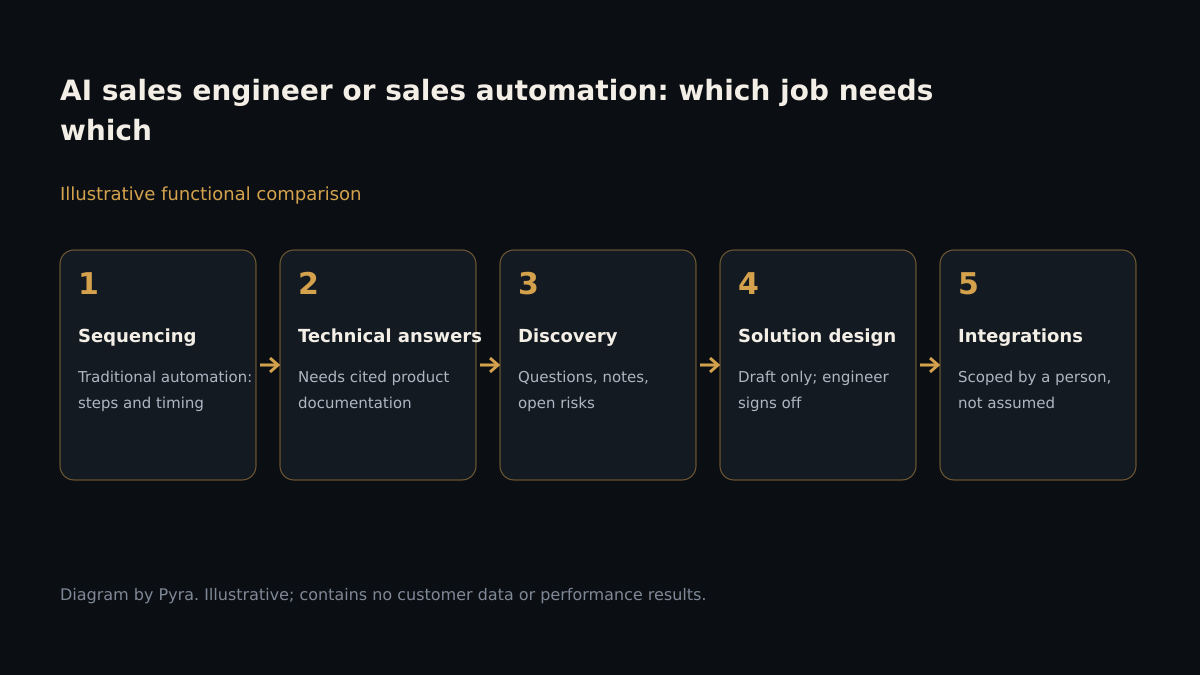
The AI sales engineer vs traditional sales automation tools question is not about rival versions of one product. A team can need both, one, or neither yet. The useful question is which job is currently costing you deals or time. Our earlier comparison of AI sales engineer solutions scores named products on how they behave at the edge of their knowledge; this page is a broader functional comparison and does not replace it.
AI sales engineer vs traditional sales automation tools, function by function
AI sales engineer vs traditional sales automation tools, compared by function
| Function | Traditional sales automation | AI sales engineer | What to verify |
|---|---|---|---|
| Timing and sequencing | Core strength: rules fire on triggers and schedules | Not its main purpose | Does the tool you use actually enforce your timing rules? |
| Technical answers | Static templates at best | Answers technical questions from product documentation | Does each answer cite a source page, and does it decline when none exists? |
| Discovery support | Forms and fixed question lists | Can ask follow-up questions and summarize needs | Are notes reviewed before they reach the CRM? |
| Solution design | None | Can draft an approach for an engineer to review | Who signs off, and is the draft marked as a draft? |
| Integration scoping | Moves data between configured fields | Can gather requirements for an integration | Is feasibility confirmed by a person, not assumed? |
| Data updates | Writes defined fields reliably | May propose updates | Does it write directly, or only propose for approval? |
Vendor categories blur here: many automation tools now add AI features, and some AI products add sequencing. Judge by the verification column, not the label.
Decision guide: AI sales engineer vs traditional sales automation tools
Which job is costing you time or deals?
| If your main problem is... | Start with | Reason |
|---|---|---|
| Leads fall through because follow-up is late or uneven | Traditional automation | Rules and reminders fix timing and routing |
| Deals stall waiting for a technical person to answer questions | The tool, with cited documentation | The delay is in technical answers |
| Data in the CRM is incomplete or stale | Automation plus a review step | Field updates and checks are rule-based |
| Prospects ask custom integration questions | The tool drafting for human review | Needs requirement gathering, not just sequencing |
| Your product documentation is thin or out of date | Fix the documentation first | It can only be as accurate as its sources |
Test the boundary
For the tool, the most informative test is a question it should not be able to answer. Ask about an unreleased feature, an unsupported integration, or a price it has no source for. A good tool declines or hands over to a person and says why. A weak one produces a confident, unsupported answer. Run ten such questions before any pilot, and keep the transcripts.
Where Pyra fits
Pyra's AI sales agents are described as execution agents with approval gates, audit trails and role-based access, which is the control model that matters for either job. Pyra sells these agents, so test any claim, including ours, against your own documentation and questions.
Questions readers ask
What is the difference in AI sales engineer vs traditional sales automation tools?
Sales automation runs rules you define, such as sequences and field updates. An AI sales engineer answers technical questions and supports discovery and solution design, which depends on cited product knowledge.
Can sales automation replace a sales engineer?
No. Rule-based automation does not answer new technical questions. It can reduce admin work around the engineer.
What should the tool do when it does not know?
It should decline or hand over to a person and say why, instead of producing an unsupported answer. Test this directly.
Do I need both?
Not necessarily. Pick the tool that matches the job currently costing you time or deals.
Sources
- Pyra AI sales agents execution agents with approval gates, audit trails and role-based access. Read Nov 23, 2026.
About the author
Bob Generale is COO and co-founder of Pyra, with 20+ years of Fortune 500 operations experience. This guide explains which jobs suit AI-assisted technical selling and which suit traditional sales automation. It is a functional comparison, not a tested ranking, and Pyra sells AI sales agents.
Test the boundary on your own questions
Bring ten questions your prospects ask that your documentation cannot answer, and see how any tool handles them.
Talk with Pyra